
Quick Answer
Olive oil, including extra virgin olive oil, is not recommended for cradle cap. The National Health Service (NHS) advises against it. Although it can soften flakes, that does not establish benefit for the condition. Gentle shampooing offers another way to remove loose scales.1,2
An oil that works well in food is not automatically the right choice for a baby’s skin. The skin-barrier findings help explain that distinction, even though they do not directly test cradle-cap treatment.
Olive oil and cradle-cap scale
Cradle cap is seborrheic dermatitis of a baby’s scalp. Olive oil may soften scale, but that does not establish that it is a suitable treatment. The cradle cap guide explains the condition and usual care.1,4
Guidance advises against olive oil for cradle cap
Olive oil can make scale feel softer, but that does not establish that it treats cradle cap. The NHS specifically advises against olive oil for this use. The American Academy of Dermatology recommends a non-food oil, such as baby oil, when stubborn scales need softening before shampooing.1,2
The reason for caution should be explained accurately. Olive oil should not be presented as inevitably causing a scalp infection, an allergy, or yeast overgrowth. The more useful discussion is whether it supports a baby’s skin barrier and whether there is evidence that it helps this particular condition.
Newborn skin research raises concerns about olive oil
What researchers studied: A pilot trial assigned 115 healthy full-term newborns to olive oil, sunflower oil, or no oil for four weeks. It examined newborn skin care rather than treatment of cradle cap.3
What they found: The oil groups had better skin hydration but less improvement in the organization of the skin’s protective lipid layers. Other measured outcomes, including water loss through the skin and redness scores, did not differ significantly between groups.3
What this means: Softer or better-hydrated skin is not the whole picture. The findings support caution, but this small pilot study does not establish that olive oil causes infection or worsens cradle cap in every baby.3
An extra-virgin label does not supply the missing cradle-cap evidence. Guidance for other oils also cannot simply be copied across: our coconut oil for cradle cap article explains why coconut oil is discussed differently, including the limits of adult dandruff research.
Gentle care instead of olive oil
Non-food oil is an optional scale softener
Start with gentle shampooing and remove only flakes that release easily. Your fingertips may be enough; a soft brush is optional. If stubborn scales need extra softening, the American Academy of Dermatology suggests a non-food oil, such as baby oil, followed by shampooing. A separate oil application is not required for every wash. Avoid picking or scraping.1,2
Breast milk is not an established substitute
There is insufficient clinical evidence that applying breast milk treats cradle cap or prevents recurrence. See our breast-milk evidence review for the full explanation.5
Happy Cappy Medicated is a cradle cap shampoo
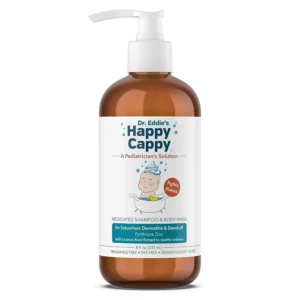
Happy Cappy Medicated Shampoo & Body Wash is a cradle cap shampoo that helps gently wash away flakes and scales while cleansing your baby’s hair and scalp. Cradle cap is the infant form of seborrheic dermatitis.
Its 0.95% pyrithione zinc helps relieve flaking, scaling, redness, and itching associated with seborrheic dermatitis and dandruff. The formula is fragrance-free and dye-free.6
Skip the oily mess. Happy Cappy Medicated helps wash away flakes and scales without applying oil beforehand. Gently massage with your fingertips and rinse, leaving attached scales to loosen gradually.2,6,7
Use as directed: wet the hair thoroughly, gently massage onto the scalp and skin, and rinse well. For best results, use at least twice weekly or as directed by a doctor. For external use only. Avoid the eyes; rinse thoroughly with water if contact occurs. Follow label advice to ask a doctor before use if seborrheic dermatitis covers a large body area. Stop use and seek advice if the condition worsens or does not improve with regular use as directed.6
A brush is optional. If you prefer a wash-and-brush routine, the Medicated Shampoo + Beanie Brush Bundle pairs an 8 oz wash with a soft silicone brush. Our cradle cap care guide explains the full routine.
Scalp changes that need assessment
Pain, bleeding, weeping, swelling, an unpleasant odor, or a rash that persists despite gentle care needs a closer look.1,2