
Quick Answer
Hydrocortisone is a topical corticosteroid that can reduce the inflammation and itching of eczema. The appropriate strength and treatment schedule depend on the person’s age, the affected body area, and the severity of the flare. Moisturizer remains part of the routine.1, 2
Hydrocortisone reduces eczema inflammation
Hydrocortisone is a topical corticosteroid that helps calm eczema inflammation. Inflamed areas can itch, swell, crack, and become uncomfortable enough to interrupt sleep. Hydrocortisone can control a flare when it is appropriate for the rash, but it does not cure eczema or prevent every future flare.
It is a medicine, while an everyday moisturizing cream supports the skin barrier and relieves dryness. A treatment plan may include both from the start of a flare. You do not need to let a prescribed eczema flare treatment wait while you repeatedly try moisturizer alone.2
The aim is comfortable, controlled skin. Ask the prescriber how to recognize improvement and what to do when a treated area becomes clear.
Hydrocortisone strength depends on age, location, and severity
Hydrocortisone comes in creams, ointments, and other formulations. In the United States, many 1% products are sold without a prescription, while 2.5% products are prescribed. Both are generally considered low-potency topical corticosteroids.
That does not make them interchangeable for every patient or every location. Babies and areas with thinner skin often need a less potent preparation than thick, inflamed patches elsewhere on the body. The formulation can also affect comfort and how the medicine is used.1
| Situation | What to clarify with the clinician |
|---|---|
| Baby or young child | Correct product, amount, body area, and course length. |
| Face, eyelids, or skin folds | Whether hydrocortisone is appropriate and how briefly to use it. |
| Thick or persistent patches | Whether a different treatment is needed instead of extending the same course. |
| Frequent recurrence | A flare plan and, when appropriate, a clinician-directed maintenance plan. |
Babies need a pediatrician-directed treatment plan
Clinicians do prescribe hydrocortisone for infant eczema. Use it under the baby’s pediatrician’s direction, rather than choosing a strength and duration from an adult’s experience. For children under 2, get medical guidance before starting an over-the-counter hydrocortisone product.7
Tell the clinician if the affected area is on the face, around the eyes, in a skin fold, or beneath a diaper. Covered skin can absorb more medicine. Do not put a steroid under wet wraps or another dressing unless that is part of the prescribed plan.1
For eyelid eczema, see our guide to creams for eczema on the eyelids. A short course of a mild steroid may be appropriate there, but the clinician should choose it and explain exactly how to apply it.6
Hydrocortisone application follows the prescribed plan
- Check the instructions. Confirm the tube, strength, affected area, application frequency, and stop or review date.
- Use the advised amount. Spread a thin, even layer over the active eczema patches. Ask the clinician or pharmacist to demonstrate the amount, using fingertip units when useful.
- Keep it out of the eyes. Wash hands afterward unless the hands are the area being treated.
- Continue moisturizing. Follow the treatment plan for the order and timing of separate products. Do not dilute the medicine by mixing it into a jar of moisturizer.
- Review the response. Use the medicine for the agreed course. Do not increase the frequency or keep extending treatment because the skin has not cleared.
There is no single application schedule that suits every hydrocortisone product and every eczema flare. Follow the prescriber’s directions and the product label.3
Side-effect risk depends on how hydrocortisone is used
Topical corticosteroids are effective eczema treatments, and serious side effects are uncommon when they are used correctly. Brief stinging or irritation can occur. Longer or inappropriate use can cause local problems such as skin thinning, visible small blood vessels, or stretch marks.2, 4
Risk depends on the medicine’s potency, the amount used, the treatment area, covering the skin, and the length of treatment. Systemic effects are rare but become more of a concern with excessive exposure, especially in young children. A short, correctly selected course should not be confused with repeated unsupervised use of stronger steroids.
Bring concerns to the prescriber rather than leaving a painful flare untreated. They can check the diagnosis, review technique, and discuss a nonsteroid option if appropriate.4
Persistent or worsening eczema needs reassessment
Improvement often begins within days, but the expected response depends on the flare. Contact the clinician if the rash is worsening, is not improving within the agreed treatment period, or keeps returning as soon as treatment stops.
The next step may involve checking the diagnosis, how the medicine is being applied, ongoing irritants, or infection. Some eczema needs a different-strength topical medicine or another treatment. More severe or persistent disease may warrant a dermatology referral.5
Do not assume every scaly rash is eczema. Ringworm and other conditions can require different treatment. Increasing pain, warmth, pus, spreading redness, or fever also deserves medical assessment.
Moisturizing Cream supports daily skin care during treatment
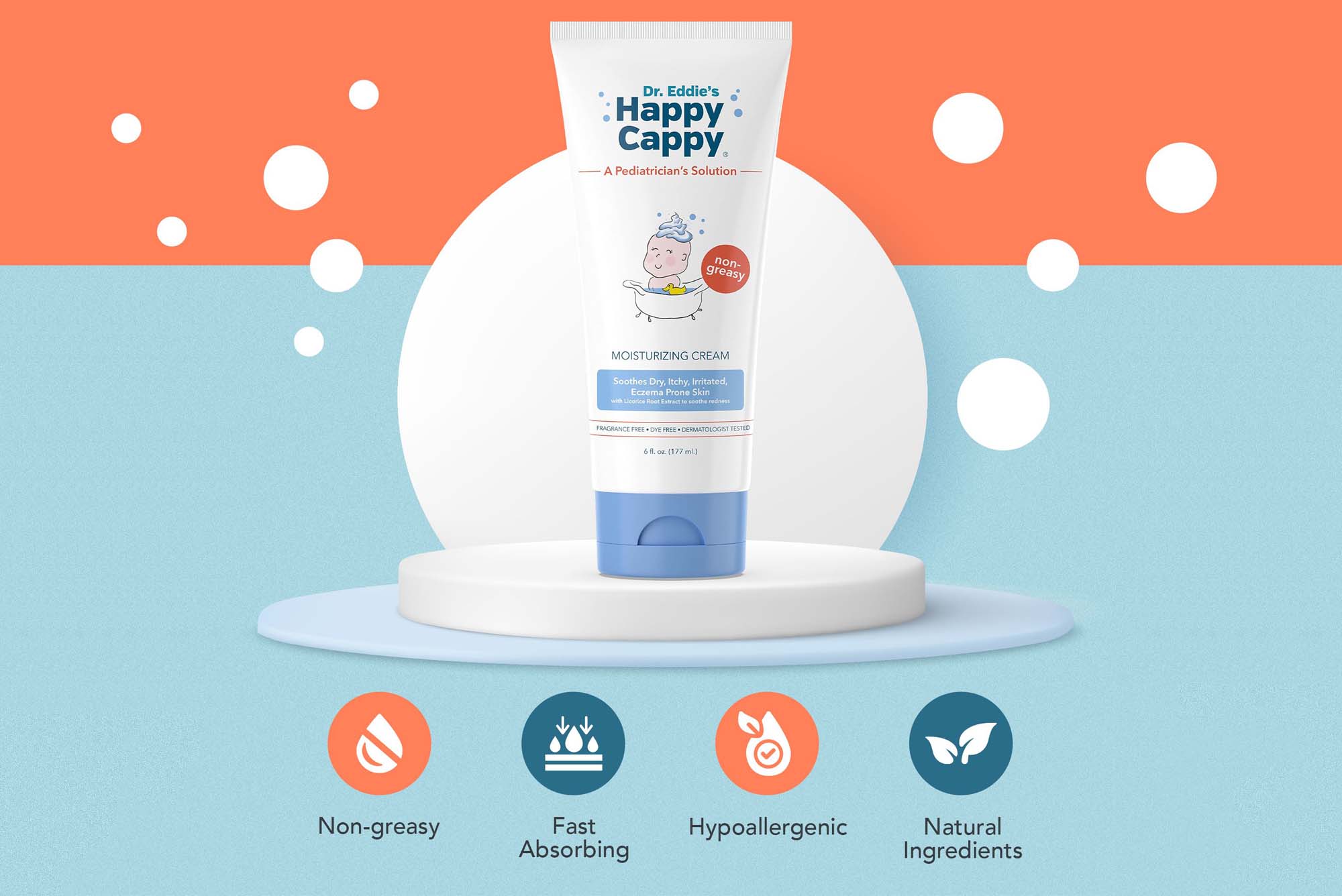
Happy Cappy Moisturizing Cream is a fragrance-free moisturizer for dry, itchy, eczema-prone skin. Glycerin attracts water, petrolatum helps retain it, and licorice root extract helps calm the look of redness. Its fast-absorbing, non-greasy formula supports daily care during and between flares, alongside prescribed eczema medicine when needed.
Keep moisturizing during eczema treatment
Choose a regular skin-care routine you can maintain, and follow the prescriber’s separate instructions for hydrocortisone.
References
- American Academy of Pediatrics. Corticosteroids for Atopic Dermatitis.
- American Academy of Dermatology. Eczema treatment: Corticosteroids applied to the skin.
- NHS. Hydrocortisone for skin.
- Guy's and St Thomas' NHS Foundation Trust. Topical steroids.
- American Academy of Pediatrics. Treatment of Atopic Dermatitis.
- Eczema UK. Eczema around the eyes.
- DailyMed, U.S. National Library of Medicine. Hydrocortisone Cream 1%: Drug Facts label.