

At a glance: Start with fragrance-free products and avoid your known allergens. Some exfoliants and drying formulas can irritate active eczema, but urea, fatty alcohols, humectants and preservatives do not all belong on a universal avoid list.
Irritation and allergy need different decisions
Eczema-prone skin can sting or become inflamed when a product damages its already sensitive barrier. That is irritation. Allergic contact dermatitis is a delayed immune reaction to a particular substance; it may appear hours or days after contact, even with a product you previously tolerated. Both can occur alongside atopic dermatitis.1, 2
The aim is a short, useful list of personal triggers. A long list of every ingredient that has ever caused a reaction can make it harder to find a cleanser or moisturizer you can comfortably use.
Ingredients and formulas to approach cautiously
Fragrance and scented essential oils
Choose products labeled fragrance-free. “Unscented” can mean that a smell has been masked. Perfume, parfum and scented botanical oils can be sources of contact allergens; “natural” does not establish that a formula will suit eczema-prone skin. If you have a diagnosed fragrance allergy, use the specific avoidance list your clinician provides.1, 3
Scrubs, exfoliating acids and retinoids during a flare
Rough scrubs and strong exfoliating or acne formulas can aggravate sore skin. Glycolic acid, salicylic acid and retinoids have legitimate uses, but a product made to exfoliate or treat acne may be uncomfortable on active eczema. Pause optional irritating products and ask how to fit any prescribed acne medicine around your eczema plan.4
Drying cleansers and alcohol-heavy toners
Repeated washing, strong detergents and products that leave the skin tight can worsen dryness. Sodium lauryl sulfate (SLS) is one potential irritant; the finished formula, amount used and contact time also matter. A sulfate-free label alone cannot guarantee tolerance. Alcohol denat., ethanol or isopropyl alcohol in an astringent toner may sting or dry inflamed skin.4, 5
Cleansers should be rinsed off as directed. Scrubbing harder or leaving a wash on longer does not make it more helpful for eczema.
Preservatives and other allergens require a personal assessment
Preservatives protect the product but can cause individual allergies
Preservatives help protect water-containing products from microbial contamination. Some, including methylisothiazolinone (MI), methylchloroisothiazolinone (MCI) and formaldehyde-releasing preservatives, can cause contact allergy. A reaction to one does not mean every preservative must be avoided.1
Parabens have a relatively low frequency of contact allergy. If testing confirms an allergy, avoid the identified ingredient and its relevant alternative names rather than treating every preservative as unsafe.6
Other potential allergens depend on your history
Lanolin, propylene glycol, certain surfactants and botanical extracts can also cause reactions in some people. Propylene glycol can be both an irritant and an allergen. These possibilities are reasons to investigate a recurrent reaction, not reasons for everyone with eczema to stop every product containing them.1, 7
Patch testing can help explain a recurrent reaction
Arrange a dermatology review if a rash repeatedly follows product use, involves the eyelids, face or hands, or persists despite appropriate treatment. Bring the packaging and ingredient lists. Clinician-performed patch testing can help identify delayed contact allergy; it is different from a blood test or skin-prick allergy test.2
Several familiar ingredients support dry skin
Humectants and barrier ingredients
Humectants such as glycerin attract water. Occlusive ingredients such as petrolatum reduce water loss from the skin surface. Emollients soften rough skin. These functions often work together in one moisturizer, so “avoid humectants” is not useful general advice for eczema.8
Urea and fatty alcohols
Urea is a moisturizing ingredient, and stronger formulations also help loosen thick scale. It can sting on inflamed or broken skin; the concentration, body site and age of the user affect whether it is suitable. Ask your clinician or pharmacist which formulation fits your needs.9
Fatty alcohols such as cetyl, stearyl and cetearyl alcohol help give creams their texture and emollient properties. They are different from the drying alcohols found in some toners. Contact allergy is possible, but the word “alcohol” alone is not enough to reject a moisturizer.14
Our petrolatum guide explains moisture retention, and the oat kernel extract guide explains that ingredient’s role without treating all oat preparations as interchangeable.
A practical way to introduce a new product
- Keep the routine small. Start with a gentle wash and a fragrance-free cream or ointment. Read the actual ingredient list, including on products you have bought before.
- Change one product at a time. Keep a note of when you started it and where you applied it so a reaction is easier to trace.
- Try a small area first. For a new cosmetic product, the American Academy of Dermatology recommends a small test area twice daily for 7–10 days. Use the normal amount and follow rinse-off directions. Stop if a reaction develops.
- Use your allergy history. Do not deliberately retest a known allergen or a product that caused a severe reaction. A home trial cannot replace medical patch testing.
A “hypoallergenic,” “dermatologist tested” or ingredient-screening badge does not guarantee that no individual will react. Judge the product by its role, ingredients, your history and how your skin responds.10, 11
Gentle cleansing followed by moisture
A cleanser removes sweat and everyday residue; a leave-on moisturizer helps dry skin retain water. That two-step routine supports eczema care while prescribed medicines address active inflammation when needed.
Daily Wash cleanses dry, sensitive skin
Happy Cappy Daily Shampoo & Body Wash is a fragrance-free cleanser for dry, sensitive, eczema-prone skin, made without SLS or SLES. Its formula includes glycerin and panthenol for moisture support. Apply to wet skin where cleansing is needed, then rinse thoroughly.12
Moisturizing Cream helps skin retain water
Follow with Happy Cappy Moisturizing Cream. Glycerin attracts moisture and petrolatum helps limit water loss; the fragrance-free, fast-absorbing texture makes regular application practical. Both products contain licorice root extract to help soothe the appearance of redness. Check the current label against any known allergies.12, 13
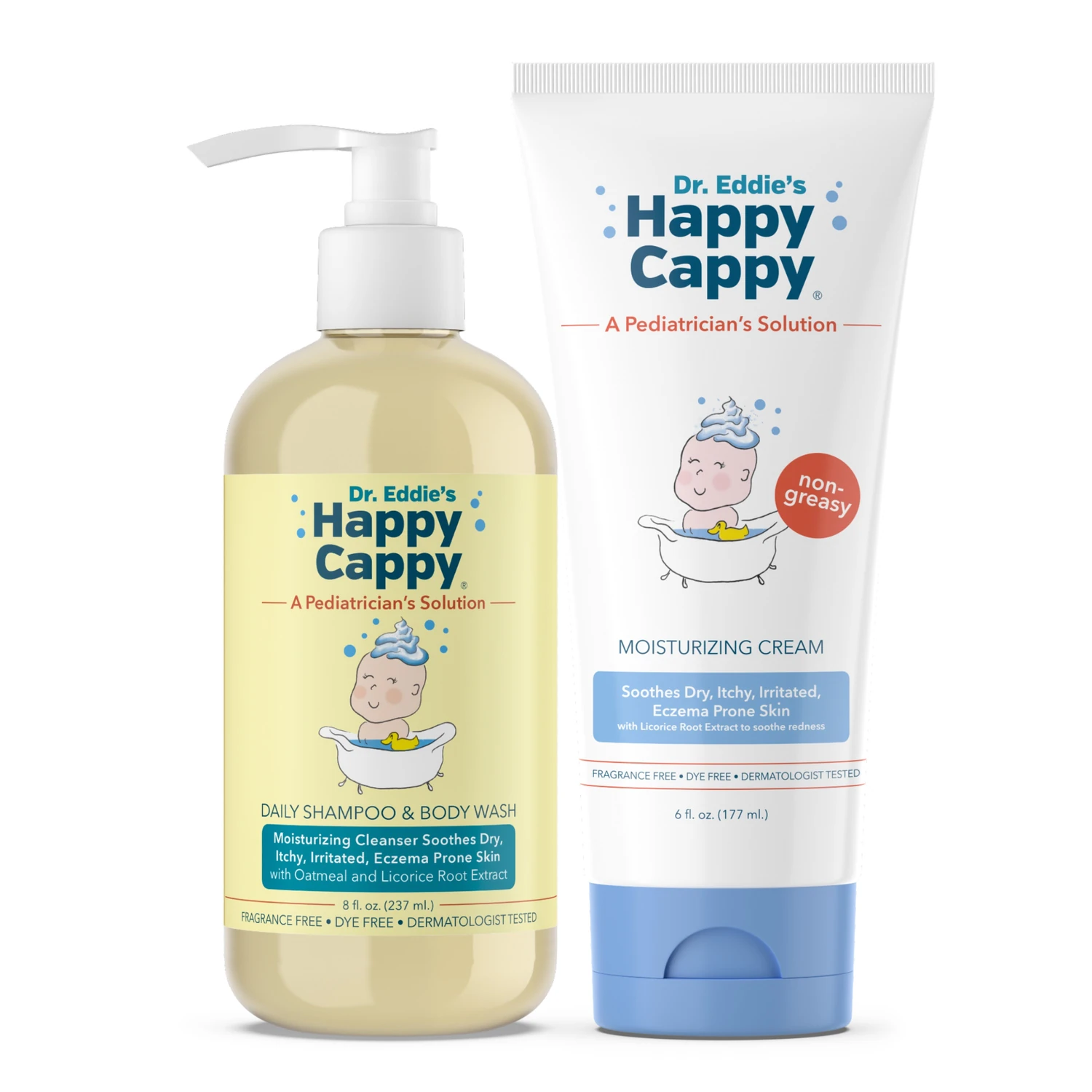
Daily Wash + Moisturizing Cream Bundle
One 8 oz wash with your choice of a 6 oz cream tube or 12 oz cream pump jar. The tube option is pictured.
Shop the Daily Wash + Cream bundle →Apply moisturizer after washing and again when dry. Repeated burning, a spreading rash or worsening symptoms warrants a treatment review.
Sources and references
- DermNet. Contact reactions to cosmetics.
- DermNet. Allergic contact dermatitis.
- AAD. Finding eczema-friendly products.
- DermNet. Sensitive skin.
- DermNet. Soaps and cleansers.
- DermNet. Contact allergy to parabens.
- DermNet. Contact allergy to propylene glycol.
- DermNet. Emollients and moisturisers.
- DermNet. Urea.
- AAD. How to test skin care products.
- FDA. Hypoallergenic cosmetics.
- Happy Cappy. Daily Shampoo & Body Wash: formulation and directions.
- Happy Cappy. Moisturizing Cream: formulation and directions.
- FDA. Alcohol-free cosmetic labeling.