

Quick answer: An itchy scalp after washing hair can come from dryness, leftover shampoo, a reaction to a hair product, or an underlying condition such as dandruff or seborrheic dermatitis. Itching the next day does not necessarily mean your scalp is dirty. Timing helps, but flakes, redness, burning, and the products you use offer additional clues.1
This guide focuses on itching after shampooing. For causes unrelated to washing, see our broader itchy scalp guide.
Timing offers clues but does not identify the cause
During or soon after washing: Irritation from a product, hot water, or shampoo left on the scalp may be involved. The next day: Dryness or an underlying scalp condition may still be present. An allergic contact reaction can also be delayed, typically appearing 24–72 hours after exposure.2
These patterns overlap. The timing alone cannot tell you whether the cause is dryness, allergy, dandruff, or something else.
Common reasons for itching after washing
Dryness or irritation from washing
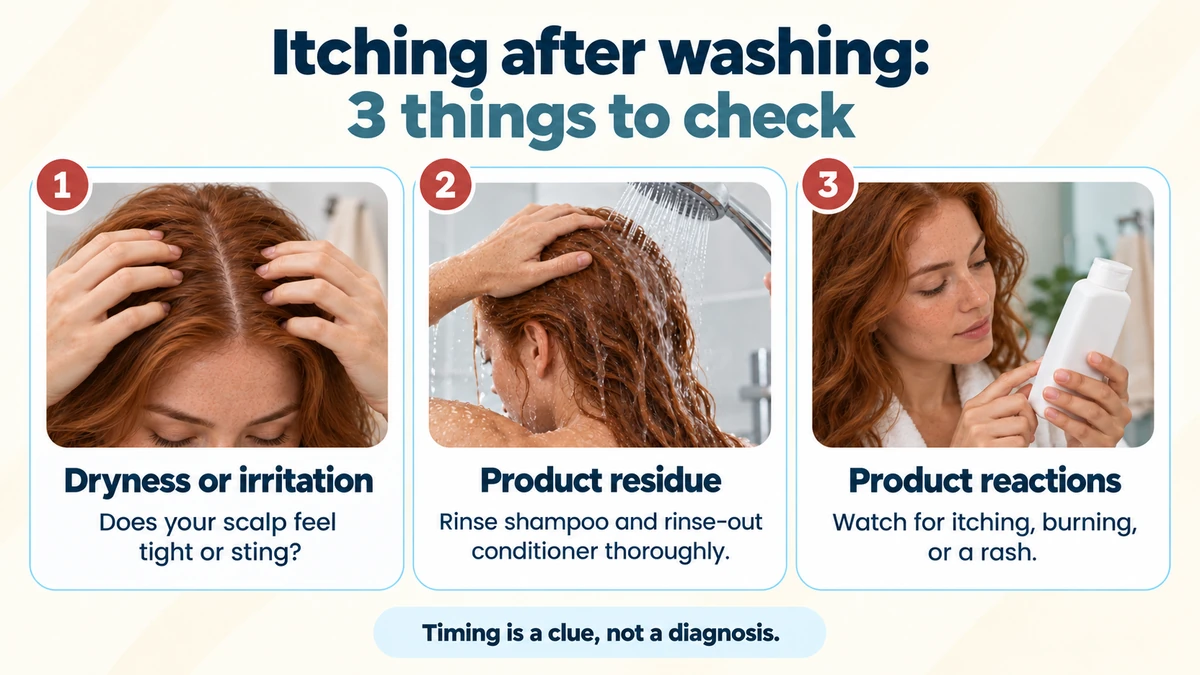
A cleanser that is too drying, hot water, or vigorous scrubbing can leave the scalp uncomfortable. A tight, dry feeling after shampooing is a reason to review your cleanser and technique. Small flakes can occur with dryness or dandruff; our dandruff vs dry scalp comparison explains the distinction.3
Shampoo or conditioner residue
Shampoo left on the scalp can irritate it. Rinse shampoo and rinse-out conditioner thoroughly. Leave-in conditioner has a different job: apply it to the hair as directed, usually from mid-lengths to the ends, because buildup on the scalp can cause irritation.4
A reaction to a hair product
Shampoo, conditioner, hair dye, or a styling product can cause contact dermatitis. Irritation and allergy are different reactions, but both can cause itching or a rash. An allergy can develop after months or years of using an ingredient without trouble. Stop a product that repeatedly triggers symptoms; a familiar brand is not proof that a reaction is impossible.2
Washing may be only part of the story. Dandruff, seborrheic dermatitis, and other scalp conditions can itch despite washing. Persistent itch, sores, or patchy hair loss deserves assessment. Our itchy scalp guide covers those conditions and their treatments in detail.1
Ingredients and product reactions
Fragrance, certain preservatives, and some cleansing ingredients can cause reactions in susceptible people. The complete formula matters: a product can be too drying without causing an allergy. “Natural” or “sulfate-free” alone does not guarantee that a shampoo will suit your scalp.5
If your scalp is sensitive, a fragrance-free shampoo is a reasonable starting point. If testing has identified an allergy, avoid that specific ingredient across your hair products.2
A shampoo reaction may show up beyond your scalp
A small case series of people with confirmed shampoo allergy described rashes on the eyelids, around the ears, and on the neck where shampoo ran during rinsing. Some had no obvious scalp rash. These patterns are clues to discuss with a dermatologist; they do not prove that shampoo is the cause.6
Look at the whole routine. Note whether itching follows shampoo, conditioner, hair dye, or a leave-in product, and whether nearby skin also reacts. Replacing the shampoo alone may miss the trigger.
A gentler washing routine
Make your next wash gentler
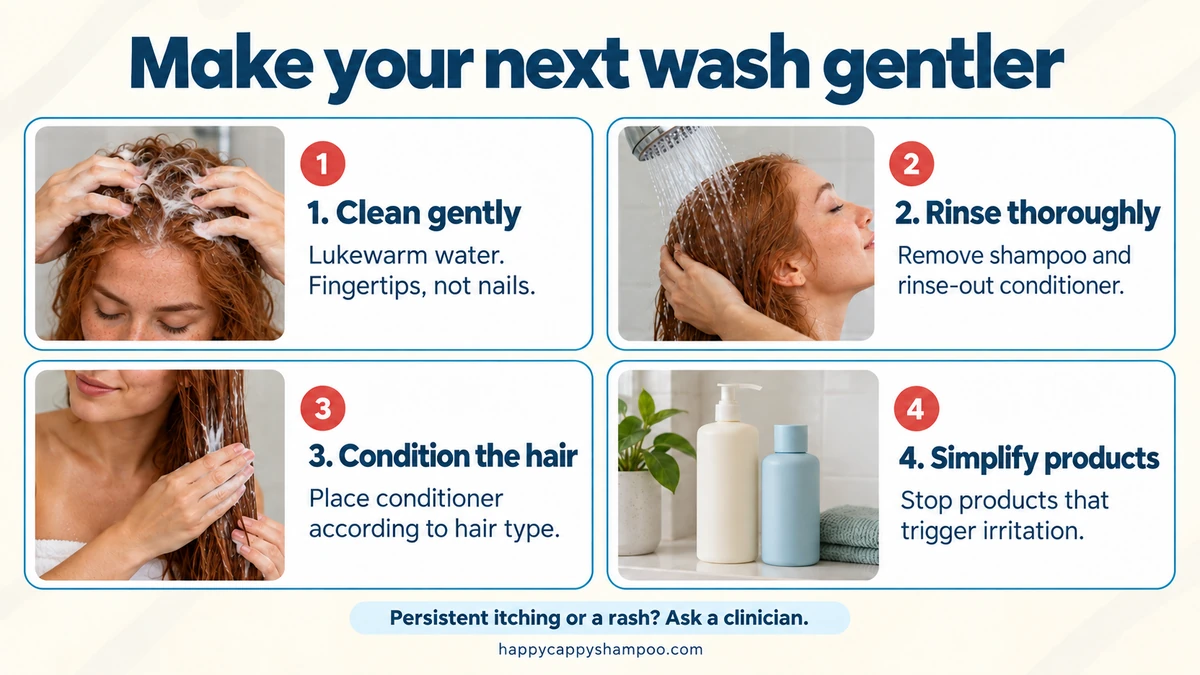
- Clean the scalp gently. Use lukewarm water and your fingertips. Concentrate shampoo on the scalp and let the rinse carry it through the hair. Avoid scratching or scrubbing flakes loose.7
- Rinse thoroughly. Work water through the hair so shampoo and rinse-out conditioner do not remain on the scalp. Do not use a rinse-out conditioner as a leave-in product.4
- Condition for your hair type. Fine or straight hair may need conditioner mainly on the ends; dry or curly hair may need it along the length. Apply leave-in products to the hair rather than the scalp.7
- Simplify what touches your scalp. Stop a product that causes a reaction and avoid introducing several replacements at once. Do not deliberately retry a product that caused a rash to see whether it happens again.
Match the shampoo to the cause of the itch
For routine cleansing of a dry, sensitive scalp, a mild, fragrance-free cleanser such as Happy Cappy Daily Shampoo & Body Wash may suit your routine. A gentle cleanser can reduce avoidable irritation, but it does not treat a contact allergy or every cause of scalp itch.3
For flaking and itching associated with dandruff or seborrheic dermatitis, Happy Cappy Medicated Shampoo & Body Wash contains 0.95% pyrithione zinc. Its label directs use at least twice weekly or as directed by a doctor: wet the hair thoroughly, massage onto the scalp, and rinse. Avoid eye contact and stop use and ask a doctor if symptoms worsen or do not improve with regular use. Ask a doctor before use if seborrheic dermatitis covers a large body area.11
Adjust frequency and products used between washes
There is no single washing schedule for everyone. Consider your scalp’s oiliness or dryness, hair texture, and response to the cleanser. Follow the directions for a medicated shampoo rather than washing repeatedly whenever the scalp itches.7,8
Dry shampoo absorbs oil; it does not replace shampooing with water. It can leave buildup or irritate the scalp, so stop using it if it causes itching or burning. Include dry shampoo and other leave-in products when reviewing what changed in your routine.10
Bring useful clues if the itching keeps returning
Save the product names and ingredient lists, note when you washed and when symptoms began, and take a photo if a rash appears. Include products used between washes. A dermatologist may recommend patch testing for recurring suspected allergy; this checks for delayed skin reactions and differs from a skin-prick test.9
Scalp symptoms that need assessment
See a clinician if itching persists despite adjusting your routine, repeatedly follows a product, or comes with a spreading rash, sores, or hair loss. Seek prompt care for a painful swollen patch, pus, or fever. A child with scaly bald patches should be checked for scalp ringworm.1
A routine guided by the cause
An itchy scalp after washing is a reason to review how you wash, what touches your scalp, and when symptoms begin. Gentle cleansing, thorough rinsing, and appropriate conditioning may help. Recurring symptoms need care directed at the cause.