


Quick answer: Fragrance-free shampoo and skin care can help people with fragrance sensitivity avoid a potential trigger. For eczema-prone skin, choose gentle fragrance-free cleansers and moisturizers, check the complete ingredient list, and keep following your treatment plan. An unscented label does not necessarily mean a product contains no fragrance.1, 2
Choosing a shampoo for a sensitive scalp involves more than finding a bottle without a noticeable smell. This guide explains fragrance labels, how fragrance relates to eczema, and how to choose a cleanser or moisturizer that fits your skin's needs.
Fragrance-free and unscented labels
Start with a fragrance-free label, then read the ingredients. FDA cautions that front-label terms such as fragrance-free and sensitive skin do not have a federal standard or definition in the United States. Your known allergies and the complete formula still matter: fragrance-free does not mean allergy-free, because a person can react to another ingredient.3
| Label wording | What to check |
|---|---|
| Fragrance-free | Look for a formula without added fragrance or masking fragrance. Ask the manufacturer if its claim is unclear. |
| Unscented | A product may contain fragrance that masks the odor of other ingredients.1 |
| Hypoallergenic | This does not guarantee freedom from allergic reactions. FDA has no federal standard defining the term.4 |
Check for fragrance, perfume or parfum on the ingredient list. A fragrance mixture may be listed collectively, so the label may not name every component. For a diagnosed allergy, follow your clinician's specific avoidance list and ask the manufacturer about ingredients you cannot identify.1, 3
Fragrance irritation and contact allergy
Some people develop irritation or an allergic reaction to fragrance ingredients. Others tolerate them. Both natural and synthetic ingredients can occur in fragrance mixtures, so a botanical or natural label alone does not tell you whether a product will suit your skin. An essential oil used to scent a product is still providing fragrance. People with a diagnosed allergy should follow their specific avoidance guidance.1
Research helps explain why fragrance remains a concern in contact allergy care. A study of 2018 searches in the American Contact Dermatitis Society's Contact Allergen Management Program (CAMP) found fragrance mix among the most frequently searched allergens. These were searches used in caring for patients with contact allergy, not a survey of allergy rates in the general population.5
You can also choose fragrance-free products simply because you prefer no added scent. You do not need a diagnosis to have that preference.
Fragrance as an eczema trigger
Yes, fragrance can be a trigger for some people with eczema. The American Academy of Dermatology recommends fragrance-free cleansers and moisturizers for children with eczema. Its guidance also includes choosing fragrance-free, dye-free laundry detergent.2
For babies, the AAD recommends a brief bath in lukewarm water, gentle cleansing without scrubbing, and a fragrance-free moisturizer immediately afterward. Thick creams and ointments generally moisturize better than lotions or oils.6
These habits support everyday care. Keep following the treatment plan your clinician recommends for an eczema flare; changing shampoo or cream does not replace prescribed treatment.
Choosing fragrance-free shampoo for sensitive skin
Begin with the reason you are washing. For routine cleansing, look for a gentle shampoo suited to your hair and scalp, and check that the formula avoids ingredients you already know bother you. Fragrance-free is one useful selection point, but it does not describe every part of a formula.
Dry skin, eczema, dandruff and seborrheic dermatitis can require different approaches. A daily cleanser washes the skin and hair. A moisturizer adds moisture. A medicated shampoo has labeled uses for specific symptoms. Choose according to those uses instead of assuming every fragrance-free wash has the same purpose.
If your scalp remains itchy or develops a recurring rash, show your clinician the products you use. Fragrance is one possible cause; other ingredients or a skin condition may be involved. A clinician may recommend patch testing when contact allergy is suspected.3
For a closer look at other formula choices, see our guides to shampoo ingredients and sulfate-free cleansing.
A practical way to switch your routine
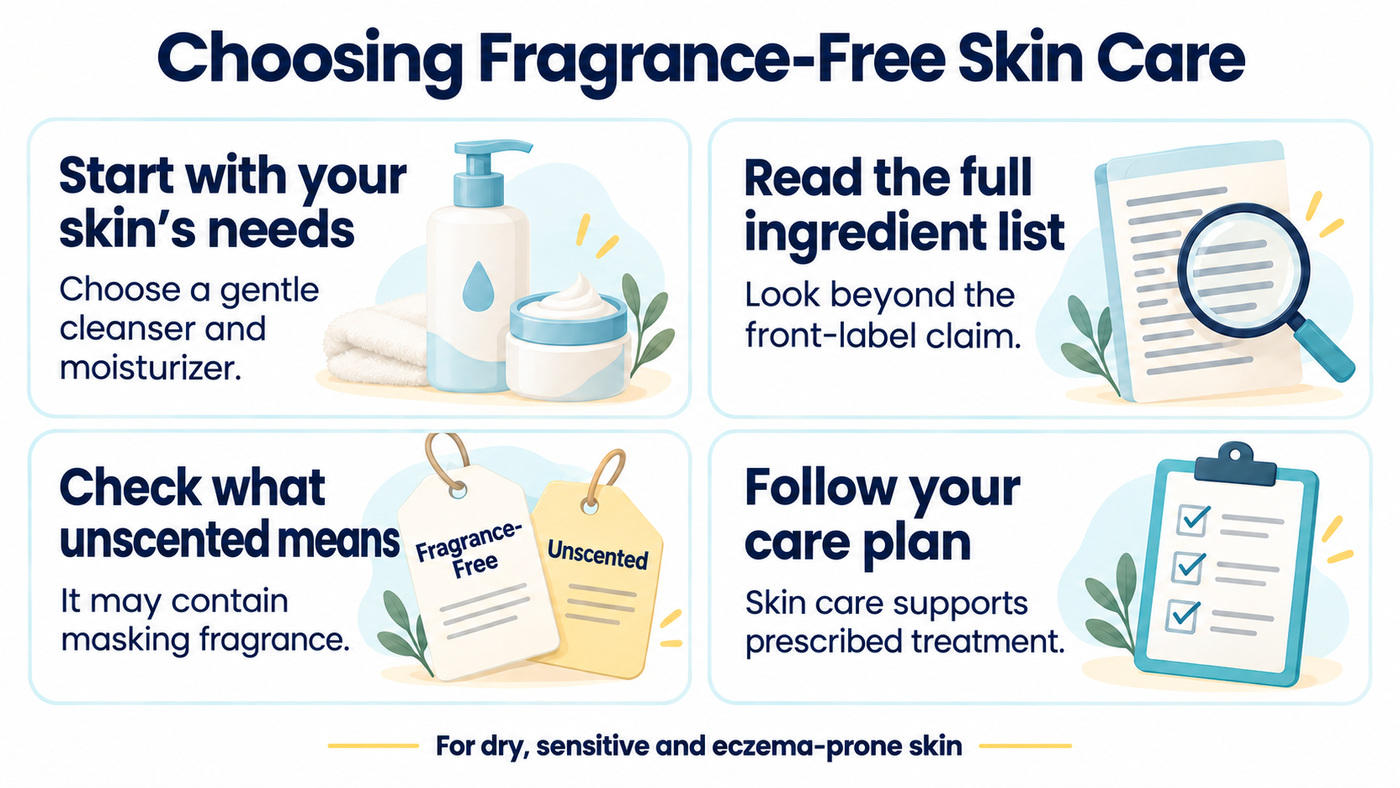
- Start with your skin's needs. Identify whether you need an everyday cleanser, a moisturizer or treatment for a diagnosed condition.
- Review the full ingredient list. Include shampoo, body wash and products that stay on your skin. Keep a record of ingredients your clinician has asked you to avoid.
- Check what unscented means. If a label leaves you unsure about masking fragrance, ask the manufacturer before choosing it.
- Follow your care plan. Use products as directed and keep prescribed treatment in place. Seek advice if a product repeatedly causes discomfort.
Keep the routine manageable. You should be able to explain what each product is for and how it fits your needs. Adding more products does not make a routine more useful.
Fragrance-free Happy Cappy formulas
Happy Cappy's shampoos, body washes and Moisturizing Cream are made without added fragrance or masking fragrance. Choose among them by purpose:
- Daily Shampoo & Body Wash provides gentle cleansing for dry, sensitive, eczema-prone skin. Use daily or as often as needed.
- Moisturizing Cream adds moisture and helps reduce moisture loss in dry skin.
- Medicated Shampoo & Body Wash contains pyrithione zinc 0.95% to help control flaking, scaling and itching associated with dandruff and seborrheic dermatitis. Follow the product directions.
The Daily wash and Moisturizing Cream provide cleansing and moisturization; they are not medicated eczema treatments. Review the complete ingredient lists and product directions when deciding what belongs in your routine.
Other ingredient labels describe different choices
Fragrance-free, paraben-free and sulfate-free describe different parts of a formula. A shampoo can meet one description without meeting the others. Check each claim separately and read the complete ingredient list. Our parabens guide explains the role of preservatives in more detail.
References
- U.S. Food and Drug Administration. Fragrances in Cosmetics.
- American Academy of Dermatology. How can I find eczema friendly products?
- U.S. Food and Drug Administration. Allergens in Cosmetics.
- U.S. Food and Drug Administration. Hypoallergenic Cosmetics.
- Scheman A, et al. Relative Prevalence of Contact Allergens in North America in 2018. Dermatitis. 2020;31(2):112–121. doi:10.1097/DER.0000000000000521.
- American Academy of Dermatology. How to treat eczema in babies.
Further reading: Scheinman PL. The foul side of fragrance-free products: What every clinician should know about managing patients with fragrance allergy. Journal of the American Academy of Dermatology. 1999;41(6):1020–1024. doi:10.1016/S0190-9622(99)70265-3.