


The cover uses a photograph from Happy Cappy’s existing baby eczema artwork. It is an illustrative image, not a before-and-after or treatment-result photo.Cover photo credits: Photo detail from Happy Cappy’s existing baby eczema article artwork. Cropped and converted to WebP. Not a treatment-result photograph.
Quick answer: Look for a trend: less rubbing or scratching, smoother skin, closing cracks, fewer new patches and better comfort. Color may take longer to settle. Peeling alone does not prove that eczema is healing, and there is no fixed recovery sequence every baby follows.
Signs of improving baby eczema
Improving baby eczema involves changes in both skin comfort and texture. Try to judge the overall direction over several days, using both how the skin feels and how your baby behaves. Atopic dermatitis often flares and settles; improvement does not mean it can never return.1
- Less rubbing or scratching: your baby seems less driven to rub the face, legs or other affected areas.
- Better comfort and sleep: less itch may mean fewer itch-related awakenings. Sleep has many causes, so it is only one part of the picture.
- Smoother, less thickened skin: rough patches feel softer and less raised. Compare gently with a fingertip rather than repeatedly rubbing the area.
- Cracks beginning to close: there are fewer raw areas from scratching and less bleeding.
- Less inflammation: redness, swelling or the purple, gray or darker appearance associated with an active flare begins to settle.
- Fewer new patches: existing areas are becoming calmer without new inflamed spots appearing.
If a patch has been weeping, less moisture can be an encouraging change, but yellow crust, pus, pain or worsening warmth needs an infection assessment. Do not use a “healing checklist” to dismiss those findings.2
Photographs and changes over time
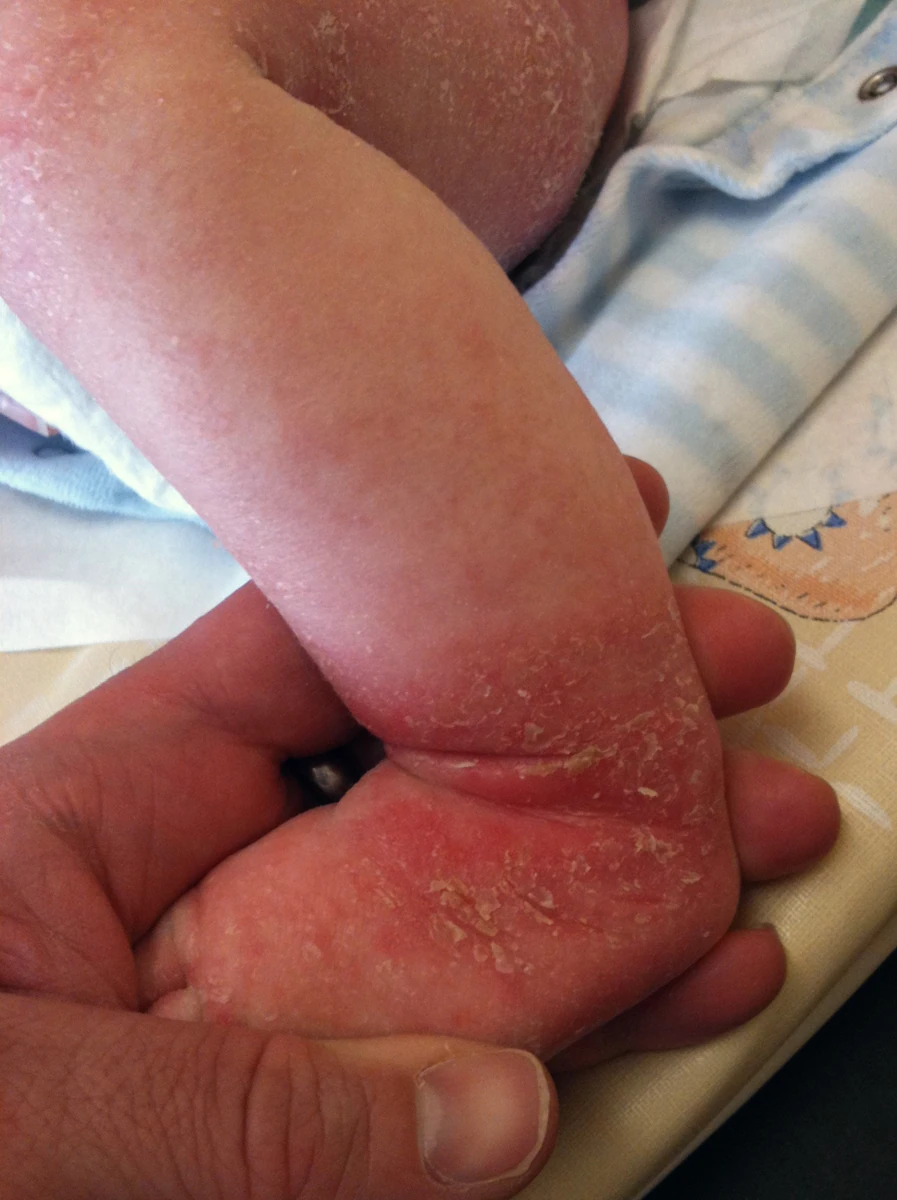
A photograph can help you remember how a patch looked, but it cannot show every change. Comfort, sleep, scratching and skin texture may improve before all discoloration fades. Two different babies’ photos are not a reliable before-and-after comparison.
Lingering skin-color changes
After inflammation settles, a patch may remain lighter or darker than the surrounding skin. These post-inflammatory changes can be particularly noticeable on darker skin and may take time to fade. Eczema itself may look brown, purple or gray rather than obviously red.3
Persistent color alone does not necessarily mean active eczema still needs stronger treatment. Consider itch, roughness, swelling and your clinician’s assessment together. Do not keep applying a prescribed flare medicine solely until the skin becomes one uniform color. See our eczema on Black skin guide for more examples.
Peeling and other skin changes
Peeling during active or improving eczema
Peeling alone does not prove healing. Flaking can occur when dry or inflamed skin sheds, including while a flare is improving. It can also occur while eczema remains active. Increasing itch, new cracks, worsening inflammation or spreading areas do not become reassuring simply because skin is peeling.
Do not pick flakes, scrub them off or exfoliate a baby’s skin. Use the gentle skin-care and treatment plan your clinician recommended. If the skin is newly raw, painful or oozing, ask for advice.
Inflammation patterns are not healing stages
You may see the terms acute, subacute and chronic eczema. These describe patterns of inflammation and skin change; they are not a required three-step healing ladder. A child can have areas with different appearances at the same time.4
Improvement timelines and reassessment
There is no reliable countdown for every baby. The extent of the flare, the treatment, ongoing irritation and any infection can affect progress. Some symptoms may begin settling before the skin looks completely clear. Ask your clinician when improvement should be noticeable and when to check back.
If scratching continues to disrupt sleep, patches spread or the plan is not producing the expected improvement, arrange a review. Do not keep increasing treatment on your own or wait for an arbitrary number of weeks while your baby is uncomfortable.
Flares over time
Some children improve substantially as they grow, while others continue to have flares. No one can promise that an individual baby will outgrow eczema by a particular birthday. See eczema changes with age for the longer-term discussion.1
Following the existing treatment plan
Follow your baby’s existing plan as the skin improves. Ask which medicines should stop, change or continue after a flare. For the full care routine and treatment options, see our baby eczema treatment guide.
A moisturizer supports the skin barrier but may not control an active flare on its own. Treatment should be appropriate for your baby’s age and the affected body area. Do not start an adult-strength medicine, wet-wrap regimen or new medicated product without checking suitability.56
Cleansing and moisturizing during recovery
Improving eczema can still leave skin dry. Gentle washing and regular moisture support comfort as you follow your baby’s treatment plan.
Happy Cappy care for lingering dryness
Happy Cappy’s fragrance-free Daily Shampoo & Body Wash and Moisturizing Cream provide a gentle rinse-off cleanser and a leave-on moisturizer for dry, sensitive skin. The wash’s glycerin and provitamin B5 help soften skin; the cream’s glycerin draws in moisture while petrolatum helps hold it there. The cream absorbs quickly without a greasy feel. Gently cleanse as needed, rinse, and apply cream after bathing as directed in your baby’s plan.
Choose one 8 oz Daily Wash with a 6 oz cream tube or 12 oz pump jar. Shop the Daily Wash + Moisturizing Cream Bundle. Continue prescribed flare treatment as directed.
If you are unsure which patch needs moisturizer and which needs medicine, ask the clinician to demonstrate. A short written plan can be easier to follow than remembering several instructions during a tiring night.
Tracking improvement between visits
Take a photograph of the same patch in similar lighting every few days, if useful. Keep a brief note of rubbing or scratching, itch-related awakenings, new patches and the treatments used. Avoid repeatedly photographing or touching a sore area throughout the day.
Bring that record to follow-up. It helps answer a practical question: is the skin becoming calmer and your baby more comfortable on the current plan? It is a record to discuss, not a diagnostic score.
Signs that need medical attention
Possible infection or worsening inflammation
Contact the clinician promptly for new pus, honey-colored crust, increasing tenderness, warmth or spreading inflammation, particularly if your baby is unwell. Fever together with a worsening rash also needs prompt advice. Do not assume a new crust is just a normal stage of healing.2
Urgent warning signs
Clusters of painful blisters or small punched-out sores can signal a serious viral infection such as eczema herpeticum. Seek urgent care, especially if lesions are near the eyes or your baby seems ill. For day-to-day flare care, see what to do when eczema flares up.