

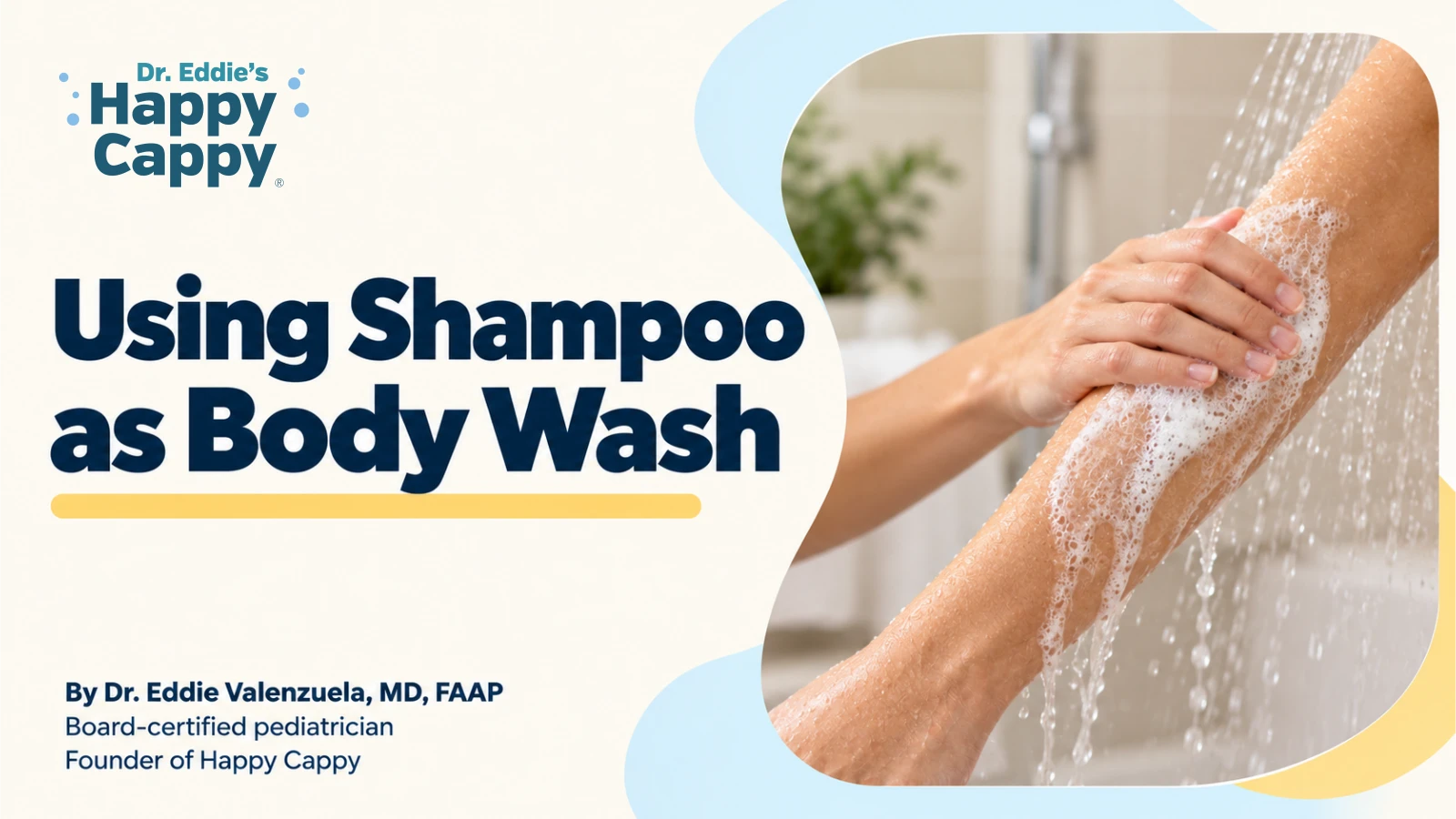
The useful comparison is how a cleanser is formulated, what its label allows, and how your skin and hair respond. A body wash is not automatically milder than a shampoo, and a shampoo does not automatically become unsuitable when it touches the skin below your neck.
Shampoo and body wash serve different priorities
Both types of product use cleansing ingredients called surfactants to help lift away oil and dirt so they can be rinsed off. Shampoos are designed with hair and scalp cleansing in mind, often with ingredients that affect how hair feels afterward. Body washes focus on cleansing the skin. Products labeled for both uses are formulated to serve both purposes.
These categories overlap. The number of surfactants on an ingredient list does not tell you how concentrated they are or how drying a finished product will be. Fragrance, conditioning ingredients, pH, exposure time, and the interactions among ingredients can all matter. Research comparing cleansers shows why mildness has to be judged in the context of the whole formula.1
| Label or formula detail | What it tells you |
|---|---|
| Shampoo | Intended for hair and scalp. Check the directions before using it on other areas. |
| Body wash | Intended for body skin. Hair cleansing and manageability may not be its design priorities. |
| Shampoo and body wash | Intended for both uses. Follow any age, frequency, or application directions on the label. |
| Medicated cleanser | Contains an active ingredient for a labeled purpose. Its directions determine where and how to use it. |
Using a shampoo on body skin
For a regular routine, choose a cleanser whose label includes body use. This is especially helpful when choosing a product for a child or for skin that is already dry or sensitive. A scalp-only product may have directions, active ingredients, or conditioning properties that make a different cleanser a better fit.
If you have used a shampoo on your body once, that alone does not mean you have damaged your skin. Rinse thoroughly and pay attention to how your skin feels. Stop using a product that causes burning, persistent tightness, or a rash. Using more product or scrubbing harder does not make it a better cleanser.
The same principle applies in the other direction. A body wash may remove oil from hair, but that does not establish that it will leave your hair easy to manage. For facial use, check the product’s directions rather than assuming that every shampoo or body wash is also intended as a face wash.
pH is one part of cleanser mildness
The skin’s surface is naturally acidic. That environment helps support its barrier processes and innate antimicrobial defenses. A cleanser’s pH is therefore relevant, but it cannot tell the whole story: a formula adjusted to an acidic pH is not automatically gentler than a neutral formula.1
In their guideline on atopic dermatitis, Eichenfield and colleagues recommend limited use of non-soap, fragrance-free, hypoallergenic cleansers with a neutral to low pH.2 This gives people with eczema a practical set of features to consider without treating a single pH number as a guarantee.
Ingredient descriptions also need context. A cleanser does not become harsh simply because an ingredient is synthetic, nor gentle simply because an ingredient comes from a plant. For sensitive skin, looking for a fragrance-free formula and checking for ingredients you personally react to are more useful than relying on a broad “natural” claim.
Happy Cappy formulas for hair and body
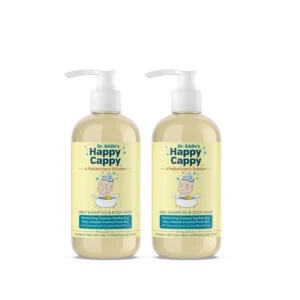
Happy Cappy Daily Shampoo & Body Wash is intended for everyday cleansing of the scalp, face, and body, including dry, sensitive, eczema-prone skin. It is a fragrance-free, non-soap cleanser formulated at an acidic pH.
Happy Cappy Medicated Shampoo & Body Wash has a different job. It contains pyrithione zinc 0.95% for its labeled dandruff and seborrheic dermatitis uses and is formulated at a neutral pH. Follow its Drug Facts directions when deciding where and how often to apply it.
Both products are labeled as a shampoo and body wash, but their pH descriptions and purposes differ. The Happy Cappy product pH comparison explains these differences in one place. The neutral pH of the Medicated Wash does not mean that it lacks an active ingredient.
A routine that suits your skin
A suitable cleanser should fit the area you want to wash and the reason you are washing it. For one bottle to use from head to toe, look for that intended use on the label. For a medicated product, let the labeled treatment directions guide your routine.
How often you cleanse also depends on your skin, hair, activity, and any treatment instructions. If skin is dry or eczema-prone, use lukewarm water, avoid vigorous scrubbing, and apply a fragrance-free moisturizer after bathing.2 A moisturizer provides a separate step that a rinse-off cleanser cannot replace.
References
- Hawkins S, et al. Role of pH in skin cleansing. International Journal of Cosmetic Science. 2021.
- Eichenfield LF, et al. Guidelines of care for the management of atopic dermatitis: section 2. Journal of the American Academy of Dermatology. 2014;71(1):116–132.
Hero artwork: AI-generated editorial illustration with the official Happy Cappy logo; not a clinical photograph.