

Quick answer: Falling estrogen levels around menopause can make skin drier and more prone to itching. Gentle cleansing and regular moisturizing often help dryness, but a new rash or persistent, widespread itch should not automatically be blamed on hormones. Treatment works best when it addresses the cause, especially when symptoms involve the vulva or vagina.1, 2
Skin that once felt comfortable may start feeling tight after a shower or itchy under your clothing. Menopause can contribute to that change, even if you have never needed much moisturizer before. Still, the timing alone does not tell you why you are itching.
This article explains the menopause connection, the clues that suggest another cause, and the care options that fit each situation. For a broader overview of itching at any age, see our itchy-skin guide.
The menopause transition and your skin
Perimenopause is the transition leading up to menopause, when hormone levels fluctuate and periods may become irregular. Natural menopause is confirmed after 12 consecutive months without a period when there is no other explanation. Postmenopause is the time afterward. Menopause can also occur earlier or follow surgery or medical treatment; it is not limited to women over 45.1
Lower estrogen and a drier skin barrier
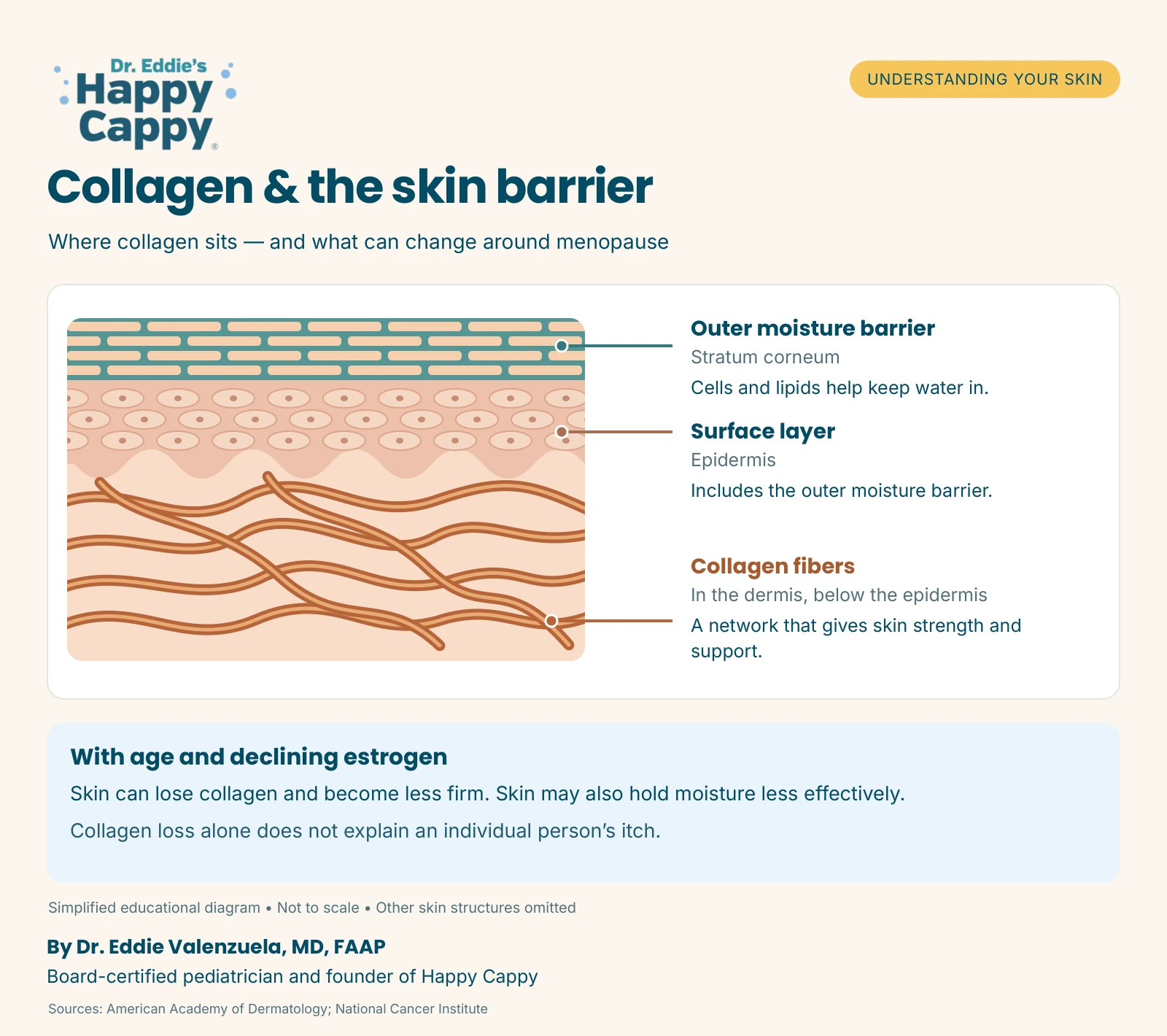
The outer skin barrier helps keep water in and irritants out, as shown in our skin-barrier diagram. Estrogen influences several aspects of skin function, and skin often holds moisture less effectively after menopause. Research has also found changes in the skin's ceramides, the lipids that help organize this protective barrier. These findings help explain dryness, but they do not prove that hormones are the cause of an individual person's itch.2, 3
Where collagen sits in your skin
Collagen also changes with age and declining estrogen, contributing to thinner, less firm skin. Itching is more complicated than collagen loss alone. Dryness, inflammation, irritants and nerve signals can all matter, which is why replacing moisture is useful but is not always the complete solution.2, 4
Itchy skin does not have a distinctive menopause rash
Dry skin may look rough, finely flaky or almost unchanged. Scratching can leave lines, broken skin or patches that look red, purple, darker or lighter than nearby skin, depending on skin tone and healing. A photograph of scratch marks cannot establish menopause as the cause. The location, texture and timing of a rash are more useful clues.4
Tingling and crawling sensations need their own context
Pruritus means itching from any cause. Paresthesia describes altered sensations such as tingling or pins and needles; formication describes a crawling sensation. These terms are not interchangeable, and a crawling feeling is not simply the “most severe” form of menopausal itch. Persistent numbness, burning or unusual sensations deserve assessment for possible nerve, medication or other causes.4
Other causes of itching during midlife
Hormonal skin changes can coexist with a separate skin condition. Before changing your whole routine, notice whether the itch began after a new product, whether there is a visible rash, and whether anyone else at home is itchy. These observations help guide an examination; they do not replace one.
| Pattern you notice | Possible explanation and next step |
|---|---|
| Rough, dry skin that feels worse after bathing | Dryness is a common contributor. Start with the gentle routine below and see our dry-skin guide. |
| Recurring inflamed patches or irritation where a product touches skin | Eczema or contact dermatitis may be involved. Fragrance, hair dye, detergents and other exposures can irritate skin or trigger allergy. |
| Raised welts that appear and fade, or a persistent scaly rash | Hives, psoriasis, fungal infection and other conditions need different approaches. A moisturizer cannot treat every cause. |
| Intense itch shared by household members | Consider an exposure or infestation such as scabies, rather than assuming menopause explains it. |
| Widespread itch with little or no visible rash | Medicines and, less often, thyroid, kidney, liver or other health problems may contribute. Persistent symptoms warrant evaluation. |
Facial flushing and burning may point toward rosacea, while painful one-sided blisters raise concern for shingles. Neither is a distinctive menopause rash. The broader itchy-skin guide explains the differential in more detail.4, 5, 12
A daily routine for dry, itchy body skin
When dryness is part of the problem, the goal is to clean comfortably and keep moisture in the skin. A consistent, simple routine is easier to assess than several new treatments started together.
Wash gently and keep showers brief
Use lukewarm water and a mild, fragrance-free cleanser where needed. Avoid hot, prolonged showers and vigorous scrubbing. Pat the skin dry instead of rubbing it. Cleansing removes sweat and everyday residue; it does not need to sterilize the skin, and a daily wash is not an infection treatment.6
Apply moisturizer while skin is still slightly damp
Use a fragrance-free cream or ointment after bathing and reapply when skin feels dry. Glycerin and hyaluronic acid attract water, while ingredients such as petrolatum help reduce moisture loss. A comfortable formula you will use regularly is more useful than a product marketed as a universal “menopause cream.” Very dry areas may need a richer ointment.2, 6
Reduce irritation and interrupt scratching
A cool, damp cloth can calm an itchy spot. Choose soft clothing, keep nails smooth and change out of sweaty clothing if heat makes symptoms worse. Pause scrubs, exfoliating acids or other products that sting while the skin is irritated. A short colloidal-oatmeal bath may help some people; avoid it if you have a known oat allergy and moisturize afterward. Drinking normally supports general health, but extra water does not replace moisturizer or treatment of an underlying condition.5, 7
Where Happy Cappy fits in this routine
Happy Cappy Daily Shampoo & Body Wash is a fragrance-free, non-soap cleanser for dry, sensitive, eczema-prone skin, including adult skin. The rinse-off formula contains hyaluronic acid and is made without SLS and SLES. Follow cleansing with Happy Cappy Moisturizing Cream, a fast-absorbing, non-greasy formula with glycerin for hydration and petrolatum to help limit moisture loss. Licorice root extract helps soothe the appearance of visible redness.15, 16
These products support cleansing and moisturizing; they do not replace estrogen or treat every cause of itching. The routine here is for body skin, not treatment inside the vagina or a recommendation for an unexplained vulvar rash.
Medicines and hormone therapy have different roles
Anti-itch medicines should match the cause
There is no single best antihistamine for menopausal itching. Oral antihistamines can help hives and some allergic causes, but they do not reliably resolve dry-skin or eczema itch. Sedating products may cause next-day drowsiness and other adverse effects, so they should not become a routine sleep solution. Topical antihistamines can themselves irritate or sensitize skin.8
A short course of an appropriate topical corticosteroid, sometimes 1% hydrocortisone, may help a diagnosed inflammatory rash. It is not a general moisturizer or a treatment for unexplained whole-body itch. Follow the label or prescribed plan, and get guidance before using it on the face, genitals, broken skin or a suspected infection. Stronger or prolonged treatment needs a diagnosis.9
Hormone therapy is an individualized menopause treatment
Menopausal hormone therapy can treat bothersome hot flashes and other established indications; it is not a routine first treatment for itchy body skin alone. Research on skin changes does not establish it as a reliable itch remedy. Discuss its benefits and risks in the context of your overall symptoms and medical history. Local vaginal estrogen has a separate role in treating genitourinary symptoms and should not be confused with treatment for itching on the arms or legs.3, 10
Vulvar and vaginal itching need a separate approach
The vulva is the external genital skin; the vagina is the internal canal. Lower estrogen can contribute to dryness, burning, irritation, painful sex and urinary symptoms, collectively called genitourinary syndrome of menopause. Depending on the situation, vaginal moisturizers, lubricants and prescribed treatments such as low-dose vaginal estrogen may help.11
Persistent genital itching still needs an examination. Contact dermatitis, infection and lichen sclerosus can resemble hormone-related irritation. White patches, tearing, sores, a lump or bleeding should be assessed. Avoid repeated self-treatment for yeast without a diagnosis, and do not put ordinary body wash or body cream inside the vagina.11, 13
Symptom duration and when to seek care
There is no dependable timetable for menopause-associated itching. Dryness may improve with regular care, recur in dry weather or persist after the menstrual transition is over. You do not need to wait for menopause to “finish” before seeking relief. If a simpler routine is not helping, the next step is to reconsider the cause rather than keep adding products.1, 5
Symptoms that deserve an appointment
Arrange an assessment if itching disrupts sleep or daily life, keeps returning, spreads widely, or does not improve with self-care. Mention new medicines, supplements and skin products. Unexplained weight loss, fever, yellowing of the skin or eyes, or a persistent changing skin lesion also need attention. Depending on the findings, an examination and targeted tests can help identify the cause.4, 5
Seek prompt care for painful blisters on one side of the body, especially near an eye, or a rapidly worsening painful rash. Get emergency help for trouble breathing, faintness, or swelling of the tongue or throat with an allergic reaction.12, 14
For mild dry-skin itch, begin with comfortable washing and consistent moisturizing. If the pattern changes or relief does not follow, bring that history to your clinician. The aim is to understand what your skin needs now, rather than assume every new symptom is an unavoidable part of menopause.
Medical and product references
Sources are primarily in English. Product pages document formulation and intended use, not evidence of a menopause treatment.
- Symptoms of menopause and perimenopause. NHS.
- Caring for your skin in menopause. American Academy of Dermatology.
- Menopause and changes in the stratum corneum ceramide profile. Experimental Dermatology, 2022.
- Causes of persistent itching and options for relief. American Academy of Dermatology.
- Itchy skin: self-care and when to seek help. NHS.
- Dermatologists' tips for relieving dry skin. American Academy of Dermatology.
- Measures that can soothe itchy skin. American Academy of Dermatology.
- Antihistamines and eczema itch. American Academy of Dermatology.
- Hydrocortisone for skin: uses and precautions. NHS.
- Hormone therapy: indications, benefits and risks. The Menopause Society.
- Vulvovaginal health. American College of Obstetricians and Gynecologists.
- Clinical overview of shingles. CDC.
- Lichen sclerosus. NHS.
- Anaphylaxis: emergency symptoms. NHS.
- Daily Shampoo & Body Wash: product information. Happy Cappy.
- Moisturizing Cream: product information. Happy Cappy.