


Quick Answer: An unhealthy gut has not been established as a cause of ordinary cradle cap. Scalp scales alone do not show that your baby has a digestive problem or food allergy. Probiotics are being studied for skin conditions, but they are not an established cradle-cap treatment.1,2,3
Advice to “heal the gut” can make a common baby rash sound like evidence of an internal problem. Here is what current research can tell parents, where the evidence stops, and when digestive symptoms deserve their own assessment.
A gut cause has not been established
Cradle cap is seborrheic dermatitis of the scalp. Its exact cause is uncertain. Skin oils, hormonal influences, and the skin's response to naturally occurring yeast may contribute. The American Academy of Pediatrics explains that cradle cap is not caused by an infection, allergy, or poor hygiene.1
The possible role of yeast on the skin does not make cradle cap proof of intestinal yeast overgrowth. Calling it a “gut yeast infection” skips several steps that research would need to demonstrate.
Scientists study how microorganisms and the immune system interact throughout the body. That broad research does not let us diagnose a baby's gut microbiome from the appearance of their scalp.
Probiotic studies do not establish routine cradle-cap treatment
There is related research, so saying “no research exists” would be too sweeping. The useful question is whether a study establishes a benefit for babies with cradle cap.
| Research | What it tells us | Limit for cradle cap |
|---|---|---|
| 2017 adult dandruff trial3 | Sixty men aged 18 to 60 received a specific Lactobacillus paracasei strain or placebo for 56 days. The researchers reported improvement in dandruff symptoms. | Results in adults do not establish effectiveness, safety, or a dose for babies with cradle cap. |
| 2025 maternal and baby probiotic trial2 | This eczema-prevention study tested Bifidobacterium bifidum PRL2010 and also recorded persistent cradle cap during follow-up. Seventy-four women were randomized; 41 completed the 12-month follow-up. | The main question concerned atopic dermatitis. The small study and substantial loss to follow-up do not establish a routine cradle-cap treatment. |
These are reasons to keep studying the subject. They are not proof that an unhealthy gut causes ordinary cradle cap or that an off-the-shelf probiotic will clear it. Atopic dermatitis, adult dandruff, and baby cradle cap also cannot be treated as interchangeable study populations.
Probiotics require a separate treatment decision
There is not enough evidence to recommend starting a probiotic specifically to treat cradle cap. A product studied for another condition cannot be assumed to work for scalp scaling, and results with one probiotic strain do not apply automatically to another.2,3,4
Discuss supplements with your pediatrician before giving them to a baby. Safety depends on the child and the product. Extra caution is necessary for premature babies and children who are seriously ill or have weakened immune systems.4
If your clinician has recommended a probiotic for a separate reason, that is a different treatment decision. This article is not a reason to stop that plan.
Cradle cap alone does not call for feeding changes
Cradle cap alone is not a reason to switch formula, stop breastfeeding, or remove foods from a breastfeeding parent's diet. It is not evidence of a food allergy.1
If your baby also has blood in the stool, repeated vomiting, feeding discomfort, or poor weight gain, contact your pediatrician. Those symptoms need their own evaluation; they should not be explained away as “the gut causing cradle cap.” A clinician can decide whether a feeding change or further assessment is appropriate.6
Applying breast milk to the scalp is a separate question. Our breast milk and cradle cap article explains the limits of that evidence.
Scalp care addresses the flakes
For a comfortable baby with typical cradle cap, gentle washing and lifting loose scales are reasonable first steps. The cradle-cap care guide gives the full routine.5
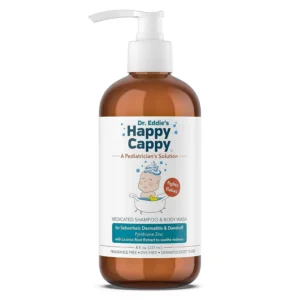
Happy Cappy Medicated Shampoo & Body Wash is a cradle cap shampoo that helps gently wash away flakes and scales while cleansing your baby’s hair and scalp. Cradle cap is the infant form of seborrheic dermatitis.
Its 0.95% pyrithione zinc helps relieve flaking, scaling, redness, and itching associated with seborrheic dermatitis and dandruff. The formula is fragrance-free and dye-free.7,8
A brush is optional; gentle fingertip massage may be enough. If you prefer a brush, the Medicated Shampoo + Beanie Brush Bundle is another option. Use a light touch and leave attached scales alone. Scalp care does not require starting probiotics or changing your baby's feeding.1,5
Use as directed: Wet the hair thoroughly, gently massage onto the scalp and skin, and rinse well. For best results, use at least twice weekly or as directed by a doctor. For external use only. Avoid the eyes; rinse thoroughly with water if contact occurs. Ask a doctor before use if seborrheic dermatitis covers a large body area. Stop use and seek advice if the condition worsens or does not improve with regular use as directed.7
Scalp and digestive symptoms that need assessment
Contact your child's clinician if scalp changes include pain, significant itching, an unpleasant smell, swelling, or weeping. Worsening or persistent symptoms may need a different diagnosis or treatment.5
For more detail, see cradle cap that is leaking fluid. Digestive symptoms and growth concerns also deserve assessment on their own, even when scalp scales are present.