

Quick answer: Malassezia is a yeast that naturally lives on the scalp. In some people, the way it interacts with skin oils and the skin's protective barrier contributes to dandruff or seborrheic dermatitis. Care focuses on easing flakes, itch, and inflammation while keeping the scalp comfortable. Symptoms that include painful bumps or patchy hair loss need a different assessment.
Malassezia normally lives on the scalp
Malassezia is a group of yeasts found on healthy human skin, including the scalp. Yeast is a type of fungus, but finding it on your skin does not automatically mean you have an infection. These yeasts belong to the skin microbiome, the community of microorganisms that normally lives there.8
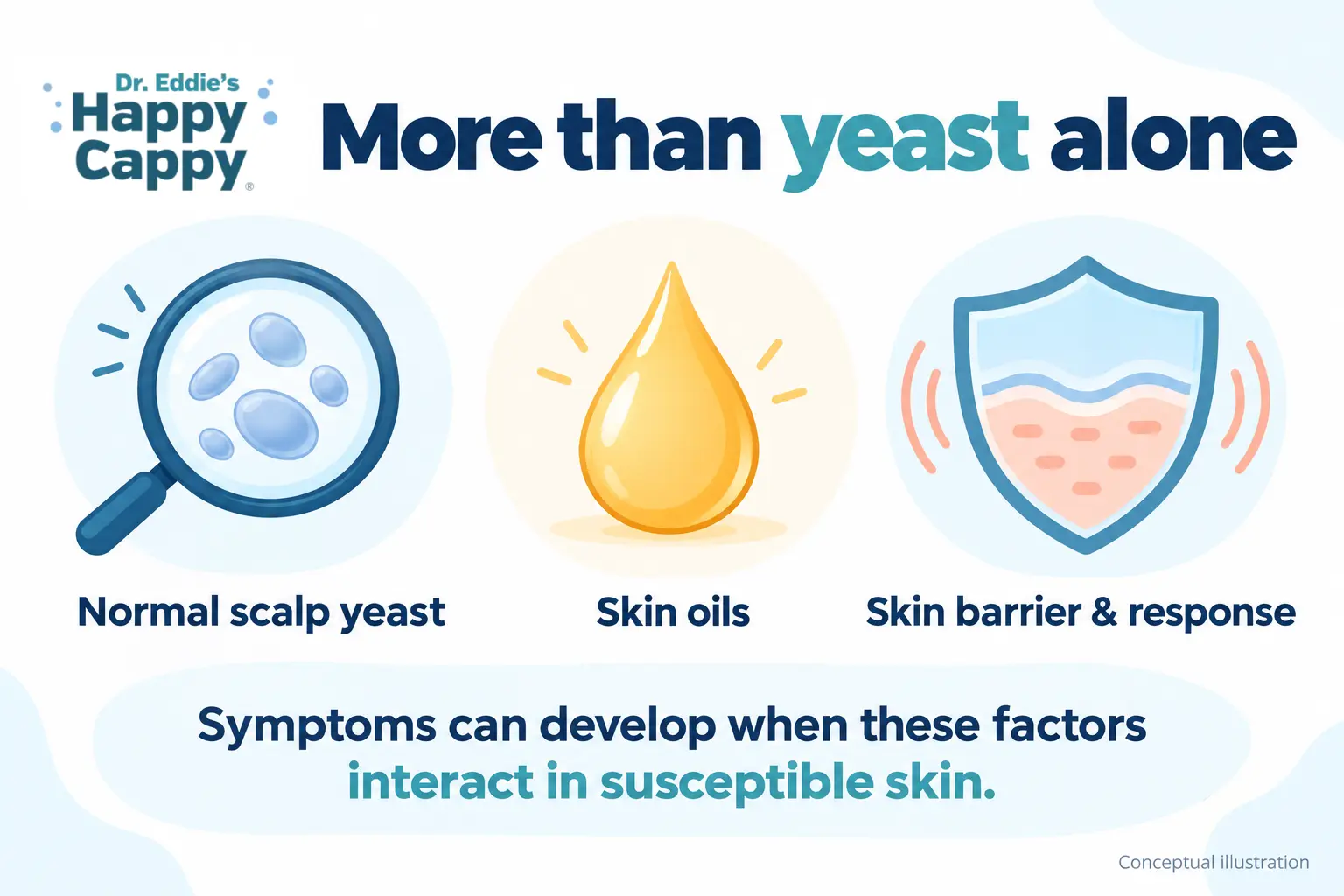
This helps explain why yeast can be present on two people's scalps while only one develops dandruff. Symptoms depend on the interaction between the yeast, the oils it uses, and the way each person's skin responds. The amount of yeast alone does not explain who will develop flakes or inflammation.1
Malassezia can also play a role in conditions elsewhere on the body, which are covered in the broader Malassezia yeast guide. On the scalp, understanding its relationship with skin oils is a useful starting point for understanding symptoms and choosing care.
Skin oils and the skin response shape symptoms
Yeast uses the scalp's natural oils
Malassezia uses fats in the oils on the skin. As the yeast processes those fats, it produces substances that can irritate susceptible skin. The scalp's protective outer barrier and its inflammatory response help determine whether that activity causes noticeable symptoms.1, 2
The result can be flaking and itch even when someone washes regularly. Dandruff and seborrheic dermatitis are therefore more complicated than a hygiene problem: care needs to account for both the yeast and the irritated skin.8
Scalp care and individual triggers affect comfort
Because the skin's response matters, it helps to notice what happens around a flare. A cleanser that burns, a heavy product left on the scalp, or a change in washing habits may make symptoms harder to manage. Those observations can help you adjust your routine, but they do not establish that yeast is the cause of every irritated scalp.
Washing frequency also needs to suit the person. An oily scalp and fine hair may need a different routine from dry, curly, or tightly coiled hair. The aim is to remove unwanted buildup and use treatment as directed without making the scalp or hair uncomfortably dry.6
Scalp symptoms help distinguish the conditions
The next step is to look at the pattern of symptoms. Loose flakes spread through the hair suggest a different problem from inflamed patches or individual bumps around hair follicles. Several conditions can itch, so itching by itself does not identify the cause.
Dandruff mainly causes loose flakes
Dandruff usually causes scalp flakes, sometimes with itch, without the marked inflammation seen in seborrheic dermatitis. It is not contagious, and an appropriate dandruff shampoo often helps control the flaking.3
Seborrheic dermatitis includes inflamed scaly skin
Seborrheic dermatitis is related to dandruff, but the skin is more visibly inflamed and may have white or greasy scale. Similar changes can occur around the ears or on the face. Because inflammation is part of the problem, treatment sometimes needs to do more than remove flakes.3
Folliculitis produces bumps around hair follicles
Malassezia can also be associated with folliculitis, which causes small, similar-looking itchy bumps or pustules around hair follicles. Unlike ordinary acne, Malassezia folliculitis usually lacks blackheads and whiteheads. However, other forms of folliculitis can look similar, so bumps alone cannot establish that yeast is responsible.4
This distinction matters when choosing treatment. A routine that helps loose dandruff flakes may not adequately treat folliculitis. Psoriasis and contact dermatitis can also resemble some of these scalp changes, which is why persistent or unusual symptoms deserve an examination.
The published photographs of Malassezia folliculitis on the face and chest show the follicular-bump pattern discussed here. Those examples are from other body sites, not photographs of scalp disease.
A clinical example of scalp seborrheic dermatitis
The photograph below shows an extensive case of seborrheic dermatitis involving the scalp and ear. It illustrates the affected skin and scale; the yeast itself is too small to see in an ordinary photograph.

Photo: CDC/Susan Lindsley (1973), PHIL 4006. Public-domain image available free from CDC. Use does not imply endorsement of Happy Cappy or its products by CDC or the U.S. Government.
Scalp ringworm is a different fungal condition
The word fungus can cause confusion here. Although yeast is a fungus, Malassezia-related dandruff is different from scalp ringworm, also called tinea capitis. Ringworm involves different fungi that can damage hair shafts and spread to other people. That difference changes both what to look for and how the condition is treated.
| Feature | Dandruff | Scalp ringworm |
|---|---|---|
| Typical appearance | Loose flakes, sometimes with itch | Scaly patches that may contain broken hairs, black dots, or bald areas |
| Spread | Not contagious | Can spread through contact with infected people, animals, or shared items |
| Treatment | An appropriate dandruff shampoo often helps | Needs prescription oral antifungal medicine; shampoo alone cannot cure it |
These clues help explain the difference, but ringworm can sometimes resemble ordinary flaking. Broken hairs, black dots, or a patch of hair loss are reasons to arrange an assessment instead of assuming that a stronger dandruff shampoo will solve the problem. Scalp ringworm needs prescription oral antifungal medicine; shampoo alone cannot cure it.7, 9
A painful, swollen patch that feels soft or boggy needs prompt medical attention. It may be a kerion, an intense inflammatory response to scalp ringworm that can lead to scarring and permanent hair loss. Our scalp ringworm guide explains these hair changes, shows clinical photographs, and discusses treatment in more detail.7
For a visual comparison, see the CDC photograph of scalp ringworm with hair loss.
Care combines symptom control with a comfortable routine
Once dandruff or scalp seborrheic dermatitis has been identified, care usually starts with an appropriate shampoo. The aim is to reduce the activity contributing to symptoms while also caring for the irritated skin. A scalp that feels comfortable between washes is a better goal than trying to remove every trace of its normal yeast.
Medicated shampoos have different roles
Antifungal shampoo ingredients used for dandruff or scalp seborrheic dermatitis include ketoconazole, ciclopirox, selenium sulfide, and pyrithione zinc. Availability and prescription status vary. Salicylic acid has a different role: it helps loosen scale rather than acting as an antifungal.3
The right choice depends on the condition, the person's age, and how well the scalp tolerates the formula. Follow the selected product's directions and age precautions. If the scalp is very inflamed or several products have failed, a clinician can help determine whether the diagnosis or treatment needs to change.6
Gentle care supports the medicated washes
Between treatments, gentle cleansing can remove oil and buildup when needed. Scraping off scale or repeatedly using a product that burns can leave an already uncomfortable scalp more irritated. Adjust the routine to hair texture, oiliness, sweating, and dryness, rather than assuming that everyone needs daily washing.
Recurring symptoms may need maintenance treatment
Even when treatment works, seborrheic dermatitis can return. Some people therefore need intermittent maintenance treatment after the initial flare improves. A clinician can help work out a schedule that controls symptoms without unnecessary irritation.5
If shampoo alone does not control the inflammation, a dermatologist may add a short course of an appropriate anti-inflammatory scalp medicine. When that medicine is a steroid, the duration should follow the clinician's instructions rather than becoming an indefinite part of the routine.5
Persistent bumps and hair loss need a diagnosis
A different approach is needed when the main problem is pustules, painful bumps, or patchy hair loss. Suspected Malassezia folliculitis may need testing and prescription treatment, while scalp ringworm requires its own treatment plan. Antibiotics do not treat yeast, so choosing treatment before identifying the cause can delay useful care. The scalp bumps guide explains other possible causes.4, 7
Children need care suited to their age and symptoms
The same need for an accurate diagnosis applies to babies and children. Malassezia can be part of their normal skin microbiome, but scalp care depends on age and the pattern of symptoms. For infant scale, the cradle cap guide explains age-appropriate care. Broken hairs or patchy hair loss should be assessed rather than treated as routine cradle cap.3, 7
Happy Cappy is an option for dandruff and seborrheic dermatitis symptoms
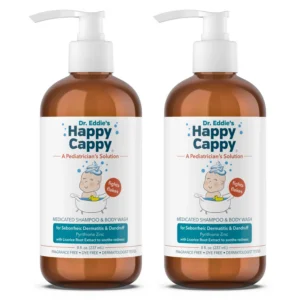
For people choosing a dandruff shampoo, Happy Cappy Medicated Shampoo & Body Wash is a fragrance-free option containing pyrithione zinc 0.95%. Its role is to relieve the flaking, scaling, and itching associated with dandruff and seborrheic dermatitis. Use it according to the label, and ask a clinician about symptoms that persist or worsen.
That role is specific: a dandruff product does not replace the oral treatment needed for scalp ringworm or an assessment of suspected folliculitis. Matching the product to the condition is more useful than choosing it simply because the word yeast appears in the explanation.
A comfortable scalp is the goal of care
Malassezia can live on the scalp without causing trouble. When dandruff or seborrheic dermatitis develops, understanding the relationship between yeast, skin oils, and inflammation helps explain why treatment and an ongoing comfortable routine can both matter. If symptoms change to painful bumps, swelling, or patchy hair loss, the next step is to reassess the cause rather than simply intensify the dandruff routine.