

On this page
The hero is an editorial illustration. The clinical photographs below show documented cases and include source credits.
Scalp ringworm, or tinea capitis, is a fungal infection of scalp skin and hair. It can weaken hair shafts, producing breakage and patchy hair loss. Prescription medicine taken by mouth treats the infection; a clinician may add a medicated shampoo to reduce surface spores and spread.1,2
Scalp ringworm infects the hair as well as the skin
Scalp ringworm is caused by dermatophytes, a group of fungi that includes Trichophyton and Microsporum. Despite the name, no worm is involved. Children are affected most often, but adults can develop it too. A perfectly round ring is not required for the diagnosis.2
Some infections produce fungal spores within the hair shaft, called endothrix infection. Others form spores around the shaft, called ectothrix infection. These patterns help explain why a scalp infection can change the hair itself rather than simply leave flakes on its surface.4
This is a different process from the yeast-related inflammation discussed in Malassezia on the Scalp: Symptoms and Care. Treating all scalp flaking as ordinary dandruff can delay the right diagnosis.
Hair breakage can leave black dots, commas and corkscrews
Infected hairs may snap close to the scalp. Their remaining stumps can look like tiny black dots. Other hairs break a little farther up, leaving short, uneven shafts among the longer hairs.3
Comma hairs are short, curved hairs seen with magnified scalp examination, or trichoscopy. Researchers have proposed that fungal invasion weakens a shaft so it cracks and bends. Corkscrew hairs have a more tightly coiled appearance. These are clues a clinician can use; they do not mean that every naturally curved hair is infected.3
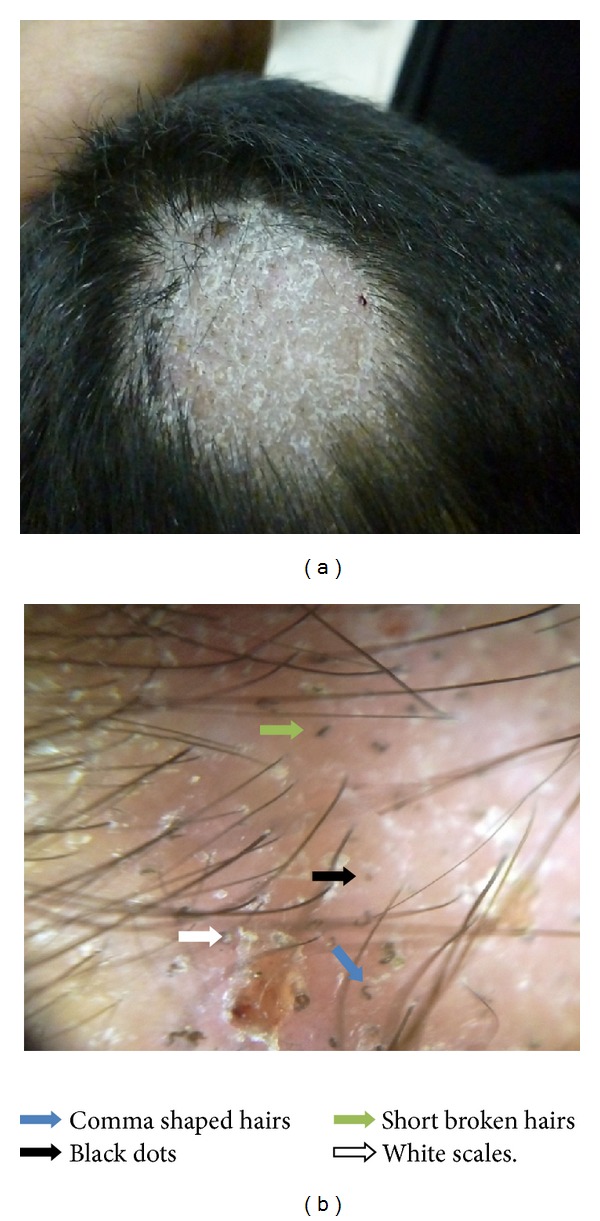
Black dots and broken hairs also occur in other hair-loss conditions. The combination of findings matters more than any single dot or curl.3
Scalp changes and laboratory tests establish the diagnosis
Visible changes can resemble other scalp conditions
Scalp ringworm may cause itching, scale, brittle hairs and areas of hair loss. Some cases are inflamed or crusted; others look surprisingly subtle. Eczema and other causes of hair loss can resemble it. Our ringworm and eczema comparison explains their broader differences.2,11
Testing identifies the fungus and guides treatment
A clinician may collect scalp scale and affected hairs for microscopy, fungal culture or, where available, PCR testing. Culture identifies the organism but can take weeks. A Wood’s lamp can help with certain fungi, but many scalp-ringworm organisms do not fluoresce: a negative examination does not rule out infection.4
When the findings strongly suggest ringworm, especially an inflamed kerion, treatment may begin while test results are pending. Results can then help the clinician adjust the medicine.2
A kerion is an inflammatory form of scalp ringworm
A kerion is a swollen, tender, boggy area caused by a strong inflammatory response to the infection. It may have crusts, pustules, drainage and loose hairs. Fever or tender glands in the neck can accompany severe inflammation.12
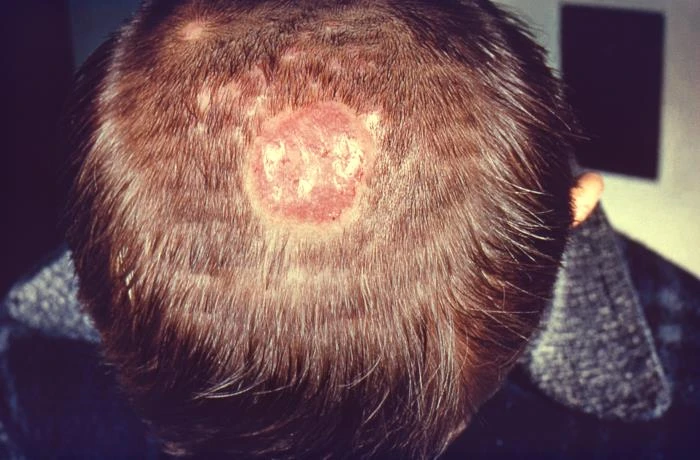
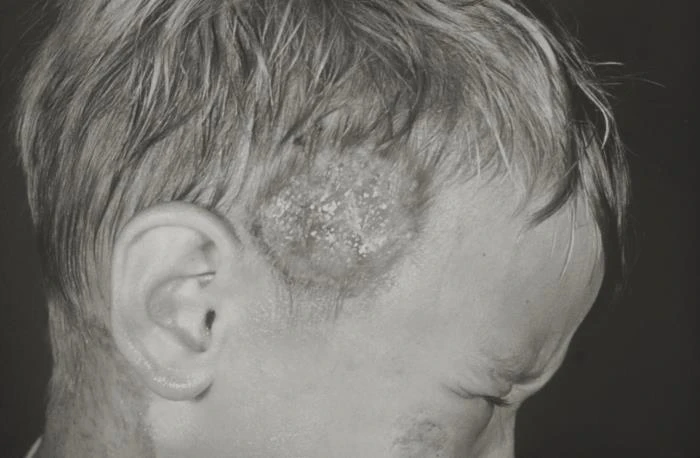
These photographs show different patients, not a before-and-after sequence. Their clinical content has not been altered. Use of CDC images does not imply CDC endorsement.
Untreated infection can threaten hair regrowth
Untreated scalp ringworm can persist and spread. Severe inflammation can damage follicles and leave scarring with permanent hair loss. A kerion is not an inevitable later stage of every infection, and its appearance alone does not reveal how long someone has been infected.12
A painful, swollen or draining scalp patch needs prompt medical assessment. A kerion can be mistaken for a bacterial abscess. Do not squeeze, puncture or try to drain it at home. Antifungal treatment is central; a clinician determines whether a bacterial infection also requires antibiotics.4,12
Oral antifungal medicine treats infection in scalp hair
Creams that work for ringworm on the body cannot adequately treat scalp-hair infection by themselves. The CDC lists griseofulvin, terbinafine, itraconazole and fluconazole as oral options. Treatment commonly lasts several weeks; the CDC describes courses of one to three months, depending on the medicine and infection.1
Children’s treatment depends partly on the organism
Griseofulvin remains an established choice for children, particularly for Microsporum infections. Terbinafine is often favored for Trichophyton. The organism, the child’s weight, available formulations and other medical factors guide the prescription.5
One practical griseofulvin detail matters: absorption can improve when it is taken with food containing fat. Follow the prescriber’s or pharmacist’s instructions for the specific formulation. Microsize and ultramicrosize products are not interchangeable milligram for milligram.6
Adults also need a tailored oral prescription
Adults are not limited to a different, separate set of treatments. Terbinafine is commonly used for adult Trichophyton infection; a published adult cohort documented treatment responses in culture- or PCR-confirmed T. tonsurans cases. Griseofulvin, itraconazole or fluconazole may be appropriate in other circumstances.7,1
Medicine selection also accounts for pregnancy, liver health and interactions with other drugs. Ask whether blood tests are needed for the chosen medicine and course. Do not share a prescription or stop as soon as the scalp looks better.4,1
Medicated shampoo supports oral treatment
Ketoconazole and selenium sulfide have established adjunct roles
A clinician may add ketoconazole or selenium sulfide shampoo to reduce fungal spores on the scalp and help limit transmission. Guidelines describe these as adjuncts to oral medicine. A small clinical study of selenium sulfide used alongside griseofulvin found faster clearance of recoverable spores than in comparison groups.5,8
The shampoo’s role is different from the oral medicine’s role. Washing the surface does not reliably clear infection within the hair. Follow the clinician’s directions for product, frequency and contact time, particularly for children.5
Pyrithione zinc has limited evidence specific to scalp ringworm
Pyrithione zinc is an interesting possible adjunct, but its evidence needs context. A 2020 laboratory study tested shampoos on hairs experimentally infected with Microsporum canis. A commercial zinc-pyrithione shampoo reduced fungal growth in that model.9
That was an infected-hair experiment, not a trial treating children or adults. It did not establish clinical cure, reduced person-to-person transmission, or equivalence to ketoconazole or selenium sulfide in patients. The tested product was not Happy Cappy, and the findings cannot be assumed to apply to Happy Cappy’s 0.95% pyrithione-zinc formula.9
Ask the treating clinician which adjunct shampoo fits the case. A pyrithione-zinc shampoo cannot replace the prescribed oral antifungal.
Household measures help limit spread and reinfection
Scalp ringworm can spread through infected people, animals and shared objects. A recurrence can reflect another exposure, so care extends beyond the visible patch.10
- Keep combs, brushes, hats, helmets, towels and pillowcases for individual use.
- Ask about cleaning or replacing hair tools and laundering shared fabrics.
- Tell the clinician about scalp symptoms in household members. Close contacts may need assessment even when symptoms are subtle.
- If a pet has suspicious skin or fur changes, arrange veterinary assessment.
- Discuss return to school, childcare or contact sports with the clinician and follow the setting’s policy.
These measures complement treatment. Avoid experimenting with steroid creams on an undiagnosed scalp rash: steroids can disguise or worsen ringworm.10,5,1
Hair recovery continues after the infection is controlled
Hair often grows back after effective treatment when follicles have not scarred. The scalp can improve before hair density returns, so an early bare patch does not automatically mean permanent loss. Follow-up helps distinguish slow regrowth from persistent infection or another cause of hair loss.12
Contact the treating clinician if pain, swelling or new patches develop, or if the prescribed course is not producing the expected improvement. Diagnosis, a suitable oral antifungal and a plan to reduce reinfection give the scalp the best opportunity to recover.
Medical sources and references
- Centers for Disease Control and Prevention. Treatment of Ringworm. Updated February 9, 2026.
- British Association of Dermatologists. Tinea capitis: patient information. May 2023.
- El-Taweel A, El-Esawy F, Abdel-Salam O. Different Trichoscopic Features of Tinea Capitis and Alopecia Areata in Pediatric Patients. Dermatology Research and Practice. 2014;848763.
- Mayser P, et al. Consensus-based Guideline on tinea capitis. JDDG. Published July 14, 2026.
- Fuller LC, et al. British Association of Dermatologists’ guidelines for the management of tinea capitis 2014. British Journal of Dermatology. 2014;171:454–463.
- DailyMed. Griseofulvin microsize oral suspension: prescribing information.
- Galili E, et al. Tinea capitis caused by Trichophyton tonsurans among adults: Clinical characteristics and treatment response. Mycoses. 2023;66:144–149.
- Allen HB, Honig PJ, Leyden JJ, McGinley KJ. Selenium sulfide: adjunctive therapy for tinea capitis. Pediatrics. 1982;69:81–83.
- Bunyaratavej S, et al. Effect of Different Shampoos and Contact Time on Microsporum canis Infected Hair: In vitro Model Study. Thai Journal of Dermatology. 2020;36:149–156.
- Centers for Disease Control and Prevention. What Causes Ringworm and Healthy Habits: Hair and Scalp Hygiene.
- American Academy of Dermatology. Ringworm: Signs and symptoms.
- Gnanasegaram M. Kerion. DermNet.