

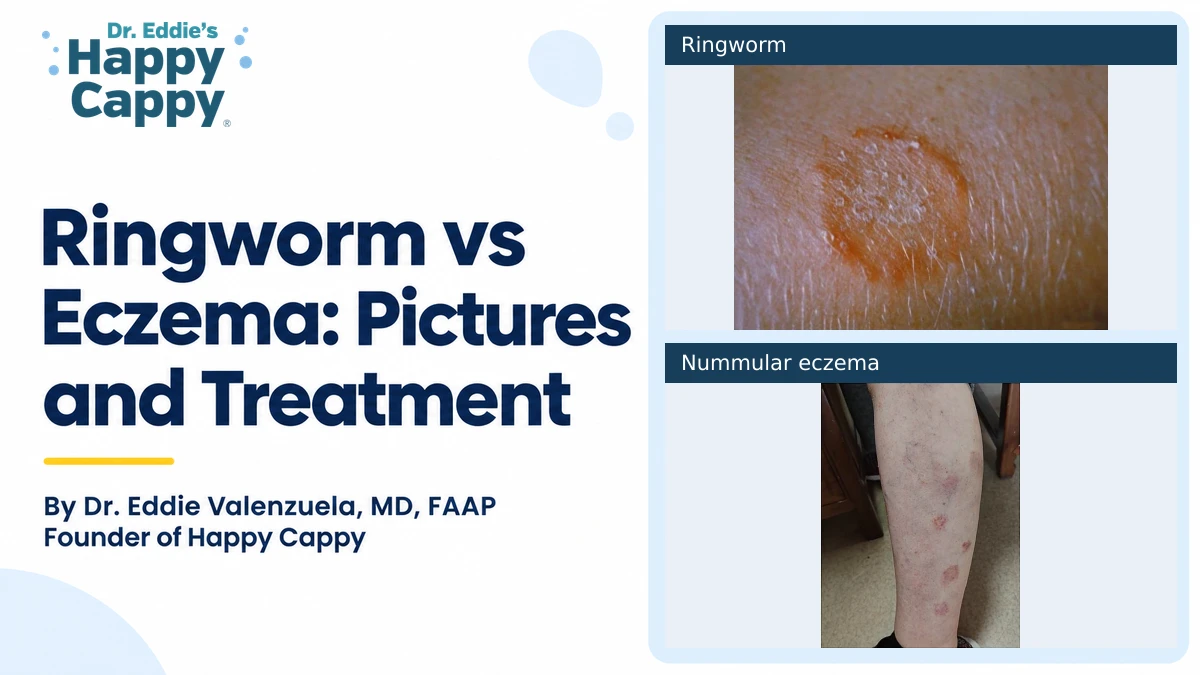
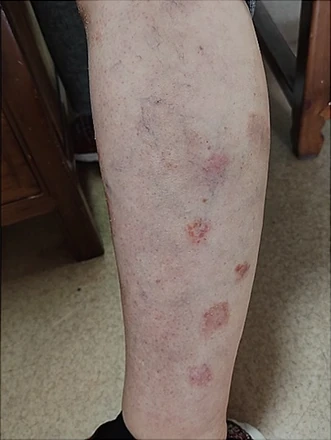
Cover photos show ringworm on an arm and nummular eczema on a lower leg. Different people are shown; these are not treatment-result photos.Cover photo credits: CDC / Dr. Lucille K. Georg, PHIL 2938. Public domain. Resized and converted to WebP. Pan J, Yu H, Ye W and Liang Y (2026), Figure 1, Frontiers in Medicine, CC BY 4.0. Baseline left-leg panel extracted and converted to WebP. Used to illustrate appearance, not to endorse the case report’s treatment.
Quick answer: Ringworm is a fungal infection; eczema is an inflammatory skin condition. Both can cause round, itchy, scaly patches. A raised border or clearer center is a clue, but an examination and sometimes a fungal scraping are needed to choose the right treatment.
Ringworm and eczema: overlapping appearances
The comparison is especially tricky with nummular eczema, which makes coin-shaped patches. Both conditions can itch and scale, and neither has to look bright red. On darker skin, affected areas may look brown, purple or gray.
A circular patch is not a diagnosis. Ringworm can lose its classic outline after steroid use, while scratched or irritated eczema may develop a more noticeable edge. Treating the wrong condition can prolong the problem.12
Dr. Eddie Valenzuela describes a common mix-up: “People often think that eczema in children is ringworm. They put ringworm treatment on it for months, and then come in and are confused as to why it’s not getting any better. That’s because it’s actually eczema, not ringworm.”
Pictures of ringworm and nummular eczema
These clinical photographs illustrate two examples. They do not show the same patient, and the appearance of your own rash may differ. Tap either image to see it larger.

Fungal infection and skin inflammation
Ringworm: dermatophyte fungi
Ringworm is caused by dermatophyte fungi. There is no worm involved. Infection can spread through contact with an affected person or animal, or contaminated surfaces and personal items. Ringworm on ordinary body skin is called tinea corporis; on the feet it is called tinea pedis.3
Eczema: inflammation and the skin barrier
Eczema involves inflammation and problems with the skin barrier. The factors vary by eczema type. Atopic dermatitis reflects a combination of inherited susceptibility, immune activity and environmental influences. It is not simply a sign of a “weak immune system,” and it is not a fungal infection.4
Ringworm vs eczema: useful clues
Outer edge
Ringworm often has a more active, scaly outer border as it enlarges. Nummular eczema may be inflamed and scaly throughout the patch. Either can be crusted or scratched.
Center of the patch
Relative central clearing can suggest ringworm, but it is not always present. A ring-shaped eczema patch can also mislead you.
Itch and location
Both may itch on arms, legs or the trunk. Location and itch intensity alone do not separate them. Multiple eczema patches may accompany generally dry skin.
History
A new patch after contact with an affected pet, person or shared equipment raises fungal suspicion. Recurring coin-shaped patches can suggest nummular eczema. Neither history proves the diagnosis.
If you have peeling between the toes or a scaly sole, use the more location-specific athlete’s foot vs eczema guide. For a broader set of possible causes, see eczema lookalikes.
Examination and fungal testing
The clinician examines the rash and asks how it developed, whether it is spreading and what treatments you have used. They may scrape scale from a suspicious border and examine it for fungus. A fungal culture or further assessment can help when the answer remains uncertain.2
Bring the names or photographs of every cream you tried. Temporary improvement after a steroid does not exclude ringworm. If a diagnosis or treatment is not working as expected, ask about reassessment instead of repeatedly alternating an antifungal and steroid.
Contagiousness and spread
Ringworm can spread; eczema itself cannot. Avoid sharing towels, clothes and sports equipment with someone who has ringworm. Launder used items and keep affected skin clean and dry. A pet with suspicious bald or scaly patches needs veterinary advice. Eczema can become infected, but the underlying eczema is not something another person catches.3
An uncertain rash does not mean you need to isolate indefinitely. Ask a clinician about school, childcare, sports and close-contact precautions for the confirmed condition.
Treatment differences
Antifungal treatment for ringworm
For confirmed ringworm on body skin: a topical antifungal is often used. Follow the product’s age, body-site and duration instructions and finish the advised course, even if the rash looks better sooner. Some locations or more extensive infections need prescription treatment. Scalp ringworm generally needs an oral antifungal because a cream alone does not adequately treat infected hair.1 Our scalp ringworm guide explains hair-shaft changes, kerions, oral treatment and recovery.
Anti-inflammatory treatment for eczema
For eczema: treatment usually combines regular moisturizer with the anti-inflammatory treatment appropriate for the person, severity and body site. Nummular eczema may need prescription care. Antibiotics are not routine eczema treatment unless an infection warrants them.24
Steroids and an uncertain diagnosis
Do not use a steroid alone on suspected ringworm or choose a steroid-antifungal combination as a diagnostic experiment. Steroids can change the appearance and allow fungal infection to worsen. If you have already used one, tell the clinician; do not feel embarrassed.1
Cleansing and moisturizing during treatment
For eczema-prone skin, gentle cleansing and regular moisturizing support comfort during treatment.
Gentle cleansing with Happy Cappy Daily Wash
Use Happy Cappy Daily Shampoo & Body Wash, a fragrance-free cleanser for dry, sensitive skin. Glycerin and provitamin B5 help skin feel hydrated and soft. Gently massage onto wet skin, rinse thoroughly and pat dry.
Moisture retention with Happy Cappy Cream
Happy Cappy Moisturizing Cream is a daily moisturizer for dry, eczema-prone skin. Glycerin draws in moisture and petrolatum helps retain it. The non-greasy cream leaves dry skin feeling soft and comfortable. Apply after bathing and whenever skin feels dry.
Choose one 8 oz Daily Wash with a 6 oz cream tube or 12 oz pump jar. Shop the Daily Wash + Moisturizing Cream Bundle
These products support eczema-prone skin care; they do not treat ringworm. Continue prescribed treatment as directed.
Avoid scratching, scrubbing the scale away or sharing a cream jar in ways that contaminate it. If a patch stays itchy or grows despite appropriate treatment, have the diagnosis and treatment reviewed rather than assuming it only needs more time.
When to seek care
Get help for an uncertain diagnosis, spreading patches, scalp involvement, repeated recurrence or failure to improve with the recommended course. Seek prompt care for fever, worsening pain, pus or rapidly spreading inflammation. People with a weakened immune system should seek individualized advice earlier.