

Quick answer: Malassezia is a group of yeasts that normally lives on skin. It can contribute to dandruff and seborrheic dermatitis, cause follicle inflammation called Malassezia folliculitis, and produce the finely scaly color changes of pityriasis versicolor. These conditions look and behave differently, so finding yeast is only part of understanding a rash.
A flaky scalp, a crop of itchy chest bumps, and pale patches on the back may seem unrelated. Malassezia can be involved in all three, but the same name does not mean the same disease. Where the yeast is growing and how the skin responds help explain the difference.
That distinction makes the subject useful beyond learning a new medical word. It helps explain why a treatment that improves dandruff may not solve every bumpy or discolored rash, and why healthy skin does not need to be stripped of its normal microorganisms.
Malassezia is part of the normal skin microbiome
Malassezia is a genus, or group, of yeasts. A yeast is a type of fungus, and these yeasts are common members of the skin microbiome: the community of microorganisms that lives on the skin. Older medical writing may use the name Pityrosporum, which is why both names still appear in descriptions of folliculitis.1
Many Malassezia species depend on fats supplied by their surroundings. On human skin, those fats are available in sebum, the oil made by sebaceous glands. This helps explain why the scalp, face, chest, and upper back are frequent settings for Malassezia-associated conditions. The yeast is microscopic; the flakes, bumps, or color changes we notice are effects on the skin, not visible clumps of yeast.1
Normal colonization and disease are different states. Someone can have Malassezia on comfortable, healthy skin, while another person develops symptoms in the same oil-rich areas. The question is therefore what is happening in the affected skin, rather than simply whether Malassezia is present.
Skin oils and the body's response influence symptoms
Oil provides a favorable environment for Malassezia, but oiliness alone does not explain a rash. In seborrheic dermatitis, researchers consider the interaction between yeast, sebum, and the skin's response important. The precise cause is not fully understood, and the condition is not a sign of unclean skin.2
The circumstances also differ by condition. Heat, humidity, sweating, and trapped moisture can favor Malassezia folliculitis or pityriasis versicolor. Recent antibiotic use or medicines that suppress immune defenses may be relevant when evaluating folliculitis. These are clues to discuss during an assessment, not reasons to stop a prescribed medicine on your own.3, 4
Thinking in terms of one universal “yeast overgrowth” misses those differences. It can also lead to unnecessary scrubbing or repeated product changes. Looking at the pattern of the rash gives a more useful starting point.
Three common conditions show different patterns
The clearest distinction is between flaking skin, inflamed follicles, and finely scaly patches of altered color. The following photographs show real clinical examples from a published medical review. They illustrate the patterns; appearance alone cannot confirm a diagnosis.
Dandruff and seborrheic dermatitis cause flaking and scale
Dandruff mainly involves scalp flaking, sometimes with itch. Seborrheic dermatitis includes more noticeable inflammation and can also affect the eyebrows, sides of the nose, ears, and chest. Malassezia is part of the explanation, alongside the skin's response, rather than a complete explanation for every flare.1, 2
This broader distribution is useful to recognize: similar scale around the nose and on the scalp may belong to the same condition. In infants, the familiar scalp form is called cradle cap. Our seborrheic dermatitis guide explains the condition across skin sites, while Malassezia on the Scalp: Symptoms and Care concentrates on scalp symptoms and care.7
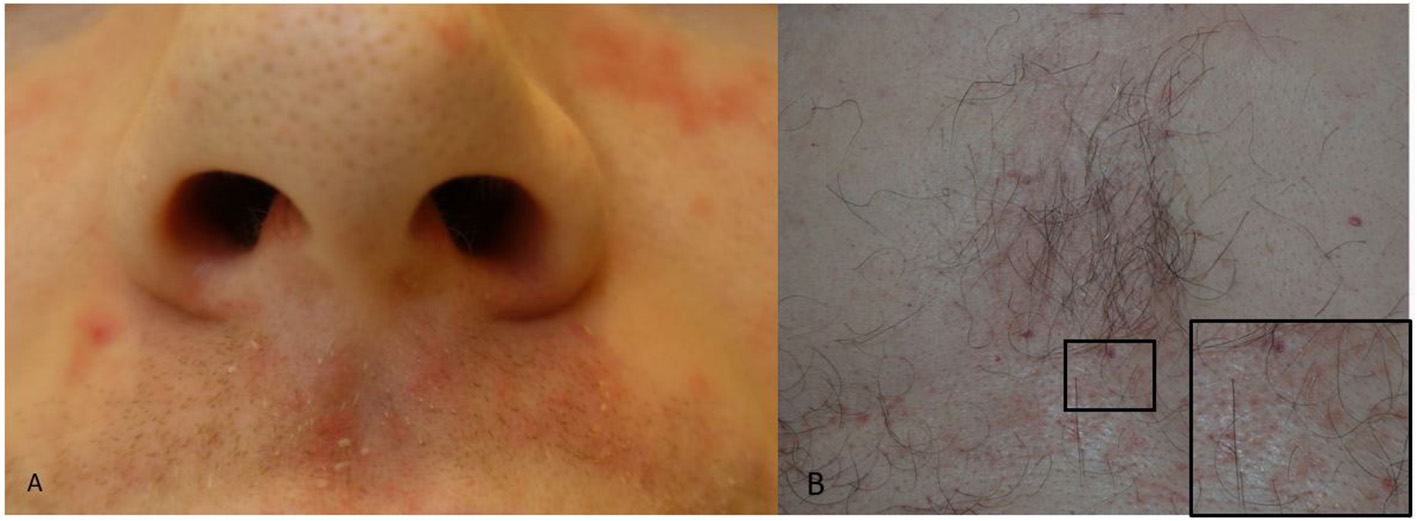
Photographs: Saunte DML, Gaitanis G, Hay RJ, Frontiers in Cellular and Infection Microbiology (2020), Figure 2. © 2020 the authors. Reproduced unchanged under CC BY 4.0.
Malassezia folliculitis causes bumps around hair follicles
In Malassezia folliculitis, the affected structure is the hair follicle. The eruption often consists of many small, similar-looking bumps or pustules on the chest, back, shoulders, or hairline. Itching is common. The popular name “fungal acne” can be confusing because this is folliculitis, not ordinary acne vulgaris.3
A pale tip on a pustule is not the same as a plugged pore. Blackheads and closed comedones, often called whiteheads, are not typical features of Malassezia folliculitis itself. Ordinary acne and folliculitis can, however, occur together. That overlap helps explain why an acne routine may improve some spots while other itchy bumps remain.1, 3
The fungal acne guide develops those distinctions and links to focused appearance and treatment information. Bumps can have other causes, so their location or itchiness should guide an assessment rather than become a diagnosis by themselves.
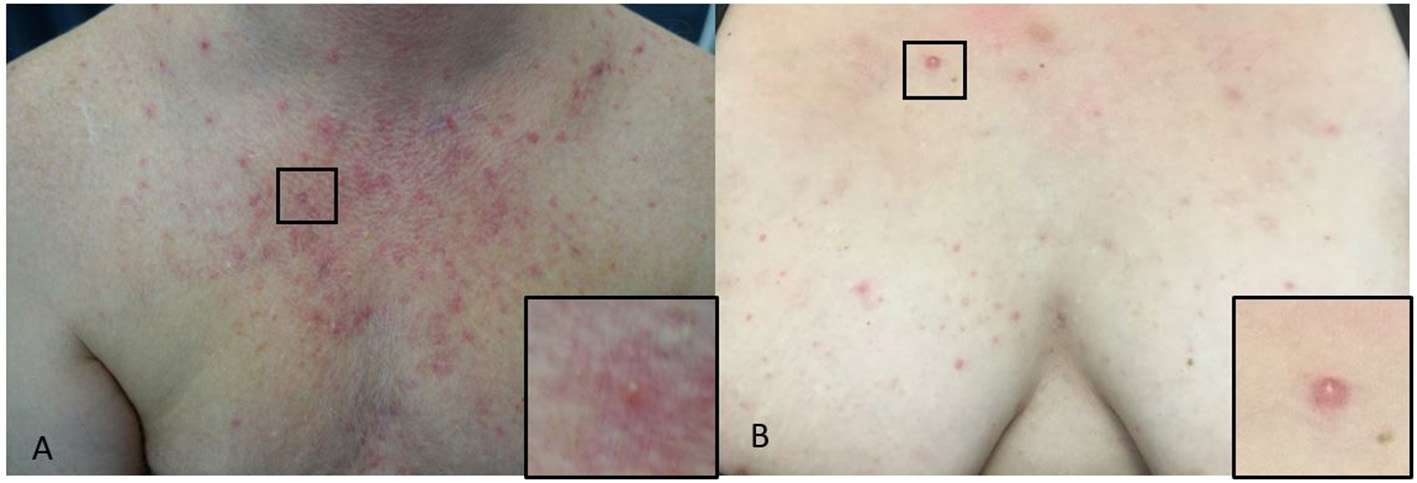
Photographs: Saunte DML, Gaitanis G, Hay RJ, Frontiers in Cellular and Infection Microbiology (2020), Figure 4. © 2020 the authors. Reproduced unchanged under CC BY 4.0.
Pityriasis versicolor changes skin color and produces fine scale
Pityriasis versicolor, also called tinea versicolor, develops in the outermost skin layer. It produces patches that may be lighter, darker, or pinker than the surrounding skin, usually on the upper trunk, neck, or arms. Fine scale may be subtle, and itching can be mild or absent.4
The color change is part of the condition, not dirt that needs to be scrubbed away. Malassezia activity can interfere with normal pigmentation, although the mechanisms are not completely understood. This is also why pale patches may stand out more when the surrounding skin tans.1, 4
Skin color can take weeks or months to settle after treatment controls the yeast. A remaining pale patch therefore does not automatically mean treatment failed. Persistent scale, new patches, and the overall examination help a clinician decide whether the condition is still active.4, 5
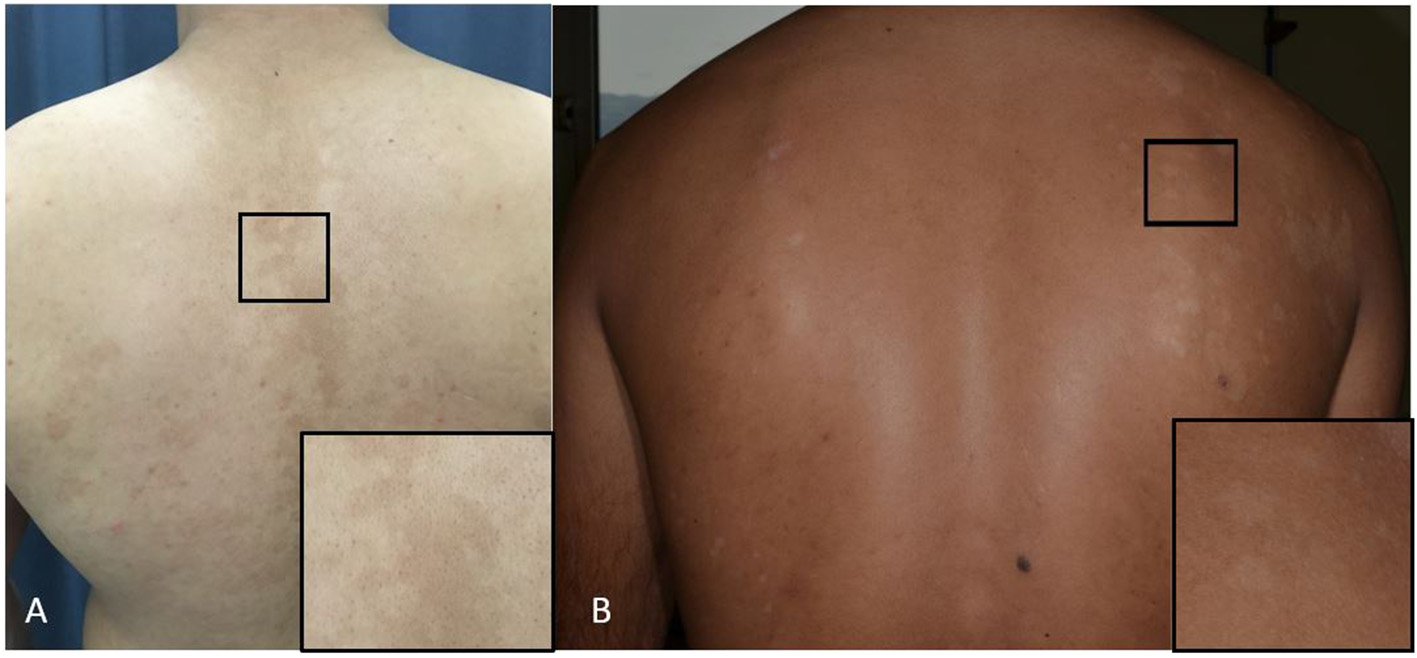
Photographs: Saunte DML, Gaitanis G, Hay RJ, Frontiers in Cellular and Infection Microbiology (2020), Figure 3. © 2020 the authors. Reproduced unchanged under CC BY 4.0.
Other associations need a more careful explanation
Malassezia can contribute to head-and-neck dermatitis in some people with atopic dermatitis, where sensitivity to the yeast may be relevant. That association does not turn all eczema into a fungal infection. Similarly, psoriasis should not be described as a disease caused by Malassezia; overlapping scale can require a different diagnosis and treatment.1, 7
In newborns, Malassezia has been associated with neonatal cephalic pustulosis, an eruption of small facial or scalp bumps without comedones that often clears on its own. “Baby acne” is a broader everyday label, so every newborn bump should not be attributed to yeast. The baby acne guide explains the age-related patterns and lookalikes.6
Diagnosis connects the skin pattern with the right evidence
A clinician starts with the rash itself: its location, texture, symptoms, and history. Scaly patches around the nose raise different possibilities from uniform itchy follicle bumps. Previous treatment also matters, including which areas improved and which did not. Seborrheic dermatitis can often be recognized from this clinical picture without laboratory testing.7
When testing would clarify the diagnosis, the sample needs to come from the relevant area. A scraping of a scaly patch can help assess pityriasis versicolor, while material from affected follicles may help assess folliculitis. Because Malassezia also lives on healthy skin, simply detecting the organism is not enough to explain an otherwise unclear rash.1, 3, 5
Microscopy can reveal yeast cells and short fungal filaments
Pityriasis versicolor has a memorable microscopic clue. A potassium hydroxide, or KOH, preparation can show rounded yeast cells beside short filaments called hyphae. Dermatologists often describe the combination as “spaghetti and meatballs.” The comparison refers to the shapes under the microscope, not something visible on the skin.4
Malassezia folliculitis more often shows budding yeast cells, with hyphae rarely seen. A biopsy is sometimes useful in difficult cases because it can show organisms and inflammation within a follicle. These differences are another reason that a positive surface test and a diagnosis are not interchangeable.3
These common conditions differ from contagious ringworm
Dandruff, seborrheic dermatitis, and pityriasis versicolor are not treated as infections caught through ordinary contact with another person. Malassezia folliculitis also usually involves yeast already living on the person's skin. The word fungus therefore does not, by itself, tell you whether a skin condition is contagious.1, 4
Ringworm is a different fungal infection that can spread between people, from animals, or through contaminated items. Despite the shared word tinea, tinea versicolor is distinct from scalp ringworm, or tinea capitis. Broken hairs or patchy hair loss deserve assessment rather than being assumed to be ordinary dandruff; scalp ringworm requires prescription oral treatment. See Scalp Ringworm and Its Effects on Hair for that separate condition.9, 10
Treatment follows the condition and the affected skin
The purpose of care is to control the condition and restore comfort, rather than permanently remove every Malassezia cell. Antifungal treatment may reduce the yeast's contribution, but inflamed skin can also need treatment directed at inflammation. The body site, age, extent of the rash, and individual tolerance all influence the choice.1, 7
For dandruff or scalp seborrheic dermatitis, familiar shampoo options include ketoconazole, selenium sulfide, pyrithione zinc, and salicylic acid. They do not all do the same job: salicylic acid helps loosen scale, while several other actives have antifungal effects. Persistent inflammation may need a prescription medicine. The dandruff guide and seborrheic dermatitis guide explain those choices in context.7, 11
Folliculitis and pityriasis versicolor have their own treatment plans. Depending on the diagnosis and extent, a clinician may recommend a topical antifungal; more extensive or persistent disease sometimes requires an oral medicine. A treatment schedule for the scalp should not automatically be copied onto the face or a large area of the body.3, 5
Recurrence can happen because treatment controls a condition involving organisms that normally live on skin. It does not necessarily mean someone has become reinfected from a household contact or has failed to keep clean. Follow-up can help distinguish a recurring condition from irritation or an incorrect initial diagnosis.
Happy Cappy has a specific role in dandruff and seborrheic dermatitis
Happy Cappy Medicated Shampoo & Body Wash contains pyrithione zinc 0.95% for symptoms associated with dandruff and seborrheic dermatitis. Its fragrance-free formula uses a non-soap cleansing base, with glycerin and panthenol among its supporting ingredients. For those choosing a dandruff wash, the aim is appropriate medicated care in a formula the skin tolerates.8
That labeled use does not establish it as a treatment for every Malassezia-associated rash. If the main problem is persistent follicle bumps or unexplained patches of changed skin color, identifying the condition comes first. Our zinc pyrithione ingredient guide explains the ingredient's role without turning every mention of yeast into the same product recommendation.
Recognizing the pattern helps guide care
Malassezia is familiar to dermatologists because it can be involved in several visibly different skin conditions. The useful connection is not just the organism's name: flaking points toward one group of possibilities, follicle bumps toward another, and finely scaly color changes toward another. Recognizing those differences makes it easier to understand a diagnosis and why a particular treatment was chosen.
If a rash keeps returning, changes character, or does not respond as expected, bring that history to a clinician rather than repeatedly escalating a “yeast-clearing” routine. Painful swelling or patchy hair loss needs earlier assessment. Comfortable skin and a plan suited to the actual condition are more helpful goals than trying to make normal skin microbe-free.