

Quick answer
Look for a fragrance-free shampoo with gentle cleansers. For a medicated option, check the Drug Facts active ingredient, uses, warnings, and directions. Ingredients such as glycerin and panthenol support the formula; they are not the medicated active.1,2,7
Cradle cap is seborrheic dermatitis of a baby's scalp. A useful shampoo comparison starts with what each formula is designed to do. The active ingredient, cleansing ingredients, and supporting ingredients have different jobs.
Routine cleansing and medicated washing have different roles
A mild, fragrance-free baby shampoo is a reasonable starting point for routine cradle cap care. Gentle washing helps loosen and rinse away scale. The American Academy of Dermatology recommends switching to a shampoo formulated for cradle cap when a regular baby shampoo is not enough.1
A medicated shampoo has a Drug Facts panel that identifies its active ingredient, purpose, uses, warnings, and directions. Read that panel before comparing front-label claims. For the washing and brushing routine, see our cradle cap care guide.
Ingredients and their jobs in the formula
Start with the active ingredient, then look at the rest of the formula. The examples below use Happy Cappy Medicated to show how cleansing, conditioning, and preservation work alongside the medicated ingredient.2,7
| Ingredient or group | What it contributes |
|---|---|
| Pyrithione zinc 0.95% | The medicated active. It helps relieve flaking, scaling, redness, itching, and irritation associated with dandruff and seborrheic dermatitis.2 |
| Cleansing ingredients | Surfactants help water lift and rinse away oils and buildup. Happy Cappy uses a blend that includes sodium lauroyl methyl isethionate and cocamidopropyl hydroxysultaine.2 |
| Glycerin | A humectant, meaning it attracts water. It supports the formula’s moisturizing role rather than providing the medicated action.7 |
| Panthenol (provitamin B5) | A conditioning ingredient that helps soften and comfort skin.7 |
| Licorice root extract | Included to help soothe redness. On Happy Cappy’s ingredient list, look for dipotassium glycyrrhizate.2,7 |
| Preservatives | Help protect the formula against microbial growth. Happy Cappy’s ingredient list includes phenoxyethanol.2,4 |
Supporting ingredients do not take the place of a medicated active. For example, licorice root extract helps soothe redness, while pyrithione zinc provides the formula's labeled medicated action. Read more about pyrithione zinc and licorice root extract.
Product labels need context
Fragrance-free and dye-free formulas
Fragrance can cause irritation or allergic reactions in susceptible skin. A fragrance-free formula is a practical choice for cradle cap care. A dye-free formula also leaves out added color that is unnecessary for cleansing. Fragrance ingredients may appear collectively as “fragrance” on an ingredient list, so check the label rather than relying on how a product smells.1,3
Made without SLS and SLES
Sodium lauryl sulfate (SLS) and sodium laureth sulfate (SLES) are cleansing surfactants. Happy Cappy is made without SLS/SLES and uses other cleansers, including sodium lauroyl methyl isethionate. This gives parents who prefer to avoid these sulfates a clear selection criterion. The complete formula and how the skin responds still matter when choosing a gentle wash.2,7
Paraben-free and properly preserved
Happy Cappy is paraben-free and uses other preservatives to help protect the formula. Paraben-free does not mean preservative-free: protection against harmful bacteria and mold matters in a water-based wash. The U.S. Food and Drug Administration (FDA) says it currently lacks information showing that parabens, as used in cosmetics, affect human health. Choose a formula that fits your preferences without assuming that all preservatives are harmful.2,4
Testing claims and individual tolerance
Dermatologist testing is useful information to consider alongside the ingredients and directions. It cannot guarantee that every child will tolerate a formula. Likewise, “hypoallergenic” is not a promise of zero allergic reactions; the FDA has no federal definition or standard governing that cosmetic claim.5
Happy Cappy Medicated is a cradle cap shampoo
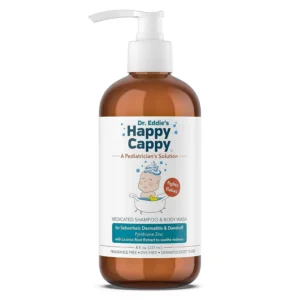
Happy Cappy Medicated Shampoo & Body Wash is a cradle cap shampoo that helps gently wash away flakes and scales while cleansing your baby’s hair and scalp. Cradle cap is the infant form of seborrheic dermatitis.
Its 0.95% pyrithione zinc helps relieve flaking, scaling, redness, and itching associated with seborrheic dermatitis and dandruff. The formula is fragrance-free and dye-free.2,7
Skip the oily mess. Happy Cappy Medicated helps wash away flakes and scales without applying oil beforehand. Gently massage with your fingertips and rinse; leave scales that do not release easily.1,2,7
This formula combines the medicated active with the supporting ingredients described above, including glycerin, panthenol, and licorice root extract. It is made without SLS/SLES or parabens.2,7
Happy Cappy Daily Shampoo & Body Wash serves a separate role as a gentle, nonmedicated cleanser for dry, sensitive skin. It does not contain the Medicated wash’s pyrithione-zinc active.
Directions and age suitability matter
Using the wash
Use the directions on the product you select. Happy Cappy’s Drug Facts direct users to wet the hair, massage the wash onto the scalp and skin, and rinse. For best results, use at least twice weekly or as directed by a doctor. For external use only. Avoid eye contact and rinse thoroughly with water if contact occurs.2
Adult dandruff formulas
Adult dandruff shampoos have different ingredients, concentrations, and age directions. Do not assume that ketoconazole or selenium sulfide products are interchangeable choices for a baby. Mayo Clinic specifically advises against salicylic-acid dandruff shampoos in babies because the ingredient can be absorbed through their skin. Our adult dandruff shampoo comparison covers that question separately.6
Changes that need medical advice
Follow Happy Cappy's label advice to ask a doctor before use for seborrheic dermatitis covering a large body area, and to stop use and seek advice if the condition worsens or fails to improve with regular use as directed. Pain, oozing, or a spreading severe rash also needs assessment rather than another shampoo purchase.1,2,6