

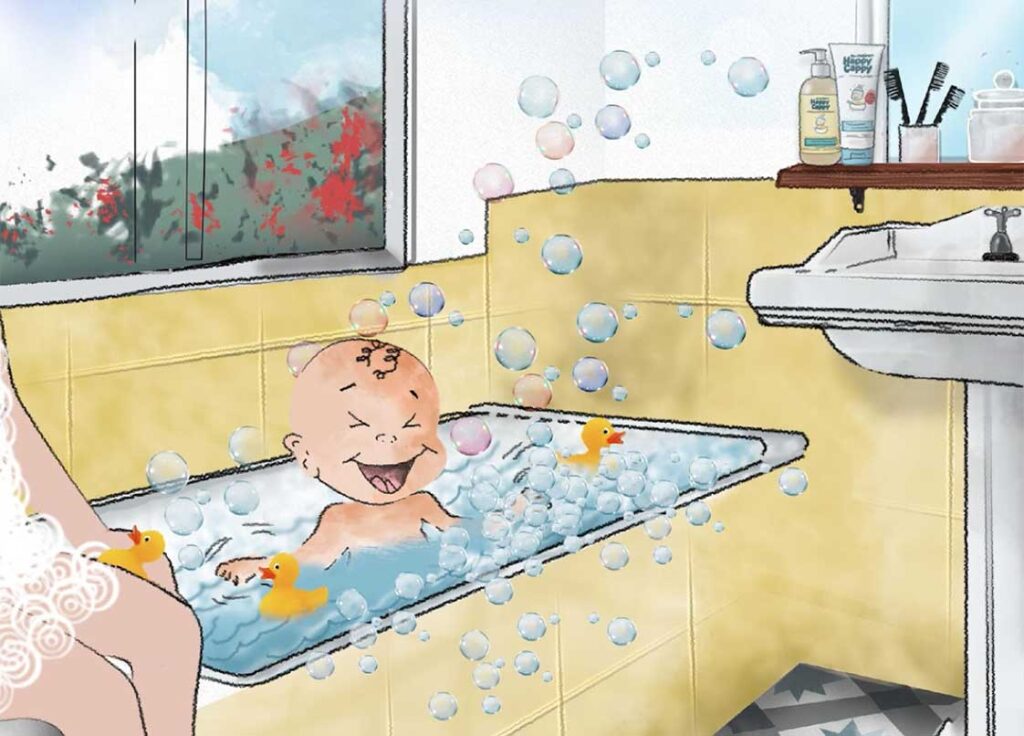
The myth: Cradle cap means a parent has not kept the baby's scalp clean enough.
A little reassurance: Cradle cap is common and is not a measure of how well you care for your baby. Mild cases may improve with simple care; some need additional treatment.
In this story
Cradle cap is common and usually harmless
Cradle cap is the name commonly used for seborrheic dermatitis on a baby's scalp. It can produce greasy or dry-looking scales and is usually harmless. Many cases improve as a baby gets older.
A few flakes on an otherwise comfortable baby do not create an emergency or an obligation to buy something. The useful questions are whether the baby is comfortable, how extensive the rash is, and whether the appearance is typical for cradle cap.
Mild cradle cap may improve with gentle washing
Mild cradle cap may improve with gentle washing and careful loosening of scale, without a medicated shampoo. Avoid picking or scratching at the scalp. If scale persists, becomes more extensive, or does not respond to simple care, ask your pediatrician which next step fits your baby.
A shampoo formulated for cradle-cap care can be useful for some families. That is a choice about the baby's needs, not a test of a parent's concern. There is room for both reassurance and treatment when treatment is helpful.
A medicated wash is an option for persistent flakes
Happy Cappy Medicated Shampoo & Body Wash contains 0.95% pyrithione zinc to help relieve flaking, scaling, redness, and itching associated with seborrheic dermatitis. Its fragrance-free, dye-free formula is designed for sensitive skin.
Use directions: Wet the hair thoroughly, gently massage in the shampoo, and rinse well. Use at least twice weekly. Keep it out of the eyes. Stop use and ask a doctor if symptoms worsen or do not improve with regular use.2
If a wash-and-brush routine suits your baby’s scalp, the Medicated Shampoo + Beanie Brush Bundle pairs the 8 oz wash with a soft silicone brush for gently moving loose flakes. Leave attached scales alone and avoid brushing raw skin.
For the full routine, visit the Cradle Cap Guide.
When to have the rash checked
Arrange an assessment if there is pain, substantial itching, spreading redness, drainage, an unpleasant smell, or hair loss. A rash that looks different from typical cradle cap may need a different approach. A baby who seems ill should be assessed promptly.
You do not have to identify every skin condition yourself before asking for help. A clear photo and a description of what has changed are often a useful way to start the conversation with your pediatrician.
Gentle care can fit an ordinary family routine
Scalp flakes say very little about the care and affection happening in your home. Choose a manageable routine, be gentle with the scalp, and get help when something seems unusual.
Then get back to the parts of your day that have nothing to do with flakes: a cuddle, a favorite book, or a wonderfully ordinary moment together.