

Quick answer: A red scalp can come from irritation, an allergic reaction, seborrheic dermatitis, psoriasis, or an infection. Flaking, bumps, pain, broken hairs, and the timing of a new product help narrow the possibilities. A scalp can also be red without itching. Persistent redness, a changing sore, or hair loss deserves an examination.
Redness is a sign of inflammation or injury, not a diagnosis. On darker skin, inflammation may look purple, brown, or darker than the surrounding skin rather than bright red. Look for changes in texture and how the scalp feels as well as its color.1
Use the symptom patterns below to help describe what has changed, including red spots without itching. For the next step, go directly to care for a red scalp or the signs that need medical care.
Red scalp with or without itching
Redness without itching
A pink or red scalp does not have to itch. Mild irritation, sun exposure, and some inflammatory or persistent skin lesions can cause color changes without much discomfort. Lack of itch does not confirm that the scalp is healthy or identify the cause.
Check whether the change is widespread or limited to one spot, whether it follows a new product or sun exposure, and whether there is scale, tenderness, swelling, or hair loss. Take a clear photograph to track a persistent change and show your clinician.
Red spots on the scalp without itching
A single red spot under the hair calls for a closer look at that spot, while widespread redness calls for a look at the overall scalp pattern. Note whether the spot is flat or raised, scaly or crusted, and centered around a hair. For bumps around hairs, see the folliculitis example below; for broader redness with flakes, compare the scalp conditions below.1
No itching does not settle the cause. A spot that grows, repeatedly bleeds, or fails to heal needs assessment even if it feels comfortable. Redness with pain, pus, or patchy hair loss also changes the next step; see the signs that need medical care.
Itching without obvious flakes
A product reaction or other irritation can cause itching before visible flakes develop. Note whether symptoms followed a new shampoo, hair dye, or styling product. This pattern alone does not establish dandruff.3
Causes of scalp redness
The timing and pattern help organize the possibilities. Redness that begins after a hair dye or shampoo may suggest a product reaction; flakes around the ears and eyebrows can point toward seborrheic dermatitis. Bumps, broken hairs or patchy hair loss add different clues. These are reasons to look more closely, not a way to confirm a diagnosis at home.
The causes below are not equally common. Everyday irritation and seborrheic dermatitis are different problems from an uncommon scarring scalp disorder. An examination is particularly useful when several patterns overlap or the change persists.
Photographs below show individual examples, not a diagnostic test. Captions identify the condition, location and relevant context; some examples show nearby skin rather than the scalp itself. Clinical appearance has not been retouched. Image use does not imply endorsement of Happy Cappy by the photographers, authors or publishers.
Dandruff with irritation from scratching
Dandruff usually causes loose flakes without obvious inflammation. Scratching can irritate the skin. Marked redness with flakes may point to seborrheic dermatitis or another scalp condition rather than uncomplicated dandruff.
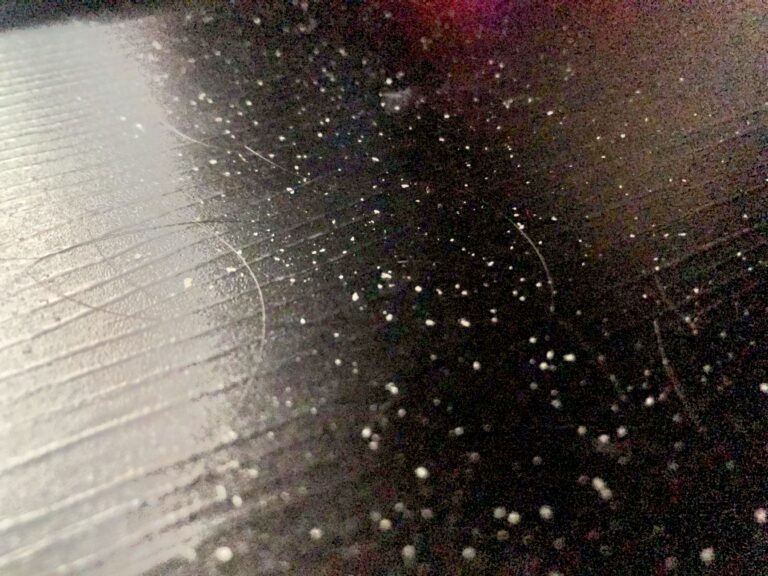
Photo: BestShah (2022), Dandruff with Hair, via Wikimedia Commons. CC BY-SA 4.0; original photograph reproduced without cropping or retouching.
Seborrheic dermatitis
Seborrheic dermatitis can cause inflamed skin with white or greasy yellow scale. Similar patches may appear around the ears, eyebrows, or sides of the nose. Malassezia yeast, skin oils, and an individual's inflammatory response all play a role.2
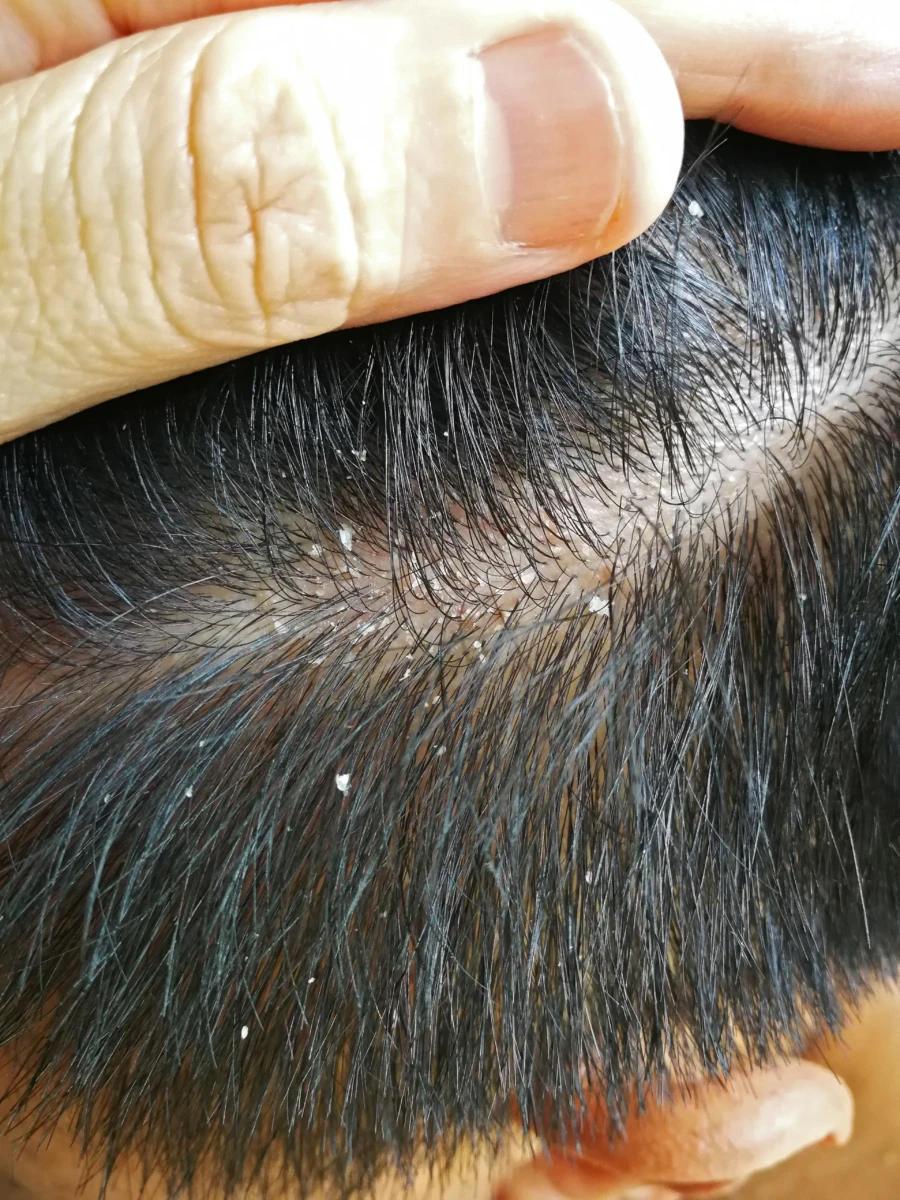
Photo: Shutterstock 1222485025.
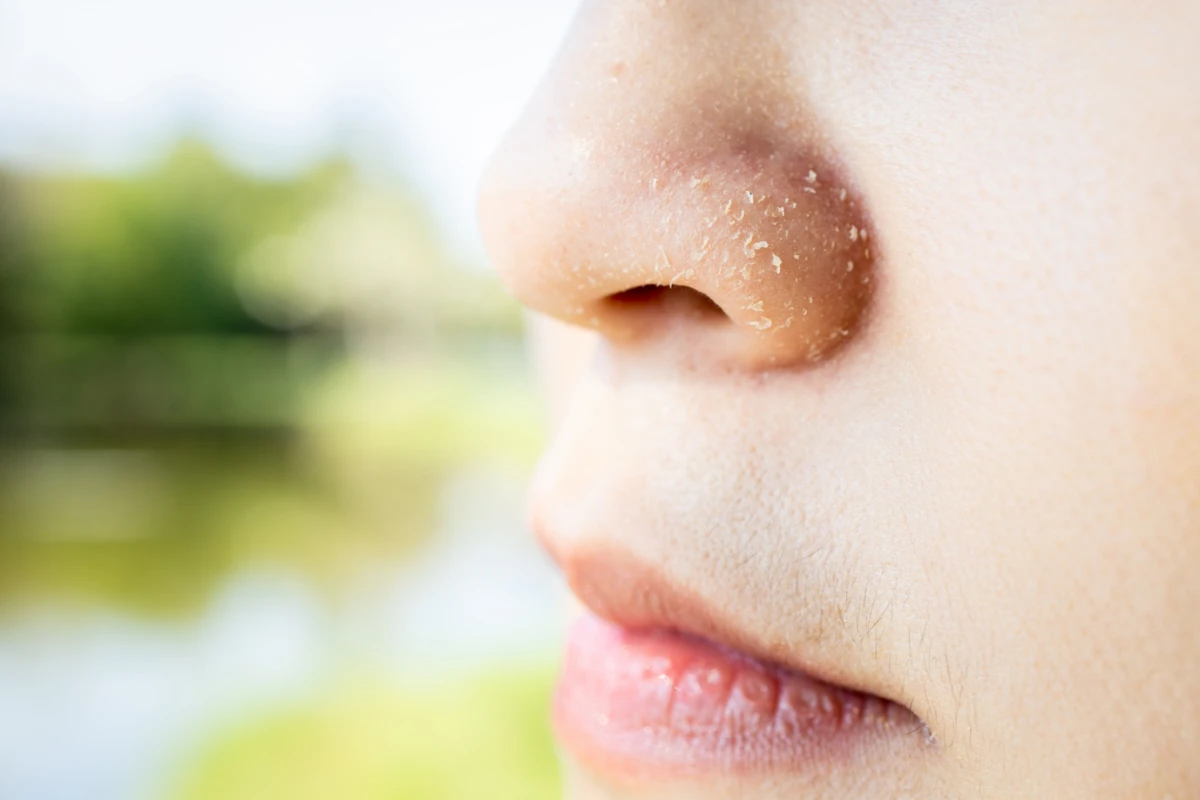
Photo: Shutterstock 1606620310.
These stock photographs illustrate visible flaking. A photograph alone does not establish its cause.
Scalp eczema
Scalp eczema can produce dry, itchy, inflamed skin. A history of eczema elsewhere is a useful clue. It is not the same diagnosis as every flaky scalp rash, and persistent symptoms may need prescribed anti-inflammatory treatment.
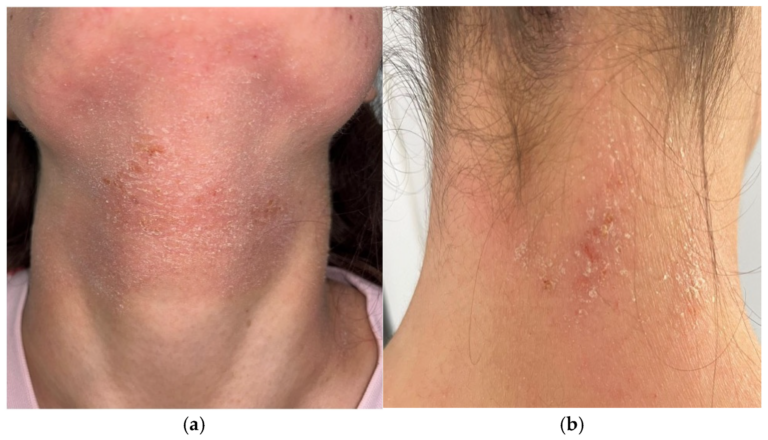
Photo: Türe Avcı et al. (2026), Figure 8, Children. © 2026 the authors. CC BY 4.0; original figure reproduced without alteration.
Scalp psoriasis
Thick, well-defined plaques and scale, sometimes extending beyond the hairline, suggest psoriasis. Scratching may cause bleeding or temporary hair loss. A dermatologist can distinguish it from seborrheic dermatitis and choose scalp-specific treatment.4
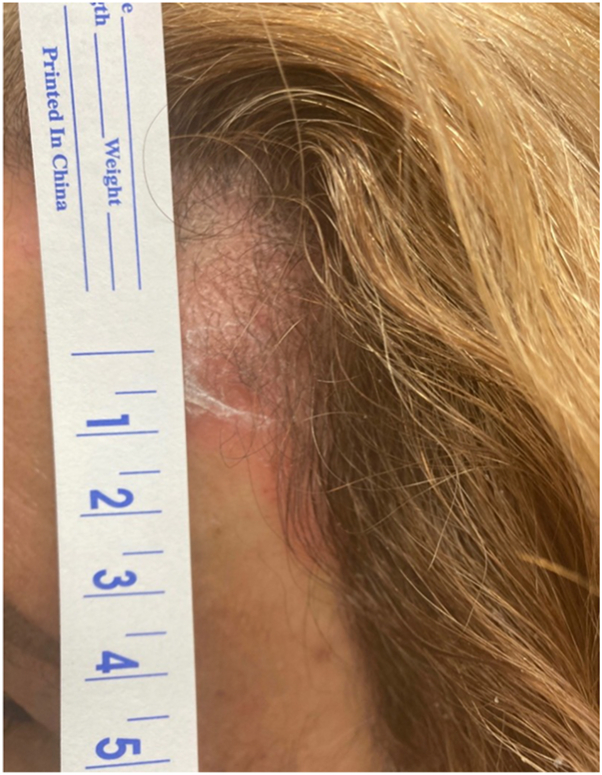
Photo: Truong, Pathak and Rao (2023), Figure 1, JAAD Case Reports. © 2023 American Academy of Dermatology, Inc. CC BY 4.0; photograph reproduced without alteration.
Allergic contact dermatitis
Hair dye, fragrance, preservatives, or another ingredient may trigger a delayed allergic rash. A product can cause an allergy even after previous use without problems. The ears, eyelids, or neck may also be affected. Patch testing can help identify the culprit.3
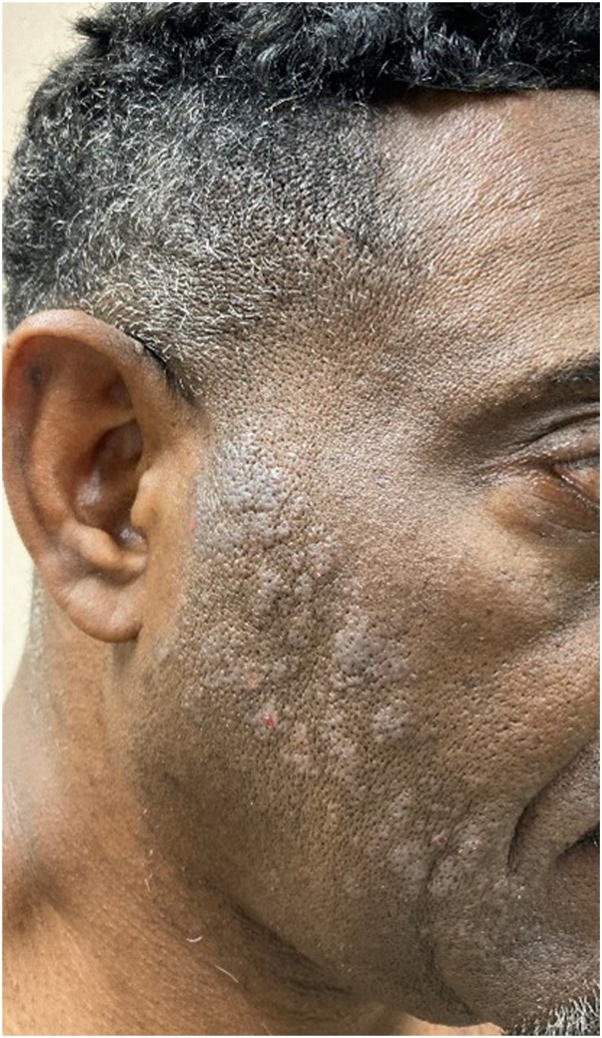
Photo: McClain et al., Figure 1, JAAD Case Reports. © 2023 American Academy of Dermatology, Inc. CC BY 4.0; photograph reproduced without alteration.
Folliculitis
Small bumps or pustules centered around hairs may be folliculitis. It can involve bacteria, yeast, or irritation. These causes need different care. The scalp pimples article explains the main differences.5
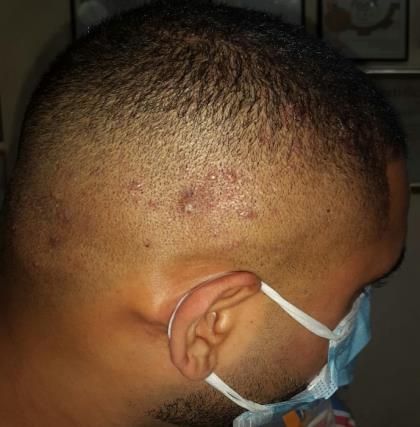
Photo: © 2022 Khalifa E. Sharquie and Raed I. Jabbar, Figure 1, Journal of Pakistan Association of Dermatologists. CC BY 4.0; photograph reproduced without alteration.
Scalp ringworm
Tinea capitis can cause scale, broken hairs, patchy hair loss, or a tender swollen area. It is especially important to consider in children. Scalp ringworm needs prescription oral antifungal medicine; shampoo alone cannot clear infection inside the hair.6
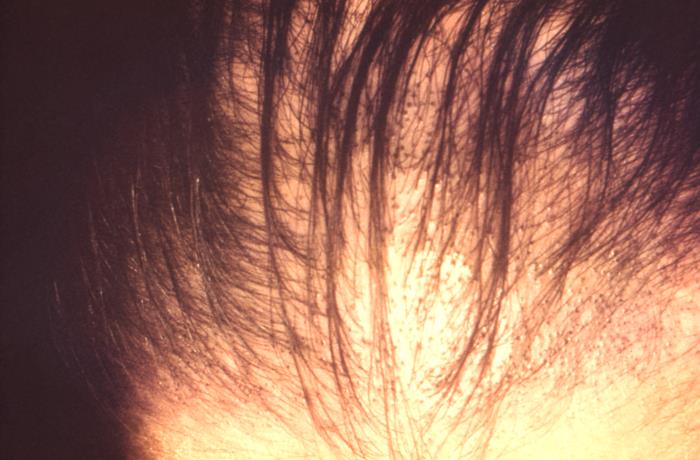
Image: CDC, PHIL 18991. Public-domain image available free from CDC. Use does not imply endorsement of Happy Cappy or its products by CDC or the U.S. Government.
Lichen planopilaris and other scarring scalp disorders
Lichen planopilaris may cause redness and scale around hair follicles, burning, and areas of permanent hair loss. Prompt assessment matters when redness accompanies progressive thinning or smooth scarred patches. Alopecia is a general term for hair loss, not one autoimmune disease.7
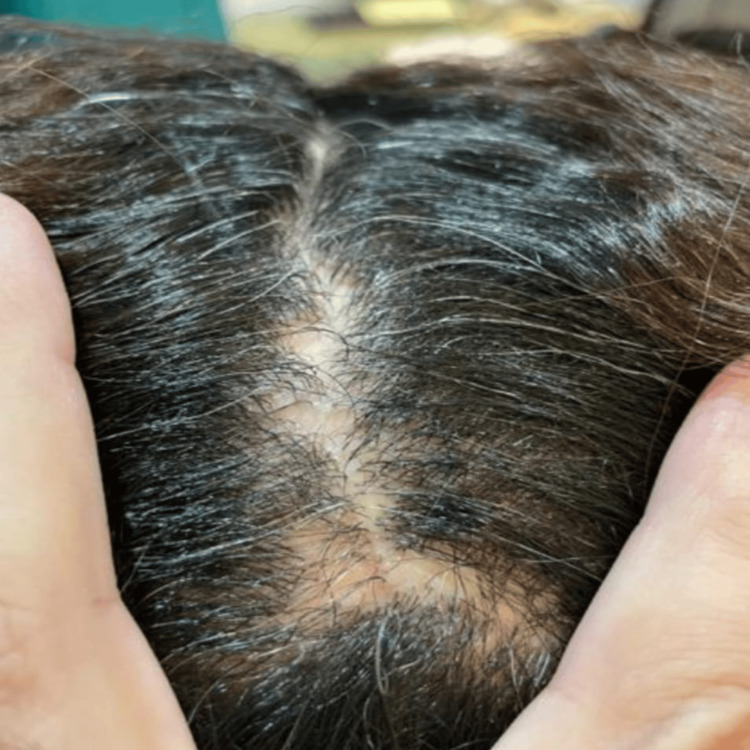
Photo: © 2024 Hamad, Alamin and Alotaibi, Figure 1, Cureus. CC BY 4.0; photograph reproduced without alteration.
Irritant contact dermatitis
Strong cleansers, chemical treatments, or repeated exposure to a product can injure the skin barrier without an allergy. Burning and stinging may be prominent. Stop a product that repeatedly triggers symptoms. A fragrance-free label does not guarantee that every individual will tolerate a formula.3
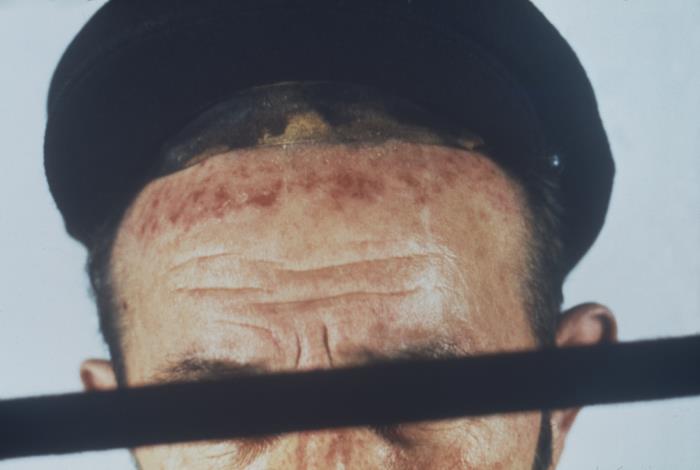
Photo: CDC (1975), PHIL 4486. Public-domain image available free from CDC. Original photograph reproduced without alteration. Use does not imply endorsement of Happy Cappy or its products by CDC or the U.S. Government.
A persistent sun-damaged or changing lesion
A single rough patch, enlarging growth, repeatedly bleeding spot, or sore that does not heal should be examined. These changes have several possible causes, including skin cancer. Do not assume a persistent spot is dandruff.
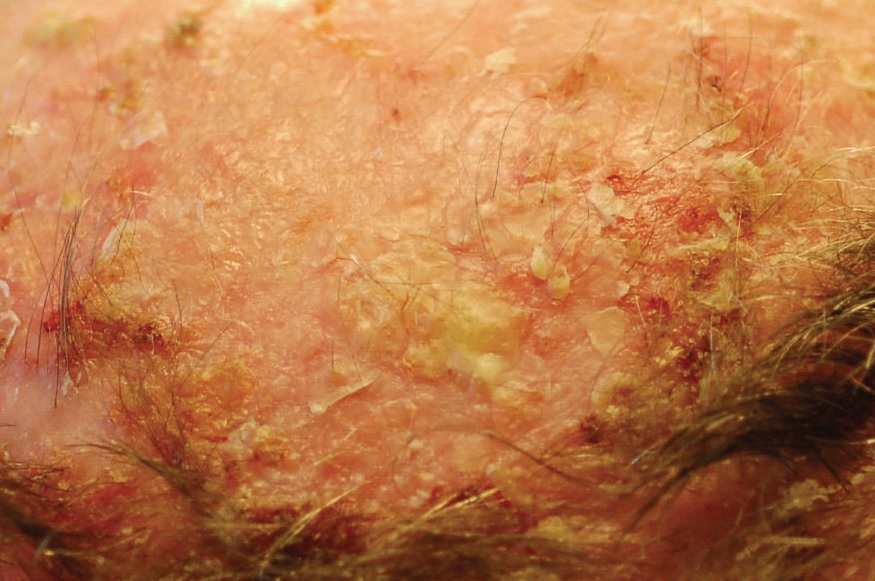
Photo: © 2010 C. Morice et al., Figure 1a, Case Reports in Medicine, via Wikimedia Commons. Creative Commons Attribution; Commons lists CC BY 4.0. Clinical panel reproduced as supplied by Commons, without further cropping or retouching.
Scratching, friction, or another injury
Vigorous scrubbing, picking, tight hairstyles, or rubbing headwear can aggravate scalp redness. Notice whether the affected area matches where a brush, hairstyle, or helmet puts pressure on the skin. Avoid further trauma while it heals.
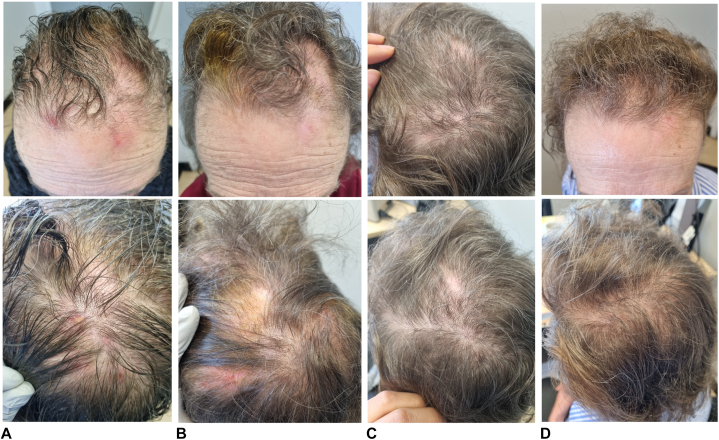
Photo: Hanna and El Moussawi, Figure 1, JAAD Case Reports. © 2024 American Academy of Dermatology, Inc. CC BY 4.0; the complete original figure is reproduced without alteration.
Sunburn
Exposed parts and thinning or closely cropped hair leave scalp skin vulnerable to sunburn. Shade and a protective hat help. Use broad-spectrum SPF 30 or higher sunscreen on exposed scalp skin, following its directions.8
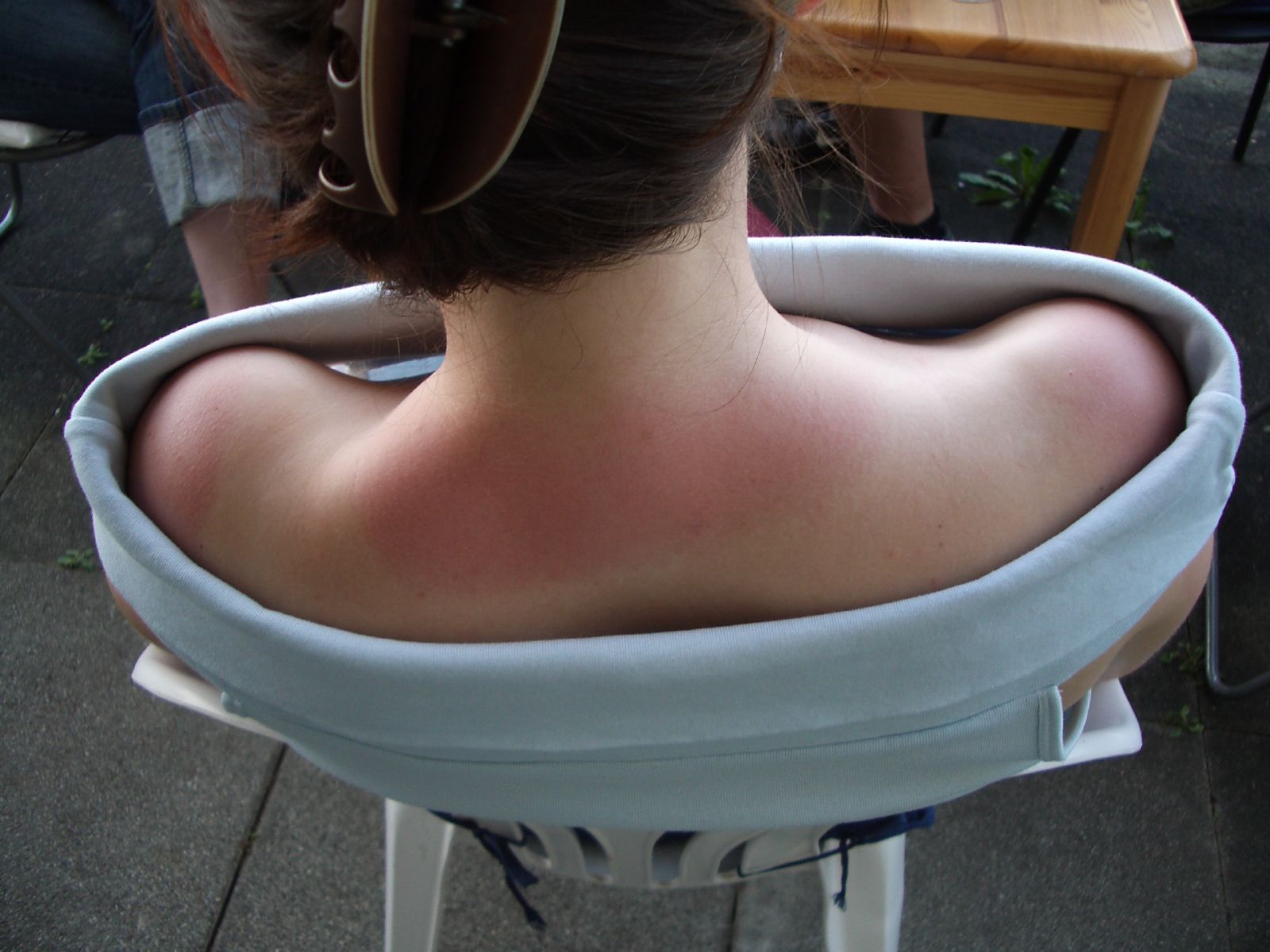
Photo: re-ality (2005), Sunburnt neck and shoulders, via Wikimedia Commons. CC BY 2.0; photograph reproduced without cropping or retouching.
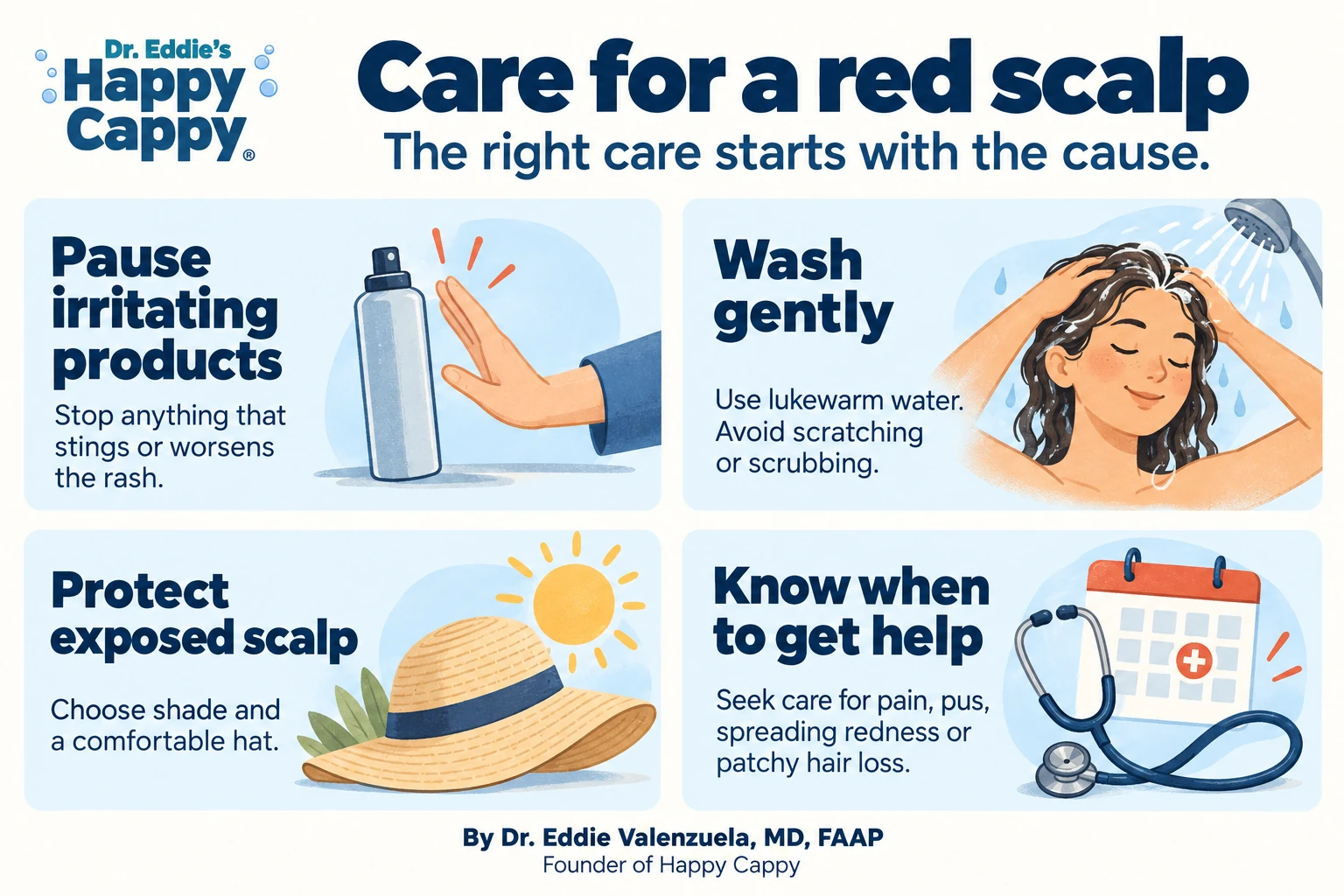
Care for a red scalp
Start by reducing anything that adds irritation, then choose treatment for the cause. A gentle wash can support the skin while a reaction settles, but it cannot replace an oral medicine for scalp ringworm or a prescribed plan for an inflammatory scalp disease.
- Simplify the routine. Pause a suspected irritating product and use a gentle cleanser you tolerate. Rinse thoroughly and avoid very hot water.
- Match treatment to the diagnosis. Dandruff and seborrheic dermatitis may respond to medicated shampoo. Psoriasis, eczema, bacterial infection, and ringworm need different plans.
- Follow the product label. Use each shampoo according to its directions. More applications are not automatically better.
- Seek help if it persists. Repeatedly trying stronger products can add irritation while delaying the right diagnosis. Review the signs that need medical care.
Irritants, habits, and flare triggers
Scratching and irritating products
Do not scrape off adherent scale, squeeze bumps, or apply essential oils, alcohol, or other harsh home remedies to inflamed skin. Avoid starting several new treatments at once; that makes a product reaction harder to identify.
Stress and existing scalp conditions
Stress can aggravate seborrheic dermatitis and other existing scalp conditions. It does not, by itself, explain a new or persistent red area; the pattern of symptoms still matters.2
Signs that need medical care
Get prompt care for a painful swollen area, pus, spreading redness, fever, or redness with patchy hair loss. A nonhealing, bleeding, or changing spot also needs assessment. Sudden facial or tongue swelling or trouble breathing after a product requires emergency care.
For persistent but less urgent redness, bring the products you use and a timeline of symptoms to the appointment. Include hair dye, styling products and any medicines applied to the scalp. Explain whether redness appeared before or after itching, bumps or hair loss. An examination, a sample for infection testing, or allergy testing may clarify a pattern that a photograph cannot.
Once a treatment is chosen, ask what improvement to expect and when to return. If symptoms persist or the pattern changes, reassessment is more useful than adding stronger products indefinitely.
Happy Cappy's role in scalp care
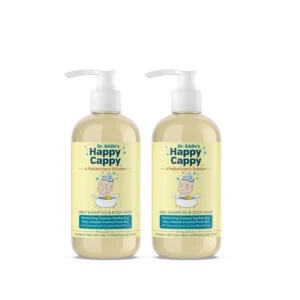
Happy Cappy Medicated Shampoo & Body Wash contains pyrithione zinc 0.95% to relieve flaking, scaling, and itching associated with dandruff and seborrheic dermatitis. It is not a treatment for every cause of redness. For gentle cleansing of dry, sensitive skin, the Daily Shampoo & Body Wash serves a different role.
Choosing the next step
Start with the pattern: flakes, bumps, tenderness, hair loss, or a reaction after a product. Gentle care can reduce added irritation, but persistent redness needs its cause identified.