


Quick answer: Dandruff and acne often occur together, especially when skin becomes oilier during puberty. Falling dandruff flakes are not an established cause of ordinary acne. Forehead bumps may instead involve hair products or yeast folliculitis. Treat scalp dandruff and acne according to their separate causes, and have persistent, itchy or painful bumps assessed.
If you have an itchy, flaky scalp and new pimples, it is reasonable to wonder whether they are connected. The useful question is what is happening in each area. Understanding that distinction helps you choose a routine that addresses both problems.
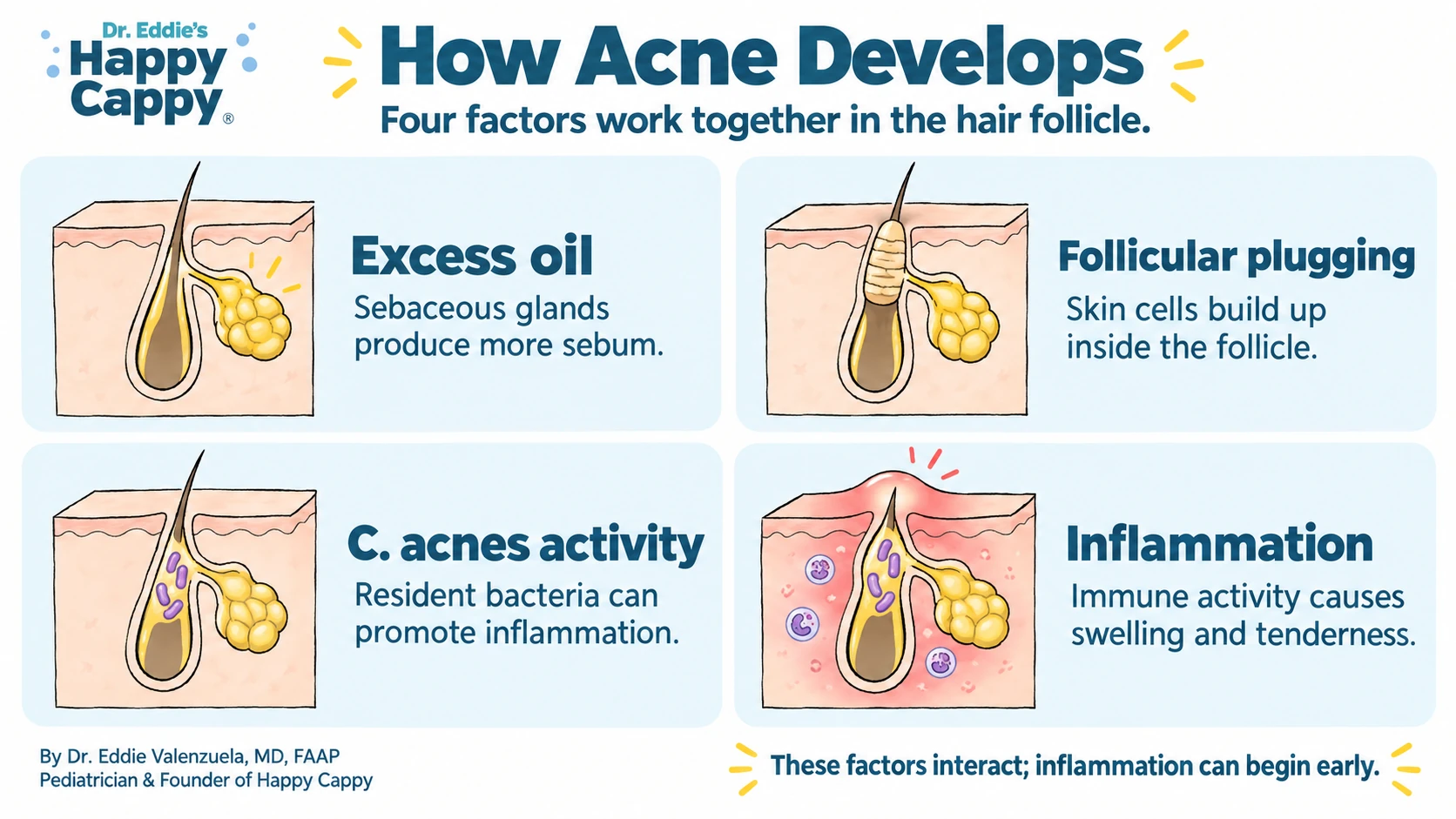
Acne Develops Within Hair Follicles
Acne develops in the hair follicle and its attached oil gland, also called the pilosebaceous unit. Oil and cells can accumulate inside the follicle, while inflammation and Cutibacterium acnes, a bacterium normally present on skin, contribute to breakouts. Blackheads, whiteheads and inflamed pimples can occur together.
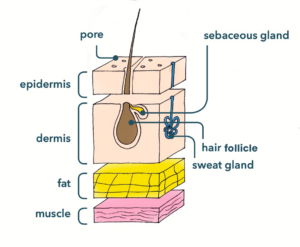
The National Institute of Arthritis and Musculoskeletal and Skin Diseases describes acne as an inflammatory disorder involving plugged follicles. It is not simply dirt sitting on the skin, and scrubbing harder does not solve it.
Causes of Dandruff
Dandruff is scalp flaking on the milder end of the seborrheic dermatitis spectrum. Its development involves skin oil, naturally occurring Malassezia yeast and the way an individual's skin responds. It is not caused by poor hygiene.
The American Academy of Dermatology (AAD) explains that oil and yeast both play a role, but the exact cause remains incompletely understood. An oily scalp does not automatically mean you will develop dandruff.
Dry skin and reactions to hair products can also cause flaking. Our dandruff versus dry scalp guide explains the differences.
The Connection Between Dandruff and Acne
Dandruff and acne can share a tendency toward oilier skin, particularly during puberty. That explains why they may appear at the same time. It does not establish that one causes the other.
The claim that dandruff flakes fall onto the face and directly cause ordinary acne is not an established mechanism in the medical guidance reviewed for this article. Acne-related plugging develops within follicles. Oils from hair and some hair products are better-supported contributors to forehead breakouts.
A second connection involves Malassezia. This yeast is associated with dandruff and can also cause a separate condition called Malassezia folliculitis, often nicknamed “fungal acne.” That condition needs to be distinguished from ordinary acne before choosing treatment.
Causes of Forehead and Hairline Bumps
The location of a breakout alone cannot identify its cause. These clues can help you describe it to your clinician:
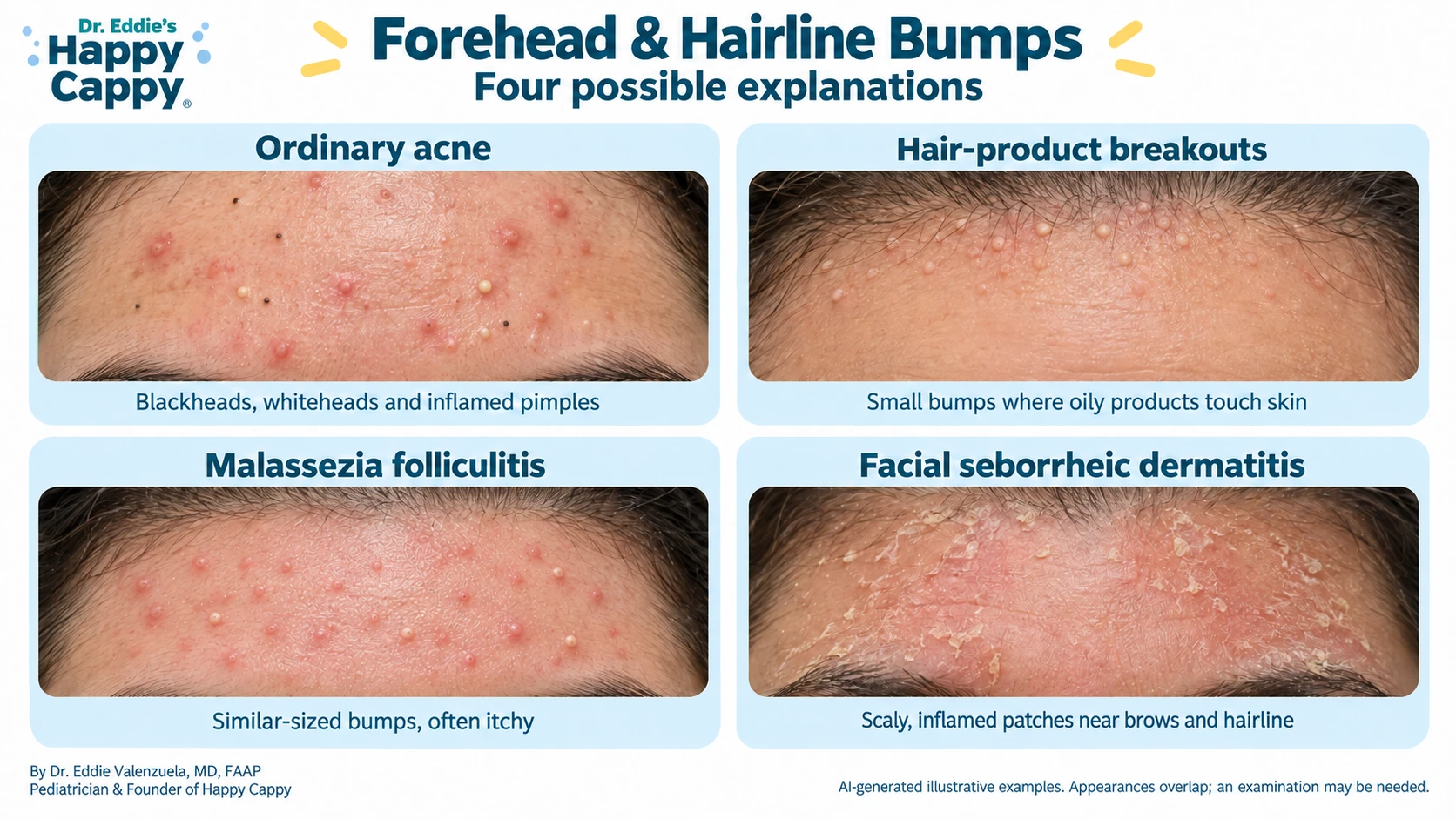
| Possible cause | Typical clues | Useful next step |
|---|---|---|
| Ordinary acne | A mixture of blackheads, whiteheads and pimples; some lesions may be deeper or tender. | Use acne-specific care and assess severity. |
| Hair-product breakouts | Small bumps or whiteheads near areas touched by pomades, oils or other products. | Review products that contact the forehead and hairline. |
| Malassezia folliculitis | Often itchy, similar-looking small bumps or pustules, usually without blackheads or whiteheads. | Ask about folliculitis, especially if acne treatment has not helped. |
| Facial seborrheic dermatitis | Flaking and inflamed patches around the eyebrows, nose or hairline. | Have persistent facial scaling assessed and use care appropriate to the area. |
DermNet's clinical review describes the uniform, itchy pattern of Malassezia folliculitis. These clues are not a home diagnostic test, and more than one condition can coexist. For a closer comparison, see fungal acne versus closed comedones.
Scalp Acne and Dandruff
Pimples on a flaky scalp are not automatically caused by dandruff. Some bumps are inflamed follicles, called folliculitis. Bacteria, yeast, irritation or other conditions may be involved, so treatment depends on the diagnosis. See the AAD's explanation of acne-like folliculitis.
Avoid picking, squeezing or brushing over sore bumps. Arrange an examination for recurring pustules, crusting, pain or hair loss. A swollen, tender patch with broken hairs in a child also needs assessment rather than repeated trials of dandruff shampoo.
Treating Dandruff and Acne Together
You can address both conditions at the same time. There is no need to wait for all dandruff to clear before treating acne.
1. Control dandruff on the scalp
Happy Cappy Medicated Shampoo & Body Wash contains pyrithione zinc 0.95% to help relieve flaking, scaling and itching associated with dandruff and seborrheic dermatitis. Its fragrance-free formula is designed with sensitive skin in mind and includes glycerin, panthenol and licorice root extract.
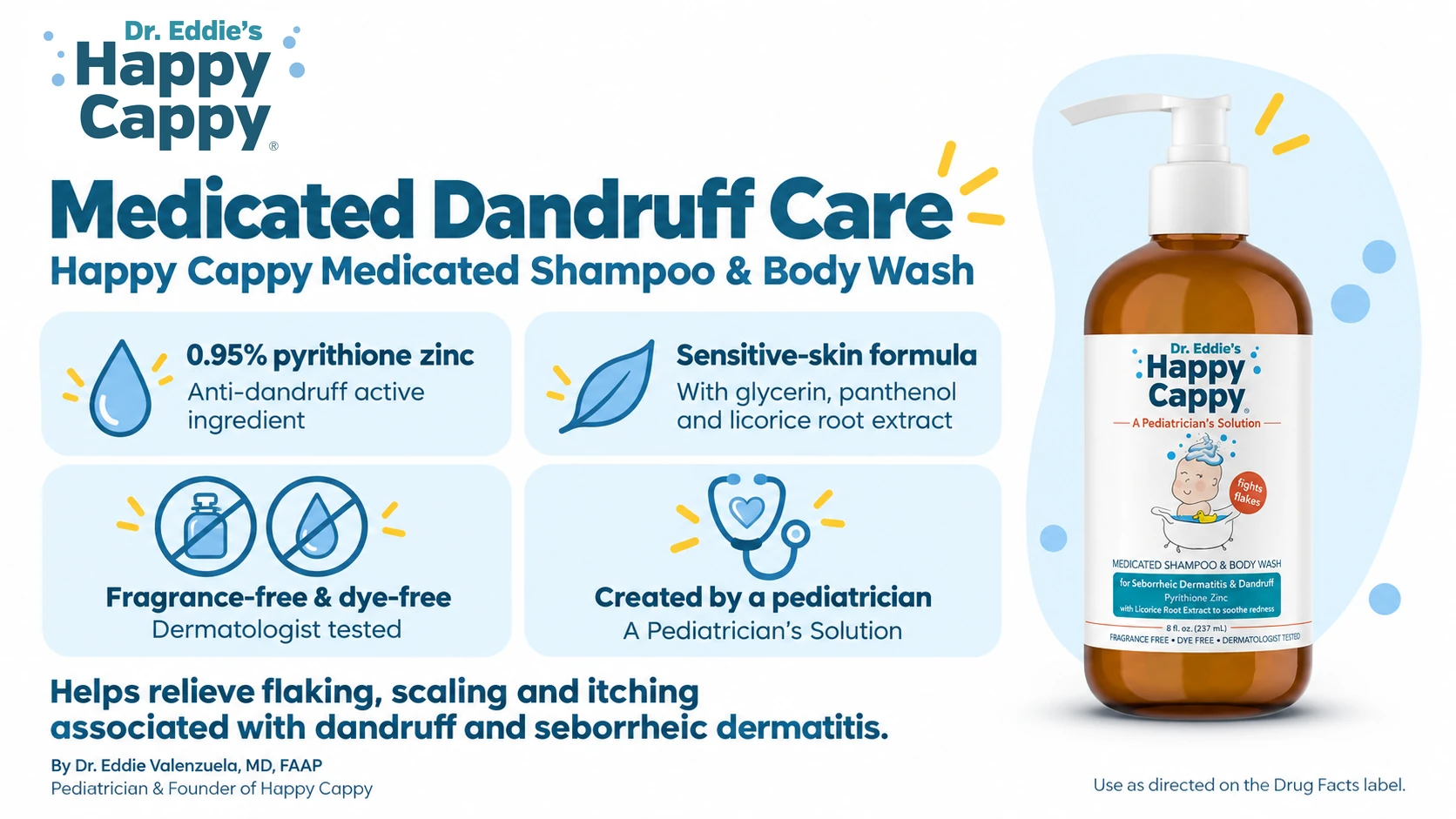
Follow the product's Drug Facts directions, including how to apply and rinse it. Shampoo frequency also depends on your hair type and scalp needs; the AAD's dandruff guidance explains why one schedule does not suit everyone. Our washing-frequency guide offers additional context.
2. Treat ordinary acne with acne-specific care
A gentle cleanser supports the routine. Acne may also need a medicine such as benzoyl peroxide or a topical retinoid like adapalene, chosen for your age, skin sensitivity and type of breakout. Follow the label or your clinician's directions. Retinoids should be avoided during pregnancy or when planning pregnancy.
Happy Cappy Daily Shampoo & Body Wash is the separate, non-medicated cleanser for dry, sensitive skin. Medicated Shampoo treats the listed dandruff and seborrheic dermatitis symptoms; it is not a substitute for an ordinary-acne treatment plan.
The AAD's acne treatment guide explains available options. Allow a consistent plan time to work, often at least six to eight weeks before fewer breakouts become apparent. Deep, painful or scarring acne deserves earlier medical care.
3. Check whether itchy bumps need a different treatment
If a clinician diagnoses Malassezia folliculitis, an antifungal treatment may help. The choice of medicine and formulation depends on the affected area and severity. A response to dandruff shampoo alone does not prove the diagnosis.
Daily Habits for a Flaky Scalp and Acne-Prone Skin
Gentle grooming can move loose flakes, but it does not treat the underlying scalp condition. Avoid scraping or vigorous brushing of irritated skin.
- Wash your face gently up to twice daily and after sweating. Use your fingertips and avoid scrubbing or picking.
- Keep oily hair and styling products from resting against your forehead.
- Choose products labeled non-comedogenic or oil-free when hairline breakouts are a concern.
- Wash product residue from pillowcases, hats and headbands.
- Use a moisturizer that suits your skin and a non-comedogenic broad-spectrum sunscreen.
- Change an irritating routine rather than adding several new active treatments at once.
The AAD discusses hair-product breakouts and gentle acne skin care. When a pore-clogging product is the cause, clearing can take four to six weeks after you stop using it.
Symptoms That Need Medical Advice
Seek prompt care for fever with a painful skin eruption, rapidly spreading redness or swelling, or a large tender area with pus. Arrange a visit for recurring scalp bumps, patchy hair loss, scarring, persistent facial scaling or acne that is not improving with a consistent routine.
For babies, use an age-appropriate assessment. Baby acne and cradle cap should not be managed by automatically applying an adult acne routine.