


Cover: AI-generated editorial illustration.
Quick answer: The hydrolipidic film is the mixture of water-based substances and oils on the skin’s surface. It works alongside the acid mantle and the stratum corneum, but those terms do not mean the same thing. Much of the barrier against water loss comes from cells and organized lipids within the stratum corneum. Gentle cleansing and a well-formulated moisturizer support this system without needing to “strip” or disinfect the skin.
On this page
The phrase “hydrolipidic protective barrier” sounds like one thin shield that sits on top of your skin. In reality, several connected features help skin stay comfortable and limit water loss. Understanding the differences makes skin-care claims easier to interpret and explains why adding moisture, sealing it in and avoiding irritation all matter.
The hydrolipidic film at the surface
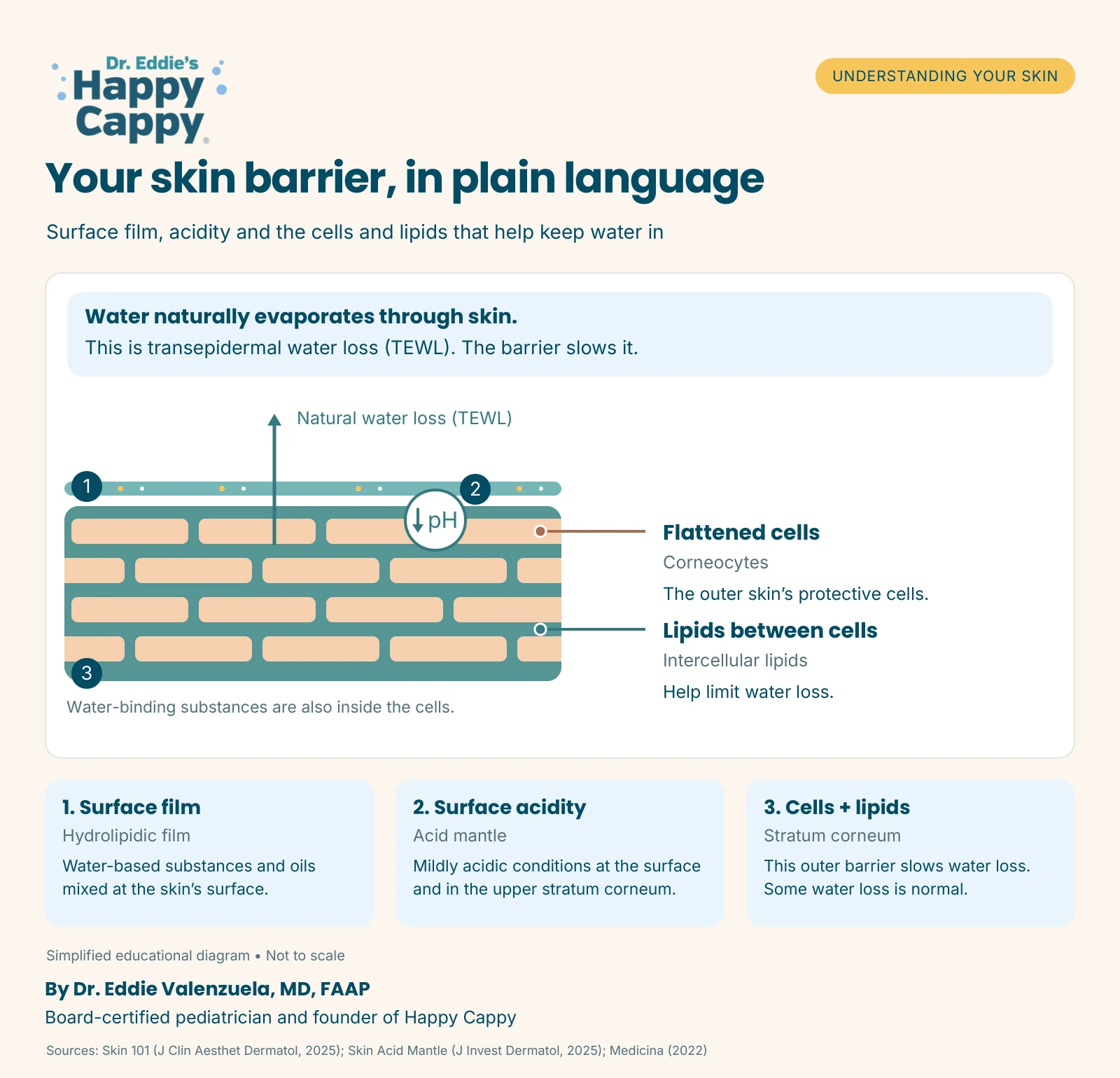
Hydro refers to water and lipid refers to fat or oil. The hydrolipidic film describes a surface mixture containing sweat-derived water and dissolved substances, sebum from oil glands, and material contributed by the epidermis. Its composition varies across the body. An oily forehead and a relatively dry shin do not have identical surface conditions.1
This film helps condition the surface, but it is not a separate anatomical layer equivalent to the epidermis. Nor is surface sebum the same thing as the specialized lipid layers between the outer skin cells. The distinction explains why oily skin can still feel tight or become irritated: visible oil does not tell you everything about hydration or barrier function.
Three related terms with different meanings
| Term | What it describes | Main point |
|---|---|---|
| Hydrolipidic film | The mixture of water-based substances and lipids at the surface | Surface oils are only one part of skin protection. |
| Acid mantle | The mildly acidic environment associated with the skin’s surface and upper stratum corneum | pH influences enzymes, microbial conditions and barrier organization. |
| Stratum corneum barrier | The outer epidermal cells and the organized lipids between them | This structure is central to limiting water loss and entry of outside substances. |
These features cooperate rather than acting as three independent shields. A cleanser, for example, can affect the surface environment and also interact with proteins and lipids in the outer skin. That is why evaluating a product requires more than checking whether it leaves the skin feeling oil-free.
The stratum corneum and its lipid structure
The stratum corneum is the outermost part of the epidermis. A useful simplified picture is a brick wall: flattened cells called corneocytes form the bricks, while lipids occupy the spaces between them. Ceramides, cholesterol and free fatty acids are major components of that intercellular lipid system. Their organization matters as well as their presence.2
Inside the cells, natural moisturizing factor is a mixture of water-binding substances that helps maintain hydration. The barrier therefore depends on both the spaces between cells and the contents within them. Applying oil to the surface does not reproduce every part of this arrangement.
The acid mantle and skin pH
Healthy skin commonly has a mildly acidic surface, although pH varies by body site, age, recent washing and measurement conditions. That environment supports processes involved in lipid handling, orderly cell shedding and microbial balance. Skin acidity comes from several biological processes; it is not simply sweat coating the surface.3
A product’s pH can be relevant, especially for cleansers, but lower is not automatically better. Concentration, the surfactant system, contact time and the rest of the formula also affect tolerance. There is no rule that every product must have a pH between 4 and 5. Applying lemon juice or vinegar is not a reliable way to restore the acid mantle and can irritate skin.
Moisture retention and transepidermal water loss
Water naturally moves through the skin and evaporates from its surface. This is called transepidermal water loss, or TEWL. A functioning barrier limits that loss; it does not stop it completely. When the barrier is disrupted, increased water loss can contribute to tightness, roughness and flaking.4
TEWL is a measurement, not something you can diagnose from one symptom or a home mirror check. Researchers use controlled conditions to assess it because temperature, humidity and body site affect the result. “My skin feels dry” is useful information, but it does not reveal a precise barrier measurement.
Skin hydration also differs from whole-body hydration. Drinking enough fluid supports health, but extra water does not replace the skin care needed for persistent dryness. For practical day-to-day care and the broader causes of dryness, see our dry skin guide.
Factors that disrupt barrier function
Repeated exposure to hot water, strong cleansing, friction and irritating products can leave skin struggling to retain moisture. Using several exfoliating acids, scrubs or retinoid products together may overwhelm tolerance, particularly when the skin is already inflamed. Cold, dry conditions can add to the problem.5
Barrier problems are not always caused by a skin-care mistake. Genetics and inflammatory conditions such as atopic dermatitis also play a role. In eczema, barrier disruption and inflammation can reinforce each other, so moisturizer may be only one part of the treatment plan. Repeatedly blaming a person for “washing away the barrier” oversimplifies the condition.
Ingredients should be judged in the context of their formulation and your individual sensitivities. Water is a chemical, preservatives help keep products safe, and “natural” does not mean nonirritating. Broad claims that all chemicals, preservatives or surfactants damage skin are not useful guides to choosing a product.
Skin changes and their limits
Dryness, flaking, tightness, stinging and increased sensitivity can accompany barrier disruption. Inflamed skin may look pink or red, or appear brown, purple or gray on darker skin. None of these findings is specific enough to establish “barrier damage” as the diagnosis.
A persistent rash might instead be contact dermatitis, eczema or another condition needing its own treatment. Oily skin, dark spots or an uneven texture alone do not prove that the barrier is damaged. If discomfort continues despite a simpler routine, an examination is more useful than adding another product labeled “repair.”
How moisturizers support the barrier
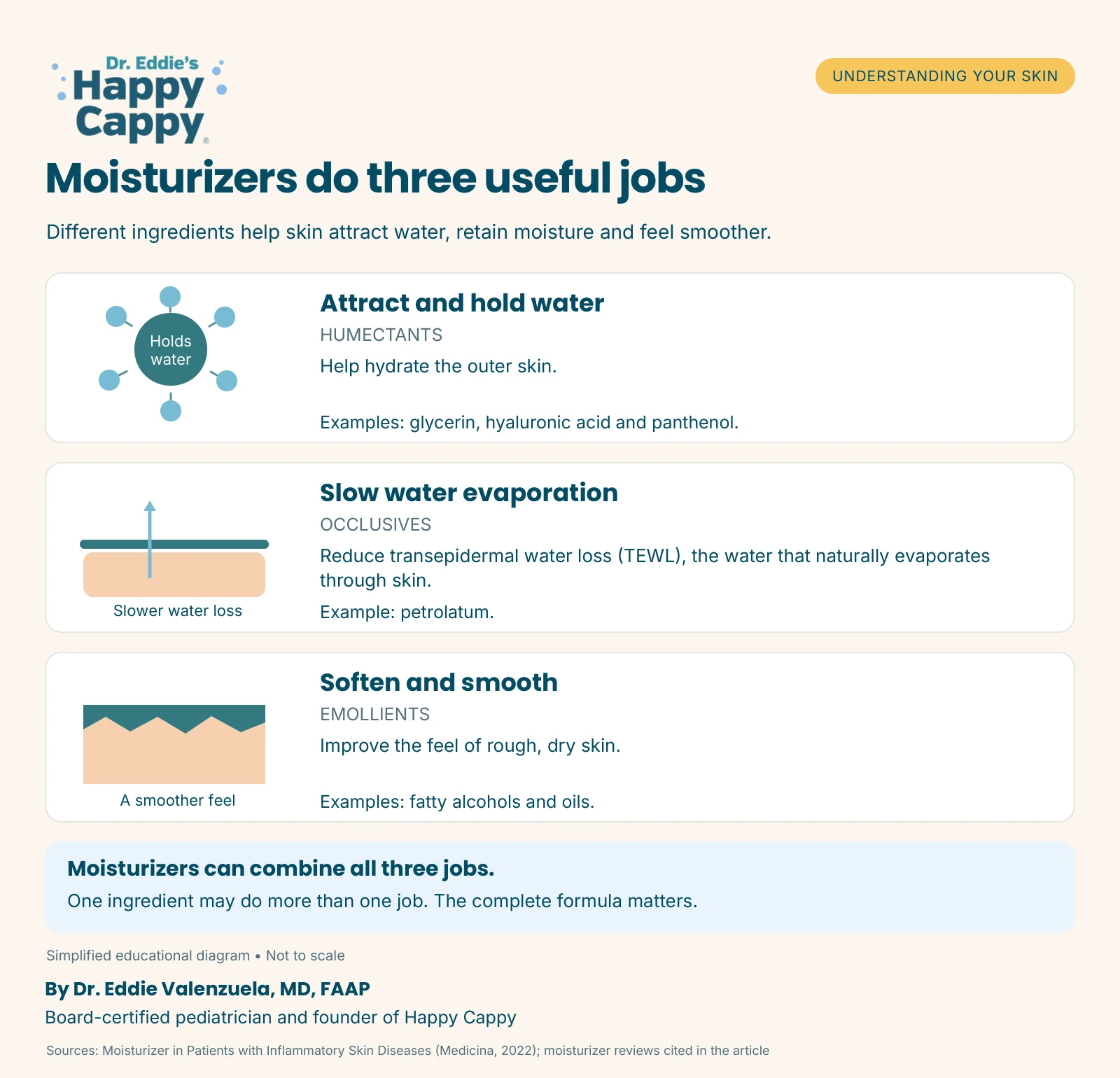
A moisturizer can combine ingredients with different jobs. Understanding those jobs helps explain why a balanced formula can be more useful than choosing a product around one fashionable ingredient.
Humectants attract and hold water
Glycerin, hyaluronic acid and panthenol are examples of humectants. They help increase hydration in the outer skin. Panthenol is also known as provitamin B5. An ingredient’s water-binding function does not, by itself, prove that every product containing it rebuilds the full barrier or treats an inflammatory skin disease.6
Occlusives reduce evaporation
Petrolatum is an occlusive ingredient. Its principal moisturizing role is to help slow water evaporation from the surface. It is not a humectant. Combining an occlusive with water-attracting ingredients gives a formula complementary ways to support hydration.7
Emollients and physiological lipids support skin feel and function
Emollients improve softness and smoothness. Some moisturizers also contain physiological lipids, such as ceramides, cholesterol or fatty acids. Ingredients can serve more than one function, and the performance of a finished formula depends on their amounts and combination. A ceramide on the ingredient list does not automatically make one moisturizer the best choice for every person.4
A gentle approach to daily care
Keep cleansing comfortable, rinse well, and moisturize after washing. If the skin is stinging or peeling, pause nonessential scrubs and exfoliants instead of trying to remove the roughness more aggressively. Cleansing removes soil and excess oil; the aim is not to sterilize normal skin or scrub away its resident microbes.
Use sun protection suitable for your age and circumstances, including shade, clothing and a broad-spectrum SPF 30 or higher sunscreen on exposed skin when appropriate. For ongoing eczema, follow the treatment plan as well as the moisturizing routine. There is no universal number of hours or days in which every “damaged barrier” will recover.
Supporting the skin barrier with Happy Cappy
Happy Cappy Daily Shampoo & Body Wash provides the cleansing step in a skin barrier routine for dry, sensitive, eczema-prone skin. It is a fragrance-free, non-soap cleanser for the hair, face and body, formulated at an acidic pH consistent with the skin’s naturally acidic surface. The formula also includes water-attracting ingredients such as glycerin and panthenol. These features fit the goal of gentle cleansing while keeping sensitive skin comfortable.
After washing, Happy Cappy Moisturizing Cream helps the skin hold on to moisture. Glycerin attracts water to the outer skin, petrolatum slows evaporation, and emollients help soften and smooth dry, rough areas. That combination brings together the three moisturizer functions explained above. The fragrance-free cream absorbs quickly without a greasy finish, making it practical for regular use on the face and body.
To use them together, wash with lukewarm water, rinse well and gently pat dry. Apply the cream while the skin is still slightly damp, then use it at least twice daily and reapply when needed. The wash rinses away; the cream stays on to help reduce moisture loss between washes.
Persistent symptoms deserve a diagnosis
Seek advice for ongoing burning, recurrent rash, painful cracks or itch that interferes with sleep. Spreading warmth, increasing tenderness, pus or fever needs prompt assessment. These findings call for identifying the underlying problem rather than assuming a stronger moisturizer will solve it.
The hydrolipidic film is one useful part of the explanation, but the skin barrier is a working system of cells, lipids, water-binding substances and chemical conditions. Good care supports that system while leaving room to treat any inflammation or disease affecting it.