Quick answer: Coconut oil may help some people with scalp comfort, but evidence for treating dandruff remains limited. Human studies have reported encouraging findings. Neither a cure claim nor a blanket warning that coconut oil always worsens dandruff is justified.1,9
It is easy to find confident advice on both sides: coconut oil “kills the fungus” or coconut oil “feeds the fungus.” A useful answer needs to separate laboratory findings, actual scalp research, and what happens on your own skin.
Human studies of coconut oil for dandruff
A 2021 study enrolled 140 Indian women with and without dandruff; 131 continued after baseline. For 12 weeks, groups used coconut oil followed by a bland shampoo or the shampoo alone. The oil was applied twice weekly and washed out after two hours.1
Researchers reported changes in the scalp microbiome, along with reductions in dandruff scores and water loss after the oil-treatment phase. That is a reason to take possible benefits seriously.1
The limit: This was mainly a microbiome study, not a comparison with medicated dandruff shampoo. It involved adult women, received L’Oréal funding, and cannot establish that oil cures dandruff, outperforms medicine, or works equally well for everyone.1
A newer trial adds useful context
A 2024 trial assigned 110 people to a commercial herbal oil or coconut oil, both used with a neutral shampoo. Dandruff scores improved in the coconut-oil group, although the herbal-oil group improved more. Because there was no shampoo-only group, the coconut-oil results cannot separate the oil's contribution from regular shampooing and study care. The trial had industry involvement and did not compare coconut oil with a medicated dandruff shampoo.9
The limits of fatty-acid arguments
Coconut oil contains a mixture of fats, with lauric acid a major component. Its fatty acids do not all have the same chain length, and an intact oil is not the same substance as an isolated fatty acid.
Older laboratory research found that certain fatty acids supported the growth of a cultured Malassezia-related yeast. That experiment studied an organism in a growth medium, not coconut oil applied to people with dandruff. Counting carbon atoms is therefore not enough to predict a person's clinical response.2
The reverse claim also needs care. Antifungal activity against Candida in a laboratory does not prove that coconut oil treats Malassezia-associated dandruff on a human scalp.3
Our interpretation: Formulation, exposure, skin tolerance, and actual symptom outcomes matter. “Contains lauric acid” is not a reliable shortcut to “good for dandruff” or “bad for dandruff.”
Moisturizing dry skin is different from treating dandruff
A small randomized study in people with dry skin found that coconut oil and mineral oil both improved skin hydration. It was a dry-skin study, not a dandruff-treatment trial.4
That distinction matters. An oil may make skin or hair feel softer without controlling a recurring scalp condition. Dandruff lies on the seborrheic dermatitis spectrum and involves more than a simple lack of moisture.5 Our dandruff vs. dry scalp guide explains the differences.
Possible moisturizing benefits
Moisturizing support and softer-feeling hair or skin. Whether that is comfortable on your scalp is an individual question.
Limits of a moisturizing effect
A diagnosis, a guaranteed antifungal effect, or a reason to replace an effective treatment for persistent dandruff.
Scalp irritation and tolerance
The studies used specific oil-and-shampoo schedules; they do not establish an optimal home regimen or show that leaving coconut oil on overnight works better. Longer exposure should not be assumed to improve results, especially when the scalp starts to itch or feel irritated.1,9
Some people find oil uncomfortable or notice more itching after using a product. If that happens, stop using it and gently wash it out. A reaction is a reason to reassess the product, not proof that a particular yeast has multiplied.
Avoid applying a new oil to an already sore, broken, or weeping scalp. Do not use coconut oil if you have a known allergy to it. A product that also contains fragrance or essential oils may introduce additional irritants or allergens.6
If you already use coconut oil and tolerate it, judge it by your symptoms rather than by a “fungal-safe” ingredient list. Keep your established treatment plan, and tell your clinician about any new products if the rash changes.
Adult scalp findings should not be extrapolated to babies. For that separate question, see coconut oil for cradle cap and the different guidance on olive oil for cradle cap. Our cradle cap guide explains the wider care routine.
Established options for recurring dandruff
Common dandruff-shampoo actives include pyrithione zinc, selenium sulfide, ketoconazole, salicylic acid, sulfur, and coal tar. Choose a formula suited to your scalp and follow that product’s directions.7
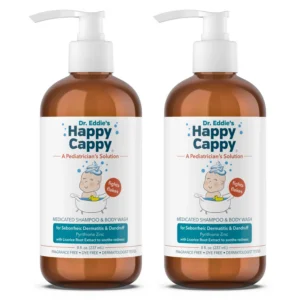
Happy Cappy Medicated Shampoo & Body Wash contains 0.95% pyrithione zinc to help control flaking, scaling, redness, itching and irritation associated with dandruff and seborrheic dermatitis. Its fragrance-free, dye-free formula is designed for sensitive skin. It offers a way to skip the oily mess while using a labeled dandruff treatment.8
How to use: Wet hair thoroughly. Massage into the scalp and affected skin, then rinse well. Use at least twice weekly. Avoid the eyes and rinse with water if contact occurs. Stop use and ask a doctor if symptoms worsen or do not improve. Ask a doctor before treating a large area of the body.8
Seek an assessment sooner for painful inflammation, oozing, patchy hair loss, or an uncertain diagnosis. Adding more oil is unlikely to answer what is causing those changes.5