

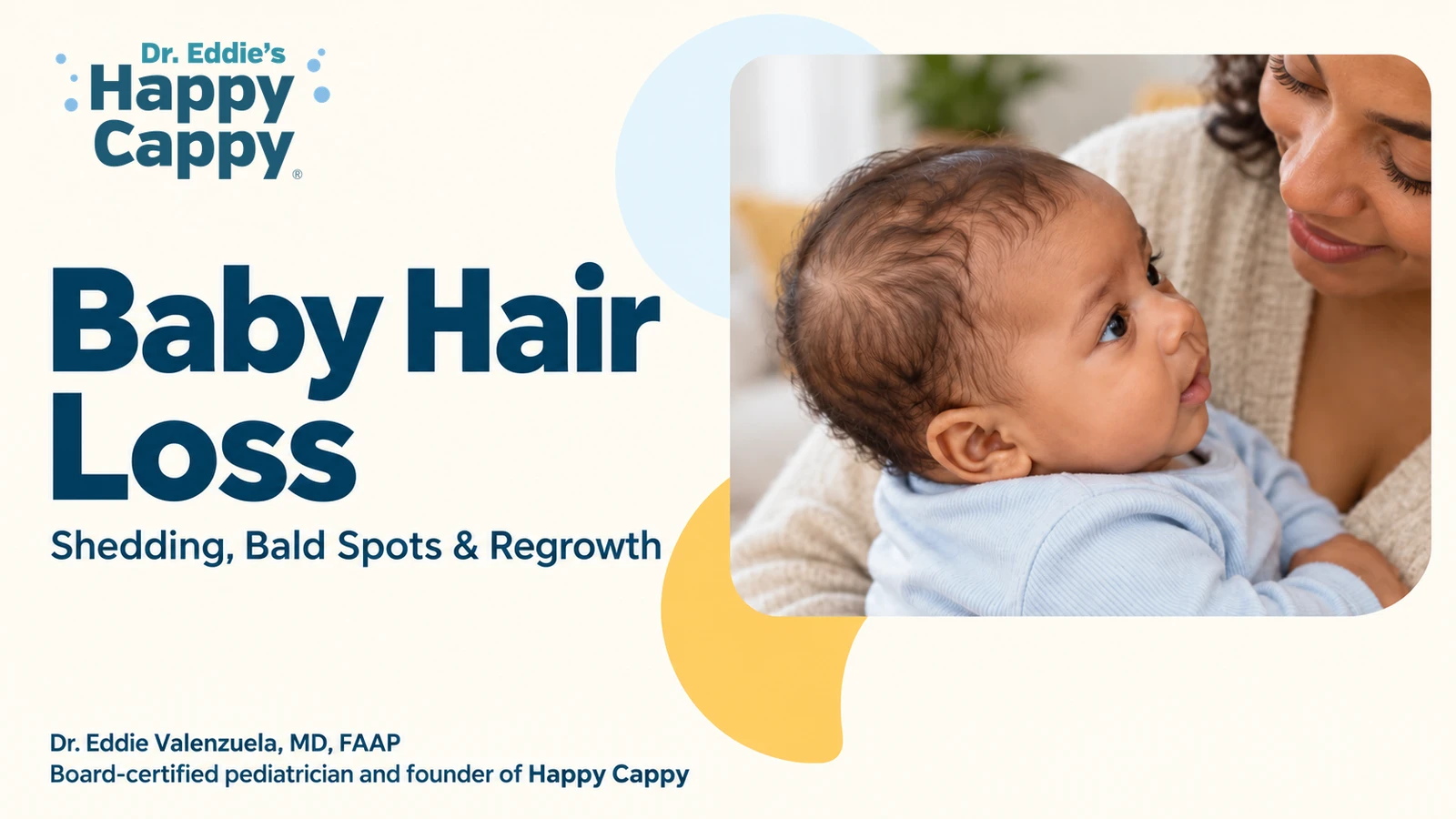
Quick answer: Many babies shed some or most of their newborn scalp hair during the first six months, often most noticeably around three months. Replacement hair commonly appears during the first year. A thin area at the back can reflect normal hair cycling, with rubbing sometimes contributing. Keep safe-sleep practices unchanged, and have unusual patches, broken hairs or an inflamed scalp examined.1,2,3
Baby hair loss can be surprisingly noticeable. A newborn who arrived with thick curls may have much finer hair a few months later, while another baby seems to keep the same sparse covering for months. Often, the difference reflects the timing of shedding and regrowth rather than a problem with the scalp.
The most useful clues are your baby's age, the pattern of thinning and how the skin looks and feels. This guide explains those clues, the usual course of regrowth and the changes that deserve a closer look.
Normal newborn shedding and regrowth
Hair follicles cycle through growth and resting phases. During early infancy, groups of hairs can shed over a similar period before replacement hairs become obvious. Sometimes shedding and regrowth overlap so smoothly that parents hardly notice. In other babies, a temporary thin or nearly bald stage is much more apparent.1,3
This ordinary shedding does not mean you used the wrong baby shampoo. A wash may simply release hairs that were already ready to fall. Irritating products or rough handling can cause separate problems, but a gentle wash does not stop the normal hair cycle or cause permanent baldness.2
The first-year timeline
Shedding can start in the first weeks or months and is common during the first six months. It often peaks around three months. New hair commonly becomes more noticeable between six and twelve months, although babies do not all follow the same timetable.2
Replacement hair may differ in color, texture or curl from the hair present at birth. That is another reason the change can look dramatic in family photographs. Lanugo, the fine body hair some newborns still have, is a separate feature from the scalp hair parents usually mean when they ask about baby hair loss.4
Bald spots and thinning at the back of the head
A thin area across the back of the head is common in young infants. Rubbing against a surface can contribute, but it should not be assumed to explain every patch. Research on neonatal occipital alopecia, the term for this temporary back-of-head thinning, also supports a normal developmental shedding process. One retrospective study found no association with sleeping position.3
That finding helps put the bald spot in perspective: it is not proof that you have positioned your baby incorrectly. Look beyond the amount of hair. Comfortable skin without sores or broken stubble is more reassuring than a patch that is enlarging, inflamed or scaly. A clearly defined patch with an uncertain cause is worth showing your pediatrician, even if the baby seems comfortable.
Safe sleep stays the same
Place your baby on their back for every sleep on a firm, flat, noninclined sleep surface with a fitted sheet. Do not use a pillow, head-shaping cushion, loose bedding or a positioner to protect the hair, and do not switch to side or stomach sleeping because of a bald spot. Hair regrowth is never a reason to change safe-sleep care.5
While your baby is awake, supervised tummy time and being held in varied positions provide opportunities to move and develop strength. Tummy time is an awake activity with an adult watching. If your baby strongly favors one head position or has difficulty turning, bring that up at a checkup so the movement itself can be assessed.
Patterns that need a different explanation
Age-related shedding is common, but not every patch of hair loss belongs in that category. The surrounding skin and the condition of the remaining hairs help determine the next step. These descriptions are clues for an examination, not a way to diagnose from a photograph.
Hair coming away with cradle-cap scale
Cradle cap causes adherent whitish or yellowish scalp scale. Some hairs may come away as the scales loosen. In uncomplicated cradle cap, those hairs regrow; attached scale should not be picked or pulled off. Scraping to expose a “clean” scalp can injure the skin and break hairs.6
Normal infant shedding and cradle cap can also happen at the same time. Care for the scale gently, while allowing the hair cycle to proceed. Marked pain, swelling, oozing or an extensive area of hair loss needs assessment rather than more vigorous scale removal.
Scaly patches with broken hairs
Scalp ringworm, or tinea capitis, is a fungal infection. It can cause scale and patchy loss with short broken hairs; some infections become tender and swollen. It requires a clinician's diagnosis and generally prescription antifungal medicine taken by mouth. A baby shampoo, dandruff shampoo or skin cream alone is not adequate treatment.1,7
Smooth patches and hair pulled under tension
Alopecia areata can produce smooth, round or oval bald patches through an immune reaction affecting the follicles. It is less typical of early infancy than normal shedding, so an unexplained smooth patch should be examined instead of automatically being attributed to rubbing.1
Tight ponytails, braids or repeated pulling can damage hairs and cause traction alopecia. Choose loose styles and gentle detangling. If a style pulls on the skin, leaves bumps or is followed by broken hairs along the edges, loosen or stop it. Persistent tension can eventually damage follicles, so it is better to respond early.8
Gentle care while hair grows back
Normal newborn shedding does not need a hair-growth treatment. The practical goal is to keep the scalp comfortable while avoiding unnecessary rubbing and pulling. Use lukewarm water, a small amount of a gentle baby cleanser when needed and thorough rinsing. Pat dry with a soft towel. A soft brush or wide-tooth comb can help with tangles, but repeated brushing is not a way to stimulate growth.
Babies usually do not need a full daily bath for ordinary hygiene. Washing needs change with spills, sweat and scalp conditions, so let the actual need guide routine cleansing rather than washing repeatedly to remove every loose hair.9 If greasy scale is present, follow the separate cradle-cap care guidance.
Happy Cappy Daily Shampoo & Body Wash can provide fragrance-free, non-soap cleansing for sensitive skin and the scalp. Its role here is gentle washing. Oils, adult hair-growth medicines and supplements are not treatments for ordinary newborn shedding, and this cleanser does not promise faster regrowth. For cradle cap, the cradle-cap guide explains the separate role of medicated cleansing and a gentle brush.
A photograph taken occasionally in similar lighting can help you notice gradual change without checking every shed strand. Look for fine new hairs and a comfortable scalp, rather than expecting a full head of hair to return all at once.
Changes to discuss with your pediatrician
Bring up an unexplained bald patch, increasing thinning, broken hairs, persistent scale or itching. Contact your clinician promptly if the area is painful, very swollen, oozing or rapidly worsening, or your baby seems unwell. These features deserve attention regardless of how old the baby is.
Also discuss hair that is not showing regrowth over the following months or has not returned by around the first birthday. The timing of the original loss, growth elsewhere, general development and scalp examination help put that concern in context. There is no need to wait for a particular birthday if the pattern is unusual.2
For a thriving baby with typical early shedding and comfortable skin, time and gentle care are usually enough. Keeping the sleep environment safe and recognizing a change in the scalp matter much more than finding a product to make the hair grow faster.
References
- American Academy of Pediatrics. Hair loss (alopecia) in children.
- HealthyChildren.org. Hair loss symptom guidance.
- Kim MS, et al. Prevalence and factors associated with neonatal occipital alopecia: A retrospective study. Annals of Dermatology. 2011;23:288–292.
- American Academy of Pediatrics. How your newborn looks.
- American Academy of Pediatrics. Back to sleep, tummy to play.
- NHS. Cradle cap.
- CDC. Treatment of ringworm.
- American Academy of Dermatology. Hairstyles that pull can lead to hair loss.
- American Academy of Pediatrics. Bathing your baby.