

Quick Answer
In babies, cradle cap usually causes greasy scalp scales with little or no itching. Atopic eczema more often causes dry, itchy, inflamed patches. Both can affect the scalp, and appearance alone may not settle the diagnosis. Persistent itching or an uncomfortable baby deserves a closer look.1, 2
This guide is for parents of babies and young children. For your own scalp, facial, or body rash, see Seborrheic Dermatitis vs Eczema in Adults.
Cradle cap or eczema: clues parents can compare
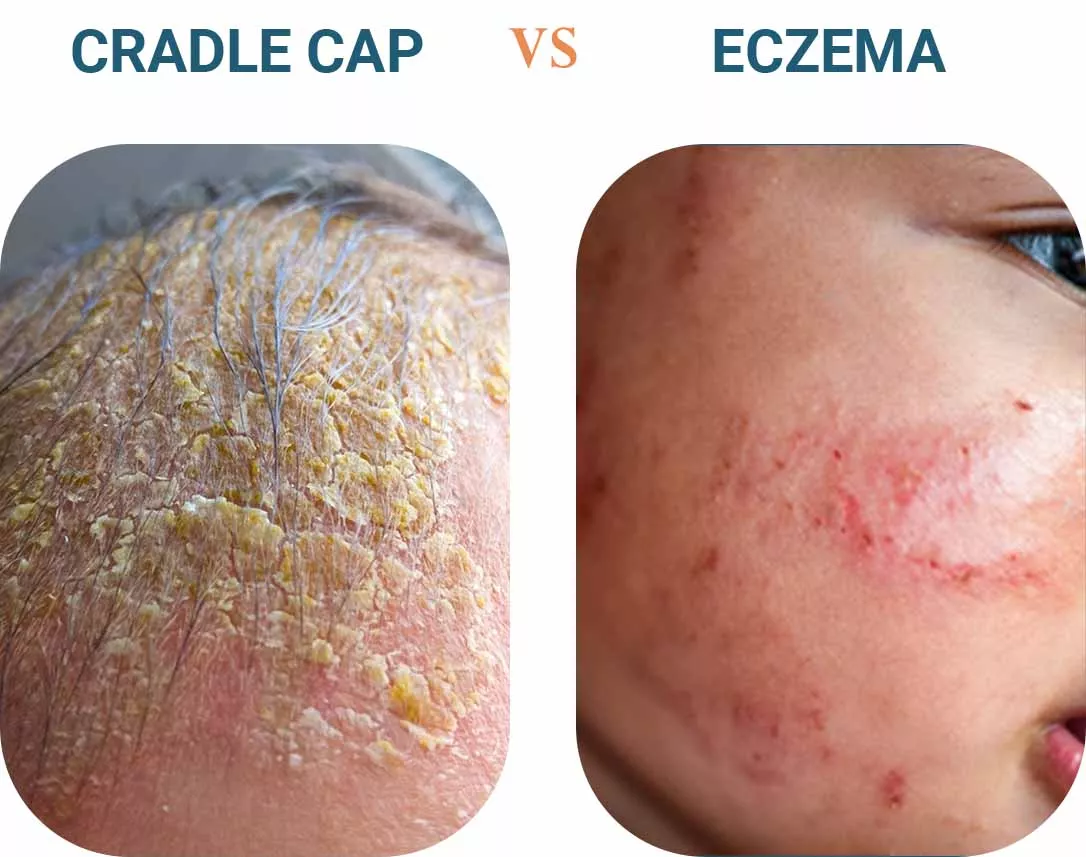
| What you notice | Cradle cap | Atopic eczema |
|---|---|---|
| Skin appearance | Greasy white or yellowish scale, sometimes forming thicker crusts | Dry, rough, inflamed patches that may crack or ooze during a flare |
| Comfort | Usually does not bother the baby | Itch may cause rubbing, scratching, fussiness, or disturbed sleep |
| Common locations | Scalp and eyebrows; seborrheic dermatitis can also involve skin folds or the diaper area | Cheeks, scalp, and outer arms or legs in babies; elbow and knee creases become more typical as children get older |
| Course | Often improves over the first year, although some cases last longer | Can improve and flare again, requiring an ongoing care plan |
These are clues, not a diagnostic checklist. Skin inflammation may look pink or red on lighter skin and purple, darker, or lighter than surrounding skin on darker skin tones. Look at texture, location, and your child’s comfort as well as color.1, 2, 3
Cradle cap and atopic eczema are different conditions
Cradle cap is the common name for seborrheic dermatitis on a baby’s scalp. Atopic dermatitis is the condition most parents mean by “eczema.” Although seborrheic dermatitis also belongs to the broader eczema family, this comparison uses eczema to mean atopic dermatitis.4
Neither diagnosis means you have failed to keep your baby clean. The causes are complex. Cradle cap is associated with activity in the skin’s oil glands and yeast normally present on skin. Atopic eczema involves the skin barrier and immune system, with inherited susceptibility playing a role.3, 4
When the pattern is unclear
A baby can have both cradle cap and atopic eczema, and eczema can affect the scalp. One does not automatically turn into the other. A clinician can use the history and examination to decide whether different areas need different care. Note itching, sleep disruption, new products, and when each rash appeared.2,5
Do not assume every flaky scalp is cradle cap. Marked itching, spreading dry patches, broken skin, or an unusual course may suggest eczema or another problem. A young child with persistent scalp scaling may need the diagnosis checked, especially if there is patchy hair loss.2, 5
Gentle care when it looks like cradle cap
- Wash gently with a suitable baby shampoo. Ask your clinician about frequency if your baby also has eczema.
- Use a soft brush to loosen scales that lift easily. Avoid picking, scraping, or scrubbing until every flake is gone.
- If gentle washing is not enough, a medicated wash formulated for cradle-cap care can help control persistent flakes. A very inflamed or uncomfortable scalp needs assessment.
For more detailed scalp-care guidance, visit the Happy Cappy Cradle Cap Guide.5, 6
Care when itchy eczema is the concern
Use gentle, fragrance-free cleansing and regularly apply a fragrance-free moisturizing cream or ointment, especially after bathing. An inflamed flare may also need a prescribed topical medicine. Ask which product, strength, amount, and duration are appropriate for your child’s age and the body area.3
Our baby eczema treatment and daily-care guide develops this routine. Moisturizer supports the skin barrier, but persistent itching or poor sleep should prompt review of the treatment plan. Avoid trying multiple new products at once, which can make it harder to identify what helps or irritates.
Signs that need your child’s clinician
- The rash is worsening, widespread, or not improving with the recommended care.
- Your baby seems itchy or uncomfortable, or sleep is repeatedly disrupted.
- Skin becomes swollen, painful, unusually warm, or leaks fluid or pus.
- There are rapidly spreading painful blisters or sores, fever, or your child seems unwell. Seek urgent assessment for these symptoms.
Cradle cap usually does not cause significant discomfort. Bleeding, swelling, or discharge should not be dismissed as ordinary scalp flakes.1, 3
Choosing products for scalp scale or eczema-prone dry skin
Cradle-cap flakes: medicated wash and gentle scalp brushing
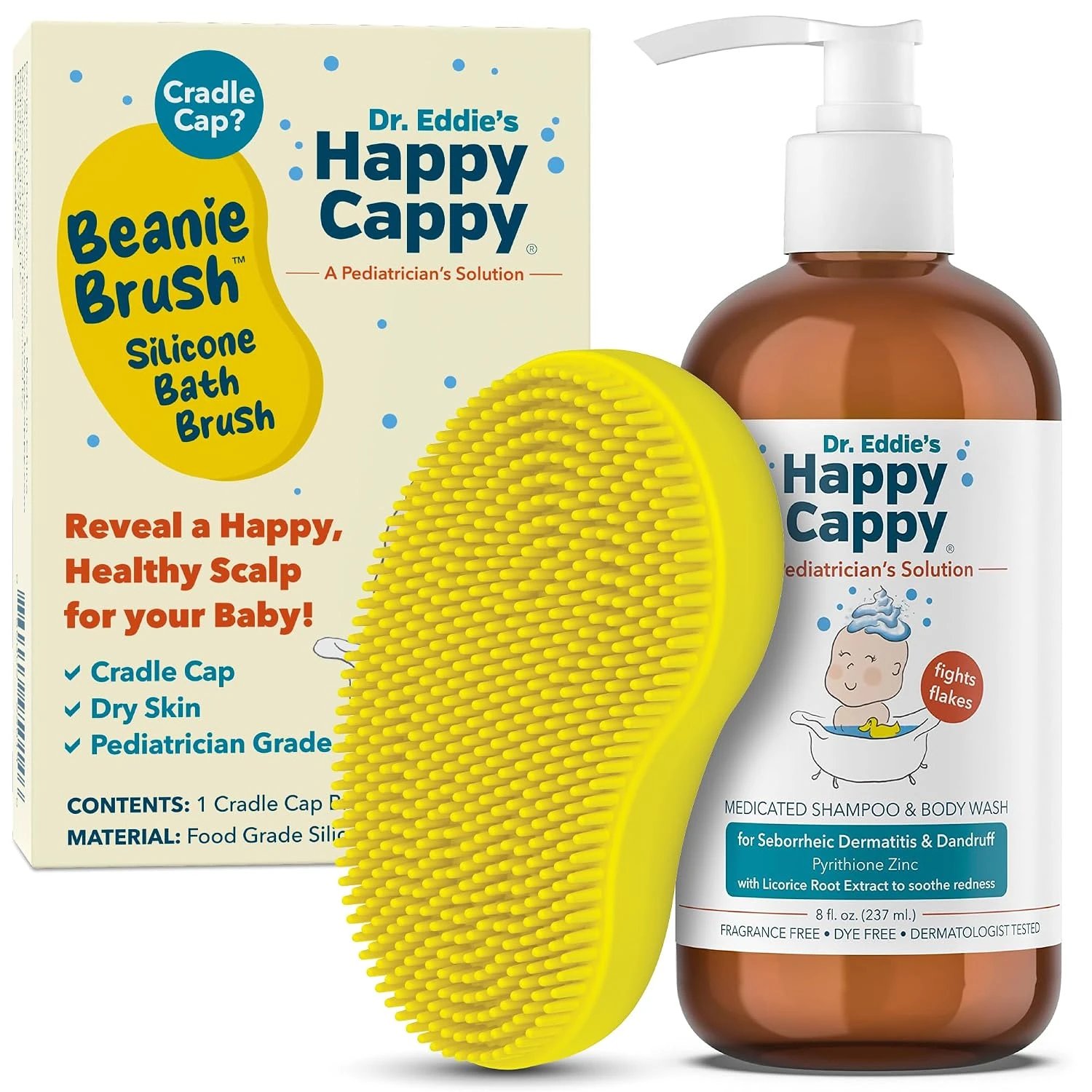
The Happy Cappy Medicated Shampoo + Beanie Brush Bundle pairs an 8 oz medicated wash with a soft silicone scalp brush.
The wash contains 0.95% pyrithione zinc to help relieve flaking, scaling, redness, and itching associated with seborrheic dermatitis and dandruff. Its fragrance-free, dye-free formula is designed for sensitive skin.7
Use the brush with a light touch during washing to move flakes that release easily; leave attached scales alone.
Use the wash as directed and keep it out of the eyes. Our cradle-cap guide explains the full care sequence.7
Eczema-prone dry skin: gentle cleansing and moisture
Happy Cappy Daily Shampoo & Body Wash provides fragrance-free cleansing for dry, sensitive, eczema-prone skin. Its glycerin and panthenol help support hydration and softness. Use daily or as often as needed.
Happy Cappy Moisturizing Cream helps reduce moisture loss with its petrolatum-based formula; glycerin attracts and holds moisture. Apply after bathing and again as needed. It is fast absorbing and non-greasy. These products can complement an eczema treatment plan; Medicated Shampoo is for seborrheic dermatitis and dandruff symptoms.