

Part of the Eczema Resource Center.
Quick Answer
An eczema moisturizer should be fragrance-free, control dryness and feel comfortable enough to use consistently. Creams and ointments are useful starting points for dry patches; a tolerated lotion can suit milder dryness or a preference for a lighter texture.
The role of moisturizer in eczema care
In atopic dermatitis, the skin barrier does not hold water as effectively and is more vulnerable to irritation. Dryness and scratching can feed each other. Regular moisturizing helps skin feel more comfortable and supports that barrier, including between flares. Our eczema guide explains the condition in more detail.
Lotion, cream and ointment textures
These names describe the product’s texture and formulation, not whether it contains medicine. Oil and water proportions vary between products, so the label alone does not tell you how well a particular formula will work.
| Type | Typical feel | When it may suit you |
|---|---|---|
| Lotion | Light, fluid and easy to spread | Milder dryness, hairy areas or a preference for a lighter feel; may need more frequent application. |
| Cream | Thicker than lotion, usually less greasy than ointment | Everyday face and body moisturizing when you want a balance of moisture retention and comfort. |
| Ointment | Greasy and usually the most occlusive | Very dry areas or bedtime use when a heavier protective layer is acceptable. |
Plain petroleum jelly is a moisturizing ointment available without a prescription. Prescription steroid ointments are different products with specific treatment directions. The NHS guide to emollients1 explains the main formats and when they are used. Ask for advice before putting a heavy ointment over weeping or possibly infected skin.
Choosing a texture the skin tolerates
For dry eczema-prone skin, the American Academy of Dermatology recommends a fragrance-free cream or ointment2. These thicker options are useful starting points when a light lotion leaves skin feeling tight soon after application.
That does not mean every lotion fails or every ointment works best. A randomized trial involving 550 children with eczema3 found no significant difference in eczema severity between lotion, cream, gel and ointment groups over 16 weeks. The study supports offering families a choice; it did not establish that every individual product is interchangeable.
Choose a texture you can use comfortably and afford to reapply. Some people prefer cream during the day and ointment on very dry areas at night. If a product repeatedly stings or the skin stays uncomfortable, review the formula and the eczema treatment plan instead of assuming that more expensive means better.
Baby lotions and formula selection
“Baby lotion” describes the intended market, not a guarantee of a suitable formula. Check the actual ingredients and choose fragrance-free. A thick cream may be more useful when a baby’s skin is persistently dry, while a tolerated lotion may be enough for milder dryness.
A familiar baby scent can be appealing to adults without helping sensitive skin. “Unscented” can still mean that masking fragrance is present. Start a new product on a small area of unaffected skin before wider use. A persistent or unusual rash deserves assessment rather than repeated product changes; see our baby eczema guide.
Applying moisturizer consistently
Make moisturizing a routine that is easy to repeat:
- Take a short, lukewarm bath or shower. Use a gentle, fragrance-free cleanser where needed and avoid scrubbing.
- Pat gently with a towel, leaving the skin slightly damp.
- Smooth moisturizer over the dry areas without vigorous rubbing.
- Apply at least twice daily and again after washing or whenever the skin feels dry, following the product directions and your clinician’s plan.
You do not need another bath before each application. Keep a tube or pump where the routine happens, such as beside the bed or sink. Our moisturizing-frequency guide covers this in more detail.
Moisturizer alongside prescribed medicine
Use prescribed eczema medicine according to its own directions. Ask your clinician about the order and spacing of medicine and moisturizer; do not mix the two together unless instructed. Moisturizer does not replace treatment for an active flare.
Moisturizer beneath makeup
A fragrance-free cream that absorbs comfortably can be used beneath makeup on intact skin. Allow it to settle first. Pause makeup on actively inflamed, cracked or weeping skin, and stop products that repeatedly worsen a facial rash. A greasy ointment may be less practical beneath makeup.
Moisturizing ingredients and their roles
A useful moisturizer often combines ingredients with different jobs. DermNet’s moisturizer overview4 explains these categories:
Humectants that attract water
Humectants attract and bind water in the outer layer of skin, helping it feel softer and less tight. Useful options include glycerin, hyaluronic acid (or its salt, sodium hyaluronate), panthenol, sodium PCA, sorbitol, urea and sodium lactate. Panthenol is also called provitamin B5 and helps condition the skin.
Urea, PCA and lactate are components of the skin’s natural moisturizing factor, the mixture of substances that helps hold water within its outermost layer. Urea and lactate-containing products can sting on inflamed, cracked or scratched skin, and higher-strength exfoliating formulas are not a default choice for babies. Humectants work well alongside emollients and occlusives that soften the skin and slow water loss. The combination and concentration matter more than a single ingredient name.
Emollients that soften skin
Emollients smooth and soften rough skin. Examples include fatty alcohols, shea butter, plant-derived squalane and fatty acid esters such as glyceryl stearate. Cetyl alcohol and stearyl alcohol are fatty alcohols used in moisturizing formulas; they are different from the drying alcohol people often think of in hand sanitizer. Newer emollients can give a cream a light, silky feel, but texture alone does not establish how well it will control dryness.
Occlusives that reduce water loss
Petrolatum, mineral oil and dimethicone form a protective layer that slows water loss. Dimethicone is not automatically unsuitable for eczema-prone skin. The amount and combination of ingredients influence whether a cream feels silky, rich or greasy.
Ceramides and petroleum-free formulas
Ceramides are lipids naturally present in the skin barrier, where they work with cholesterol and fatty acids to help limit moisture loss. They are useful barrier-supporting ingredients, not humectants. Plant-derived squalane, shea butter and other modern emollients offer additional formulation options. A petroleum-free label, a premium ingredient or a higher price does not by itself guarantee better relief from dryness. A ceramide-containing cream may also contain petrolatum.
Research compares complete formulas. A 2023 trial in children with eczema5 found similar improvements with a ceramide-based moisturizer and a paraffin-based moisturizer, although it did not establish that the treatments were equivalent. A 2025 trial of a ceramide-plus-postbiotic moisturizer6 reported a longer time before relapse than a paraffin-based moisturizer after initial eczema treatment. That result applies to the tested combination and cannot be attributed to ceramides alone.
Ceramides can be a worthwhile option. A simpler, well-formulated moisturizer can also work well. Choose according to how the finished product controls dryness, feels on the skin and fits a routine you can maintain.
Licorice-derived and other added ingredients
Licorice-derived ingredients such as dipotassium glycyrrhizate can be included to help soothe the appearance of redness. Different licorice derivatives are not interchangeable names for a single chemical. Choose the complete product for its moisturizing performance and tolerability; a botanical ingredient does not make it a substitute for eczema medication.
Ingredients and product claims to review
- Fragrance and essential oils: prioritize fragrance-free products, especially if scented products have triggered symptoms before.
- Known allergens: avoid ingredients you have reacted to or that your clinician has identified. Lanolin and individual preservatives can cause contact allergy in some people.
- Exfoliating or anti-aging actives: strong acids and retinoids can be uncomfortable on inflamed or scratched skin. Urea can also sting, although it is a useful moisturizing ingredient for some people.
Preservatives and contact allergy
Preservatives protect water-containing products against contamination. “Paraben-free” does not mean preservative-free, and eczema does not automatically mean a person is allergic to every preservative. The FDA explains why parabens and other preservatives are used7. Repeated reactions may warrant a dermatologist’s assessment and, when appropriate, patch testing.
Limits of marketing labels
Likewise, “natural,” “hypoallergenic” or a long free-from list cannot guarantee that an individual will tolerate a product. The FDA’s explanation of hypoallergenic labeling8 is helpful here. Focus on a fragrance-free formula, your own allergy history and how your skin responds.
Product pH and skin tolerance
The skin surface is naturally mildly acidic, and its pH can rise in atopic dermatitis. Product pH is one part of formulation, but a lower number is not always better and an acidic product can still irritate. A claim of “pH balanced” does not establish that a cream treats eczema.
Citric acid may be present in a small amount to adjust a formula’s pH; that is different from choosing a strong exfoliating acid treatment. For the background science, see our guide to acidification in atopic dermatitis. Do not try to acidify a moisturizer yourself.
Happy Cappy Moisturizing Cream in daily care
Happy Cappy Moisturizing Cream is a fragrance-free cream for dry, sensitive, eczema-prone skin in babies, children and adults. It is a practical choice when you want leave-on moisture in a lightweight, fast-absorbing texture.
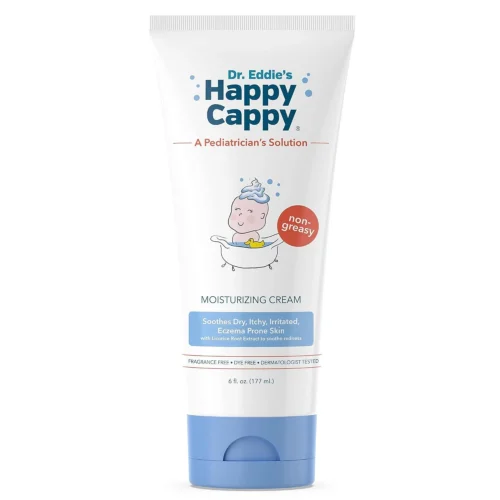
- Attract and retain moisture. Glycerin attracts water, while petrolatum helps reduce moisture loss.
- Soften dry skin. Emollients help keep skin smooth without a greasy feel.
- Soothe the look of redness. Licorice-derived dipotassium glycyrrhizate adds soothing care.
Use it consistently: Apply after washing and at least twice daily, following your skin-care plan.
Pair the Cream with one Daily Wash:
Shop Daily + 6 oz TubeShop Daily + 12 oz JarFor the cleansing step, Happy Cappy Daily Shampoo & Body Wash provides a gentle, fragrance-free wash. Rinse it off before applying the leave-on cream. Use daily skin care alongside any treatment prescribed for an active flare.
Symptoms beyond moisturizer care
Ask your pediatrician or dermatologist for a review when itch, sleep disruption or recurring inflamed patches continue despite a consistent routine. Stop a product that causes a persistent worsening rash. New pain, spreading redness, pus, fever or sudden painful blisters need prompt medical attention. Our eczema flare-up guide explains the next steps.
References
- NHS guide to emollients
- American Academy of Dermatology recommends a fragrance-free cream or ointment
- randomized trial involving 550 children with eczema
- DermNet’s moisturizer overview
- 2023 trial in children with eczema
- 2025 trial of a ceramide-plus-postbiotic moisturizer
- FDA explains why parabens and other preservatives are used
- FDA’s explanation of hypoallergenic labeling