


Quick answer: Fungal acne treatment begins with establishing that the bumps are Malassezia folliculitis. A clinician may choose a topical antifungal or, for selected cases, an oral medicine. Gentle skin care supports the plan, and recurring flares may need maintenance treatment and follow-up.
When an acne routine leaves a crop of itchy, similar-looking bumps behind, another treatment is not always the first thing to add. The first step is to clarify what is being treated. Acne, yeast-associated folliculitis, bacterial folliculitis and irritation can resemble one another, yet respond to different care.
This guide focuses on treatment decisions and what to do after starting a plan. For the broader condition and cleanser research, see our fungal acne guide.
Establishing the diagnosis before treatment
“Fungal acne” is a nickname for Malassezia folliculitis, an inflammatory eruption associated with yeast in hair follicles. It commonly produces small papules or pustules that look similar to one another, often with itching. Malassezia already lives on human skin; its presence alone does not explain every breakout.1
A clinician considers the distribution, symptoms, medicine history and response to previous treatments. When confirmation is needed, material from an affected follicle can be examined under a microscope. Other testing, sometimes including a biopsy, may be useful if the diagnosis remains uncertain. A surface sample showing yeast has to be interpreted in that clinical context.3
Bring the names of products and medicines you have used, including recent antibiotics or corticosteroids. Mention whether some lesions improved while others persisted. Acne vulgaris and Malassezia folliculitis can coexist, so treating one does not necessarily clear every bump.2
Our appearance guide explains visual clues, and the closed comedones comparison distinguishes plugged pores from pustules. Neither replaces an examination when the cause remains unclear.
Topical and oral antifungals have different roles
Treatment is selected for the extent of the eruption, previous response and the person’s medical history. The evidence includes clinical studies and expert recommendations; it does not establish one universal product or schedule for everyone.3
Medicines applied to the skin
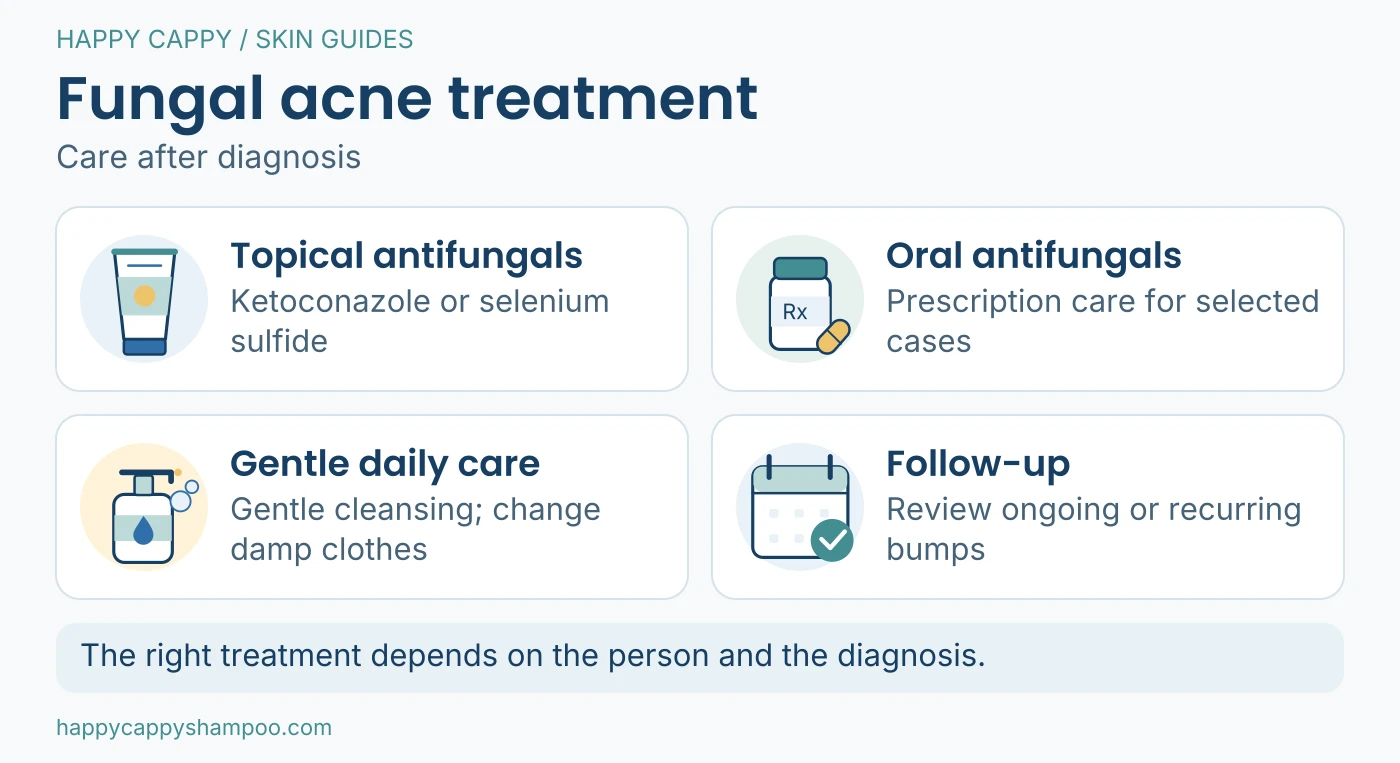
Options used for Malassezia folliculitis include topical azole antifungals, such as ketoconazole or econazole, and selenium sulfide preparations. A clinician may start with topical treatment for a limited eruption. The formulation matters: a wash, solution and leave-on cream have different directions, and products intended for the scalp are not automatically suitable for every facial area.1, 3
Ask where to apply the treatment, whether to rinse it off, how often to use it and when to reassess. Keep it out of the eyes and follow instructions for irritated or broken skin. If the routine repeatedly burns or worsens the eruption, get advice instead of increasing contact time or adding another active ingredient.
Oral treatment for selected cases
A prescriber may consider fluconazole or itraconazole when disease is more extensive, persistent or otherwise warrants systemic treatment. These medicines are not simply stronger cleansers. Other medications, liver health, pregnancy or breastfeeding, and other medical conditions affect whether they are appropriate. Laboratory monitoring may be needed.3
Do not borrow an antifungal prescription or copy a dosing schedule from an online routine. Agree on the course and follow-up with the prescriber, including what to do if symptoms persist or a side effect occurs.
The limits of specialist light treatment
Small studies have explored photodynamic therapy for difficult cases. It combines a light-sensitive medicine with a controlled light source and is a specialist option. Ordinary sun exposure, tanning or a home UV lamp is not an equivalent treatment.3
Judging improvement and arranging follow-up
Ask your clinician what improvement should look like and when to check back. Useful changes include fewer new bumps and less itching or inflammation. Treatment studies use different regimens and follow-up periods, so their results should not be turned into a promise that everyone clears in a fixed number of days.2, 3
Flat marks can remain after an inflamed bump settles. That is different from continuing to develop new pustules. Recording the appearance in consistent light and noting when new bumps form can make the follow-up discussion more useful than judging the skin from day to day.
If the eruption persists, review the diagnosis, the instructions and how the skin tolerated treatment. Coexisting acne, a different type of folliculitis or irritation may need attention. The next step is reassessment, not automatically a longer oral course or more frequent washing.
Seek care sooner for fever, rapidly spreading redness, marked pain or a large tender swelling. People with a weakened immune system should seek medical advice early for an unexplained eruption.
Daily skin care during treatment
Home care should make the treatment plan easier to follow. Cleanse gently, rinse well and avoid picking or abrasive scrubbing. Use a moisturizer and sunscreen that feel comfortable and fit the plan. There is no universal ingredient blacklist that predicts how every complete formula will behave on every person’s skin.
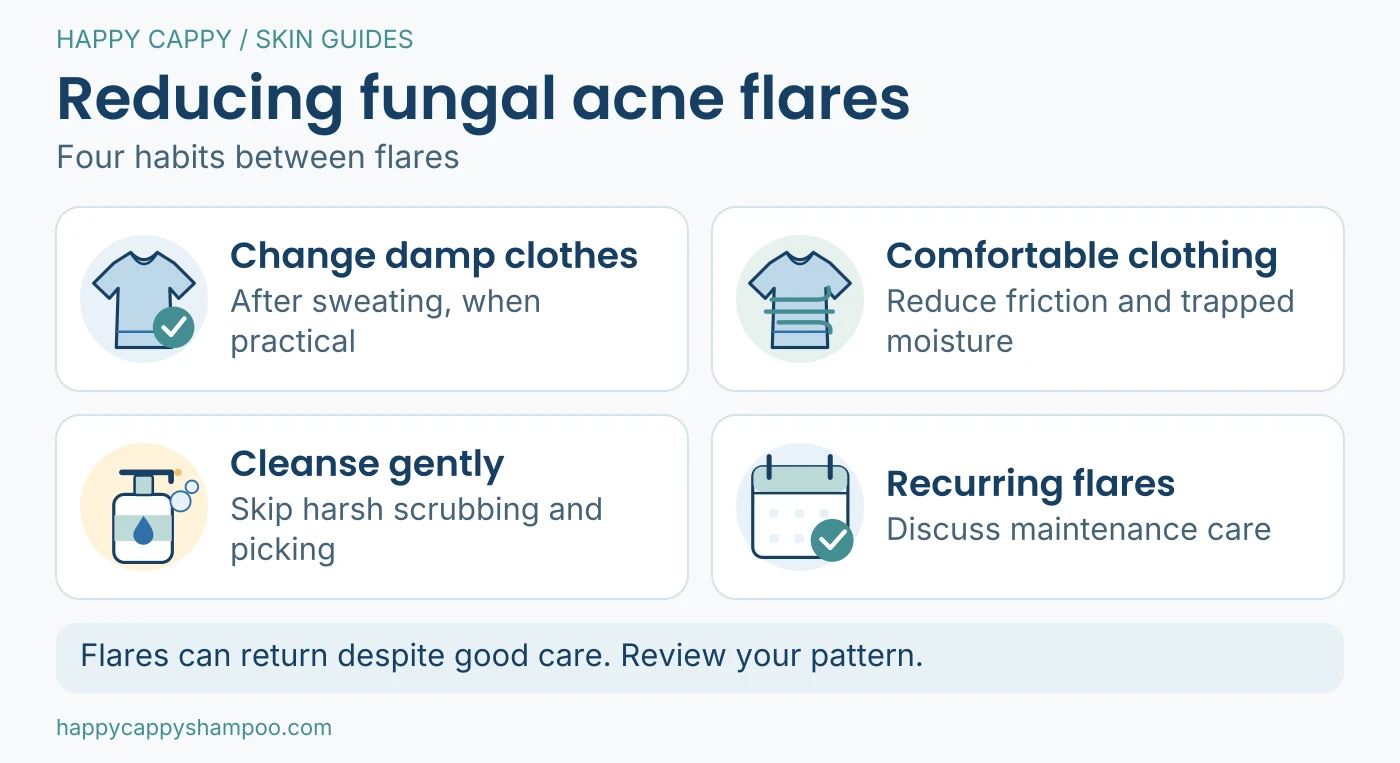
After exercise, change out of damp clothing and shower when practical. Reduce prolonged rubbing and trapped moisture from tight clothing. These habits can limit aggravating factors without requiring you to stop exercising or treat sweating as a hygiene failure.4
DIY vinegar mixtures and concentrated essential oils are not interchangeable with medicines used in clinical care. They can irritate the skin. Keep the routine manageable and avoid introducing several new products at once, which makes an adverse reaction harder to identify.
If acne is also present, acne medicines may still have a role. Ask how to combine the treatments rather than stopping prescribed acne care simply because some bumps were identified as folliculitis.
Where Happy Cappy fits
Happy Cappy Medicated Shampoo & Body Wash is a fragrance-free cleanser containing 0.95% pyrithione zinc. It washes away sweat, excess surface oil and everyday buildup. Its labeled medicated uses are dandruff and seborrheic dermatitis.5
Some dandruff ingredients have activity against Malassezia, which explains why they appear in discussions of fungal acne care. Ingredient research and studies of other concentrations or products are not a clinical trial of the Happy Cappy formula for Malassezia folliculitis. A cleanser’s role should be considered alongside the diagnosis and any prescribed treatment.
For the supporting research and a fuller discussion of the formula, visit Happy Cappy and fungal acne. That resource helps put the evidence in context without treating a wash as a substitute for every topical or oral medicine.
Recurring flares and maintenance care
A successful course does not permanently remove Malassezia from the skin. It is part of the normal microbial community, and flares can recur when contributing conditions return. A breakout is not, by itself, evidence that you caught an infection from another person.1
Review your own pattern: heat and humidity, prolonged sweating, occlusive products, or a recent medicine may be relevant. Discuss prescription changes with the prescriber instead of stopping antibiotics, steroids or other necessary medicines on your own.
For repeated episodes, the clinician may recommend intermittent topical maintenance after the initial course. Ask which product to use, how often, for how long and when to review the plan. A maintenance schedule is different from indefinitely repeating an oral antifungal course.1, 3
If a new eruption looks different, is painful or is spreading, do not assume it is the same condition returning. Other types of folliculitis can resemble Malassezia folliculitis and may need a different approach.4
A clear plan for the next visit
Leave the appointment knowing what is being treated, how to use each medicine and when to follow up. If the cause is still uncertain, that uncertainty deserves clarification before the routine grows more complicated. If the diagnosis is established, gentle care and a workable maintenance plan can support treatment without promising a permanent cure.