


Quick answer: Hair washing with seborrheic dermatitis has two parts: cleansing as often as your scalp and hair need, and using medicated shampoo on its own schedule. Daily medicated washing is not a universal requirement. Follow the actual product label or prescribed plan, then adjust for scalp comfort, hair dryness and response.
Cleansing and treatment have different jobs
Seborrheic dermatitis can cause recurring scalp inflammation and scale. Shampooing removes surface oil, sweat and loose flakes; a medicated shampoo also delivers an active ingredient to the scalp. The number of times you wash your hair and the number of times you use treatment therefore do not have to be identical.
That distinction makes a routine easier to follow. Someone whose fine hair becomes oily quickly may need ordinary cleansing between medicated washes. Someone with tightly coiled hair may need less frequent washing and a plan that reaches the scalp without repeatedly drying the hair lengths. Neither person needs to copy the other’s wash days.
A schedule that fits your hair
The American Academy of Dermatology describes medicated shampoo two or three times weekly as one approach for straight or wavy hair. For curly or tightly coiled hair, a dermatologist may recommend once weekly. These are examples for an individualized plan, not directions that override the bottle in your shower.1
| Your routine | A useful adjustment |
|---|---|
| Hair becomes oily between treatment days | Use a gentle cleanser between medicated washes if needed, while keeping the medicine on its labeled schedule. |
| Curly, coily or easily dried hair | Focus treatment on the scalp and condition the hair lengths. If the labeled schedule is difficult to tolerate, ask about a plan that fits your hair. |
| Flaking improves, then returns when treatment stops | Discuss a maintenance schedule instead of repeatedly stopping and restarting without a plan. |
| Washing repeatedly causes burning or more irritation | Stop the product that irritates you and reassess it; adding more washes may make the discomfort worse. |
A brief note of wash days, the shampoo used and changes in itch or scale can reveal a pattern. Keep the routine steady enough to judge it, while responding promptly if a product makes the scalp worse.
Daily washing and scalp comfort
Daily cleansing can suit an oily scalp, particularly with straight hair, but it is not necessary for every hair type. The AAD recommends choosing washing frequency around oiliness and hair texture.2 More frequent cleansing also does not automatically mean more frequent medication: some shampoos have specific limits or age restrictions.
If your hair feels brittle after washing, separate scalp care from hair care. Work the medicated lather onto the scalp and use conditioner where your hair needs it. The AAD’s curly-hair guidance discusses treating the scalp while protecting hair from dryness.3 Persistent itching immediately after a wash may reflect irritation as well as the original condition; our itchy-scalp-after-washing guide explores those clues.
Using medicated shampoo
Match the directions to the active ingredient
Common nonprescription choices include ketoconazole, selenium sulfide, pyrithione zinc and salicylic acid. Some act against yeast associated with dandruff and seborrheic dermatitis; salicylic acid helps loosen scale. Concentrations, age limits and directions differ, and stronger formulations or other medicines may require a prescription.2, 4 The seborrheic dermatitis guide covers those treatment choices in more depth.
Reach the scalp with a gentle touch
Wet the scalp and hair, part the hair where necessary, and massage gently with your fingertips. Avoid scratching with your nails or scrubbing off attached scale. Rinse thoroughly. Follow the product’s contact-time instructions or your prescribed plan: there is no single three-to-five-minute wait or compulsory second lather that applies to every medicated shampoo.1, 2
A brush is optional, not a required treatment step. Removing loose flakes should never mean pulling at adherent scale or working over painful, raw skin. If scale is difficult to loosen, get advice about softening it instead of brushing harder.
Happy Cappy in the washing routine
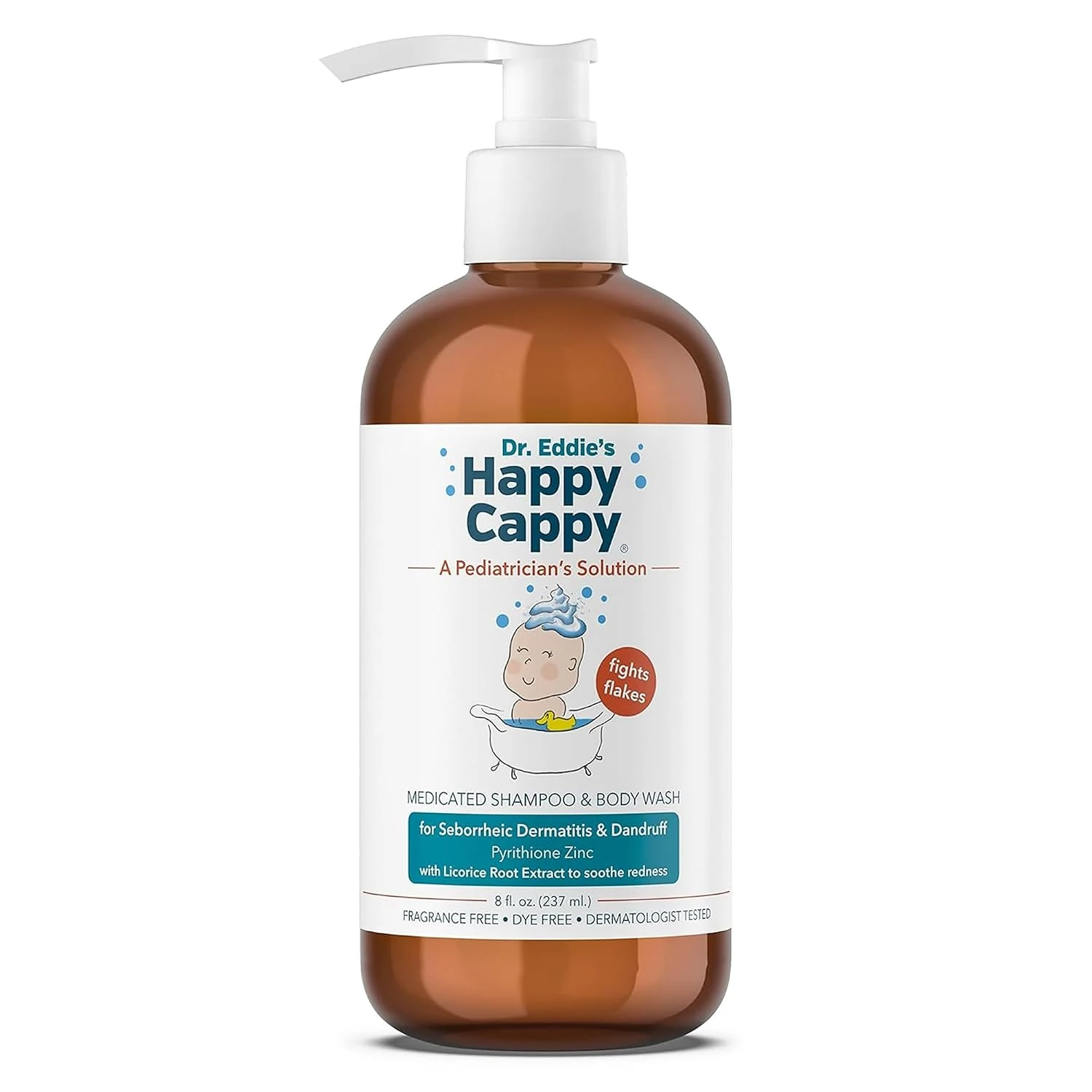
Happy Cappy Medicated Shampoo & Body Wash combines 0.95% pyrithione zinc with fragrance-free, dye-free cleansing. The active ingredient helps relieve flaking, scaling and itching associated with dandruff and seborrheic dermatitis. Glycerin and panthenol support moisture, and licorice root extract helps soothe the appearance of redness.
Its Drug Facts directions call for use at least twice weekly or as directed by a doctor: wet the hair, massage onto the scalp and skin, then rinse. The label does not prescribe a fixed leave-on interval or require two washes. Avoid the eyes; stop and ask a doctor if the condition worsens or does not improve with regular use as directed.5
Infant scalp scale needs an age-appropriate routine. For babies, use the separate cradle-cap guide instead of automatically applying an adult shampoo schedule.
Progress, maintenance and reassessment
Look for a trend rather than a wash-count promise
Improvement may develop over several weeks, depending on the treatment and the cause of the scaling. Less itch, fewer new flakes and a more comfortable scalp are useful signs. DermNet describes medicated-shampoo courses over several weeks, followed by continued use when needed.4 There is no reliable promise that two or three washes will clear every scalp.
Maintain the improvement
Seborrheic dermatitis can return. Once it is controlled, a clinician may recommend a less frequent maintenance schedule, while taking the particular product’s directions into account.1 Keep caring for the hair between treatments so that dryness does not become a second problem.
Reassess a routine that is not helping
Persistent or worsening symptoms deserve another look, especially if you have followed the recommended course. The diagnosis, product choice, application or inflammation may need attention. A prescription scalp treatment can sometimes help without simply increasing shampoo frequency. For thick, sharply outlined patches, the scalp psoriasis and dandruff comparison explains another possible pattern.
Seek prompt care for significant pain, pus, swelling, fever, broken hairs or new bald patches. Those findings should not be treated as ordinary flakes that only need more shampoo.