


Quick Answer: Breast milk has not been established as a treatment for cradle cap. Research on other skin conditions does not prove that applying it to the scalp clears cradle cap or prevents it from returning. Gentle washing and careful loosening of scales are the usual starting points.123
If you have heard that a few drops of breast milk can clear your baby's scalp, it is reasonable to ask what supports that advice. The question here is topical use: putting breast milk directly on cradle-cap scales.
Cradle-cap-specific evidence is insufficient
There is not enough direct clinical evidence to recommend breast milk as a cradle-cap treatment. A 2020 paper examining non-nutritional uses of human milk specifically noted that there were no studies of its use for seborrheic dermatitis, including cradle cap, at that time. That paper surveyed mothers' experiences; it was not a trial proving that the remedy worked.1
A frequently cited 2015 trial compared topical breast milk with 1% hydrocortisone for atopic eczema. The researchers found no significant difference between the groups during 21 days of follow-up, but the study took place at one site and did not study cradle cap. Its results cannot establish that breast milk treats seborrheic dermatitis, replaces prescribed treatment, or prevents future scalp scaling.2
Breast milk contains biologically active components, but an ingredient's properties do not establish how well the whole milk works when applied to a particular rash. Claims that its antibodies, fats, or stem cells make it a proven cradle-cap remedy go beyond the evidence.1
Research on cradle-cap treatments is limited more broadly, too. A 2019 Cochrane review found very low-certainty evidence for the treatments it evaluated. Promises of an instant cure or guaranteed prevention are not justified.4
Natural improvement can look like a treatment effect
Cradle cap often improves naturally over weeks or months. A parent may also wash the scalp or gently loosen flakes at the same time as applying milk.35
That gives more than one possible explanation for an improvement. Seeing fewer flakes afterward does not show which step helped or prove that breast milk caused the change. This is why personal experiences, while understandable, cannot tell us how reliably a treatment works.
Scalp care after trying breast milk
A lack of evidence for benefit does not mean that every application causes harm. It also does not support a blanket promise that applying breast milk is harmless. There is no established cradle-cap regimen telling parents how much to apply, how often, or how long to leave it on.
If you have been trying it, you can return to a simple scalp-care routine instead of repeatedly adding milk. Stop any home remedy that seems to cause irritation. If the skin is raw, bleeding, weeping, or developing pus-filled bumps, contact your child's clinician rather than continuing home treatment.5
Gentle care for cradle-cap scales
Mild cradle cap usually does not require aggressive treatment. If you want to help the flakes come away, dermatologists recommend gentle care:3
- Wash with a mild, fragrance-free baby shampoo. Rinse the scalp well.
- Loosen only scales that release easily. Use your fingertips or a soft baby brush while shampooing. Avoid scraping or picking.
- Soften stubborn scale if needed. A small amount of a suitable non-food-based oil, such as mineral oil, can be used before washing. Shampoo it out afterward.
- Ask for help if the rash persists or worsens. A clinician can confirm whether it is cradle cap and recommend the next step.
Our cradle-cap treatment guide covers the wider care routine. This article focuses on what the evidence can and cannot tell us about breast milk.
Scalp changes that need assessment
Get medical advice for oozing, bleeding, swelling, pus bumps, pain, or a rash with an unpleasant smell. These signs deserve assessment and should not be treated by adding breast milk.5
For more specific guidance, see what to do when cradle cap is leaking fluid and what a smelly scalp can mean.
Medicated washing for persistent flakes
Common dandruff-shampoo actives include pyrithione zinc, selenium sulfide, ketoconazole, salicylic acid, sulfur, and coal tar. Formulations and age directions differ; these are not interchangeable choices for a baby.7
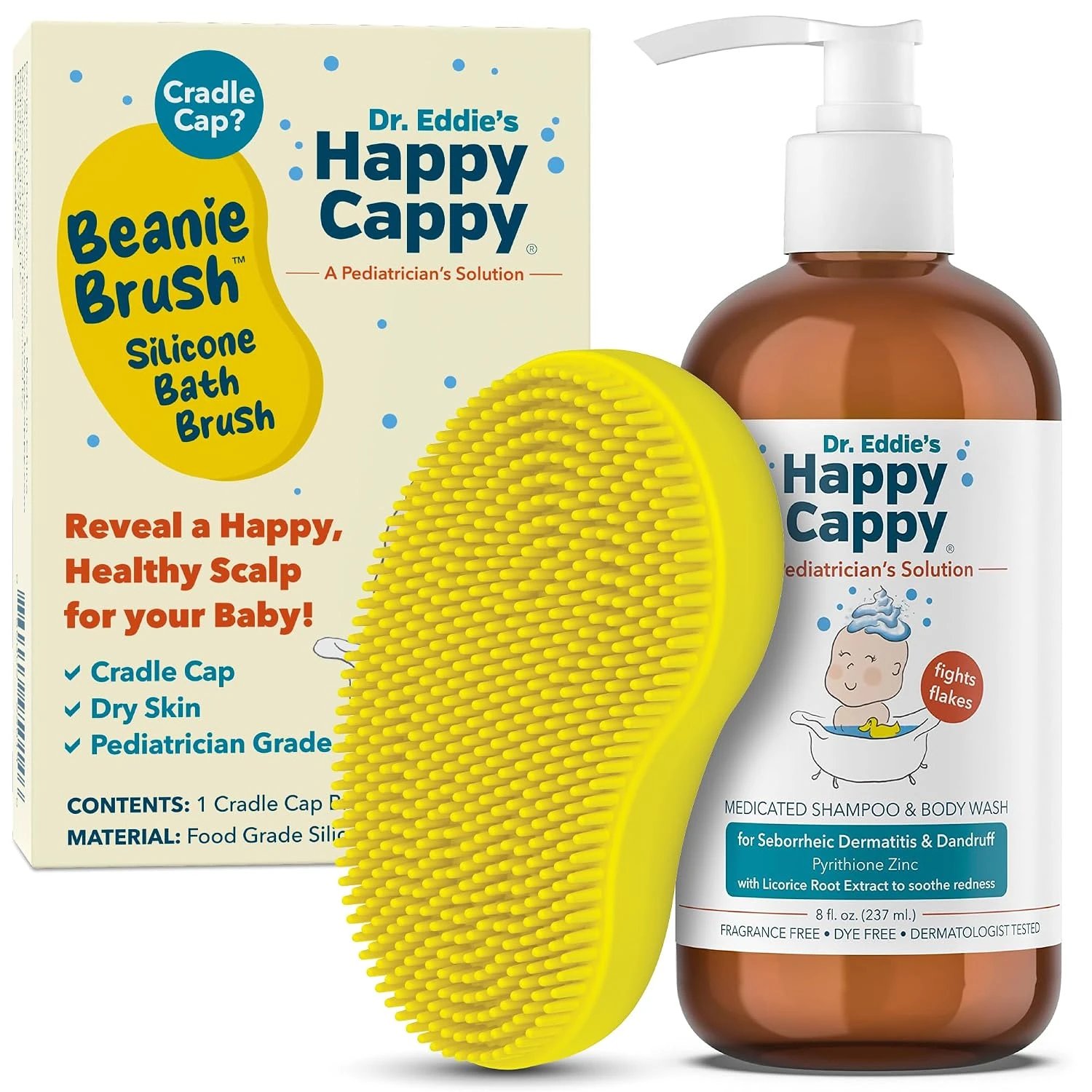
A medicated wash is another option when gentle washing is not enough to control the flakes.
The Happy Cappy Medicated Shampoo + Beanie Brush Bundle pairs an 8 oz medicated wash with a soft silicone scalp brush.
The wash contains 0.95% pyrithione zinc to help relieve flaking, scaling, redness, and itching associated with seborrheic dermatitis and dandruff. Its fragrance-free, dye-free formula is designed for sensitive skin.6
Skip the oily mess. Use the brush with a light touch during washing to move flakes that release easily; leave attached scales alone.
Use directions: Wet the hair thoroughly, gently massage in the shampoo, and rinse well. Use at least twice weekly. Keep it out of the eyes. Stop use and ask a doctor if symptoms worsen or do not improve with regular use.6