

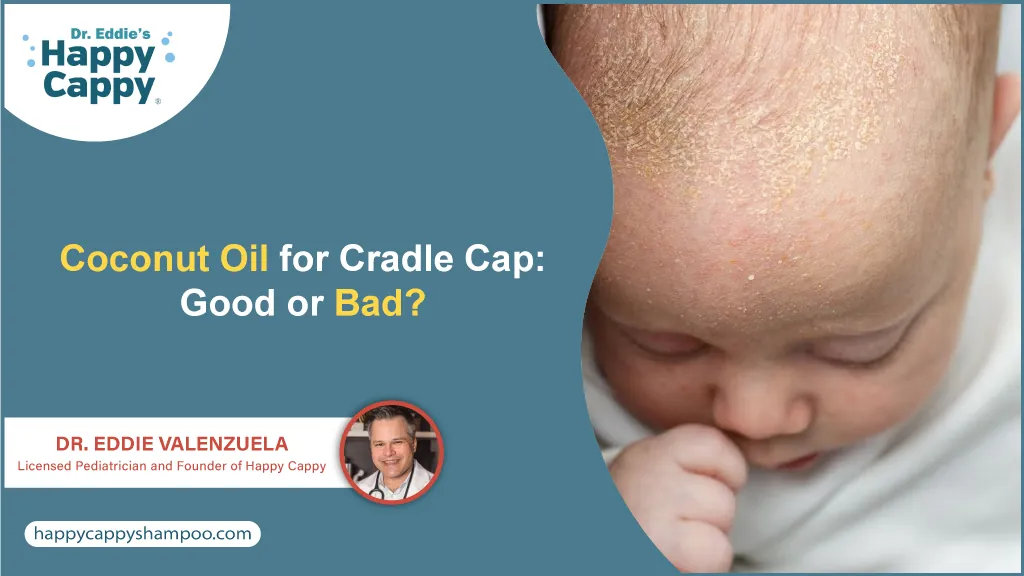
Quick answer: Coconut oil may help soften cradle-cap scales so they are easier to wash away. That does not establish that it cures cradle cap. Guidance differs: the NHS includes coconut oil as an option, while the American Academy of Dermatology recommends a non-food oil for stubborn scales. Neither a cure promise nor a blanket claim that coconut oil always worsens cradle cap is justified.1,2
When flakes appear on a baby’s scalp, it is understandable to look for a simple way to loosen them. This article focuses on coconut oil for cradle cap. Our coconut oil for dandruff article discusses the separate research in adults.
Coconut oil softens scale but is not an established treatment
Cradle cap is seborrheic dermatitis of a baby’s scalp. Coconut oil is sometimes suggested to soften its attached scales; softening scale is different from treating the condition. For recognition and the usual course, see the cradle cap guide.1,3
Guidance differs on coconut oil
The NHS lists coconut oil or an emollient as options to help loosen scales, followed by gentle brushing and baby shampoo. The American Academy of Dermatology instead suggests a non-food oil, such as baby oil, for scales that resist gentle washing.1,2
These recommendations concern softening and removing scale. They should not be read as proof that coconut oil treats the underlying inflammation or prevents recurrence. A Cochrane review found that research on cradle-cap treatments was limited and generally of very low certainty.3
Coconut oil and olive oil deserve separate guidance. The NHS advises against olive oil for cradle cap. See Does Extra Virgin Olive Oil for Cradle Cap Work? for the skin-barrier evidence and its limitations.1
Adult dandruff research does not establish benefit in babies
The useful question is whether it helps loosen scale without irritating the skin. It is too strong to say that coconut oil necessarily creates a breeding ground for yeast and makes cradle cap worse. Human scalp research has reported encouraging findings with coconut oil, but the 2021 study involved adult women, not babies with cradle cap.4
That adult evidence does not establish a treatment schedule, an antifungal effect, or a cure for infant cradle cap. The distinction between the study population and your baby matters.
Gentle alternatives to coconut oil
Start with gentle, fragrance-free shampooing and lift only flakes that release easily. We favor the American Academy of Dermatology’s non-food-oil guidance when stubborn scale needs softening; a plain, fragrance-free mineral oil is one option. Shampoo it out afterward.1,2
Using an oil does not establish a treatment schedule
There is no established overnight coconut-oil regimen for cradle cap. More oil or longer contact should not be assumed to work better. Avoid essential-oil blends, do not use coconut oil with a known coconut allergy, and stop any product that irritates the skin.
Sore or weeping skin needs assessment
Pain, bleeding, swelling, fluid leakage, an unpleasant odor, or a rash that keeps worsening deserves medical assessment. Avoid experimenting with oil on raw skin or cracked skin behind the ears.1,2
Medicated washing for persistent cradle-cap flakes
When gentle shampooing is not enough, the Happy Cappy Medicated Shampoo + Beanie Brush Bundle offers a scalp-care routine without oil. The wash contains 0.95% pyrithione zinc to help relieve scaling and flaking associated with seborrheic dermatitis and dandruff; the soft brush helps lift flakes that release easily.5
Coconut oil’s role is to soften scales. A medicated wash addresses the flaking and scaling themselves. Follow the product directions and see the full cradle-cap care routine for the washing steps.
Key Takeaways
- Coconut oil may help soften scale, but it is not an established cure for cradle cap.
- Adult dandruff studies do not prove effectiveness in babies.
- Coconut oil, olive oil, and mineral oil should not be treated as interchangeable.
- Gentle washing and scale removal come first. Persistent or uncomfortable symptoms deserve a closer look.