


Quick answer: Dandruff usually causes loose flakes with little visible inflammation. Scalp psoriasis more often creates persistent, thicker patches with attached scale and a clearer edge. It can extend beyond the hairline, but does not always do so. Color and itch alone cannot settle the diagnosis. Pain, bleeding, bald patches or symptoms that keep returning deserve an examination.
Scalp psoriasis and dandruff can both leave flakes in the hair, but the skin beneath them often offers better clues. Notice whether the scale is loose or attached to a lasting patch, whether the scalp feels sore, and whether the rash reaches beyond the hairline. Those observations help explain why similar-looking flakes can need different care.
This guide focuses on what you can notice on the scalp. For a comparison that also covers the eyebrows, face and body folds, see seborrheic dermatitis vs. psoriasis.
Scalp psoriasis vs. dandruff at a glance
These are common patterns, not a home diagnostic test. Mild psoriasis can look like dandruff, and more inflamed seborrheic dermatitis can produce substantial scale.
| What you notice | Dandruff | Scalp psoriasis |
|---|---|---|
| Flakes and scale | Usually loose, finer flakes scattered through the hair | Often thicker scale attached to persistent patches |
| Skin underneath | Usually little visible inflammation | Raised or thickened areas with more defined edges |
| Hairline | Usually limited to the scalp | May extend onto the forehead, neck or behind the ears |
| Discomfort | Itch may occur | Itch, soreness, burning or cracking may occur |
| Other clues | No psoriasis-related nail or joint changes | Nail changes or patches elsewhere can support the diagnosis |
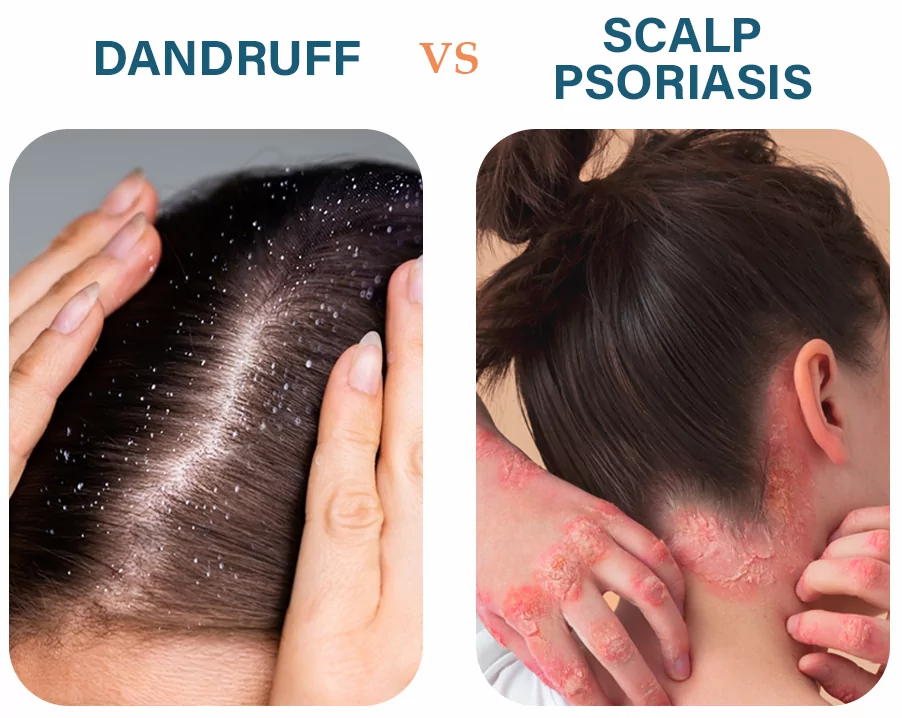
Clues that suggest scalp psoriasis
With psoriasis, immune-driven inflammation speeds up skin-cell turnover. The result can be a patch that feels thicker than the surrounding scalp, with scale that keeps returning in the same place. Look at the edge of the patch as well as the flakes.
On lighter skin, affected areas may look pink or red. On darker skin, they may look purple, gray-brown or darker than nearby skin. Scale may be gray or silvery. A lack of bright redness does not mean there is no inflammation.
Psoriasis can affect only the scalp and remain within the hairline, so clear elbows and knees or an unaffected forehead do not rule it out. Still, tell your clinician about changes elsewhere, including nail pits or lifting. The DermNet scalp psoriasis guide describes these patterns and their variation across skin tones.
Dandruff and other causes of flakes
Dandruff is generally considered the milder, less inflamed scalp end of the seborrheic dermatitis spectrum. A naturally occurring yeast called Malassezia, skin oils and the skin's response all play a role. It is not simply a sign that someone is dirty.
More inflamed seborrheic dermatitis may also affect the eyebrows, sides of the nose or ears. Psoriasis and seborrheic dermatitis can overlap; clinicians may call that pattern sebopsoriasis.
Dandruff does not turn into psoriasis. A change in the pattern may mean the diagnosis needs review, or that both conditions are present. Neither dandruff nor psoriasis is contagious.
Other possibilities include scalp eczema, irritation or allergy from a hair product, and dry scalp. A rash that begins after a new dye, fragrance or styling product is worth mentioning.
In children, scaling with broken hairs or bald patches raises concern for scalp ringworm, also called tinea capitis. It can sometimes look like ordinary dandruff. It requires a clinician's assessment and oral antifungal treatment; shampoo alone will not cure it. See DermNet's explanation of scalp ringworm.
Dandruff care for recurring flakes
If the main issue is recurring flakes and mild itch, a consistent dandruff routine is more useful than switching products every few days. Dandruff can return after improvement; the dandruff guide explains choosing treatment and maintaining control.
- Use a dandruff treatment consistently. Work it onto the scalp, not just through the hair, and rinse thoroughly.
- Keep cleansing gentle. Use fingertips rather than scratching with nails. Avoid scrubbing off attached scale.
- Notice what changes. Track flakes, itch and comfort. Stop a product that causes irritation, and seek advice if symptoms worsen or persist.
For flakes and itching associated with dandruff or seborrheic dermatitis, Happy Cappy Medicated Shampoo & Body Wash contains 0.95% pyrithione zinc to help relieve flaking, scaling and itching. Use at least twice a week, gently lather and rinse well. Avoid contact with the eyes.
Happy Cappy Medicated helps relieve dandruff and seborrheic dermatitis symptoms, but it does not treat psoriasis. If psoriasis is causing your scalp symptoms, your clinician can recommend an appropriate treatment. For a baby or young child with an unexplained scalp rash, check with your pediatrician before trying an adult's treatment.
Treatment for scalp psoriasis
Scalp psoriasis is a chronic condition, and effective treatment can control symptoms and sometimes clear the skin for long periods. Gentle washing and avoiding picking support comfort, but home remedies do not replace the treatment plan. Your clinician may prescribe a corticosteroid solution, foam or another scalp-friendly formulation, a vitamin D medicine, or a combination. The formulation matters because a medicine has to reach the skin beneath the hair.
Selected patients may use a scale-softening treatment. Ask before using salicylic acid or coal tar on a child. Picking off scale can worsen irritation and pull out hairs. The AAD's guide to nonprescription psoriasis care explains the different roles of moisturizers and scale softeners.
Prescription nonsteroid options also exist. Roflumilast foam 0.3% (Zoryve) is approved for plaque psoriasis of the scalp and body in people 12 and older. Suitability and side effects should be reviewed with the prescriber; see the current prescribing information.
When topical treatment is not enough, a dermatologist can discuss light therapy or medication that works throughout the body. Treatment intensity depends on symptoms and daily-life impact as well as the amount of skin involved.
Scalp changes that need assessment
Arrange an examination for thick or persistent patches, bleeding, significant soreness, broken hairs, bald spots or itch that disrupts sleep. Ordinary dandruff usually does not cause hair loss. Scalp inflammation, scratching and forceful scale removal can contribute to temporary shedding with psoriasis, but new hair loss still needs assessment rather than an assumption about its cause. Get prompt care for a painful swollen area, pus, spreading redness or fever.
Bring a short list of products and medicines you have tried, how often you used them and whether they helped. Partial improvement with dandruff shampoo does not confirm a diagnosis: application, inflammation or another condition may still need attention. Photos of a flare can be useful if the scalp looks calmer on appointment day. Mention joint pain, swelling or morning stiffness, too.
A dermatologist usually examines the scalp, nails and other skin. Testing for fungus or occasionally a biopsy may help when the picture is unclear. The AAD's diagnosis and treatment guide explains that assessment.