

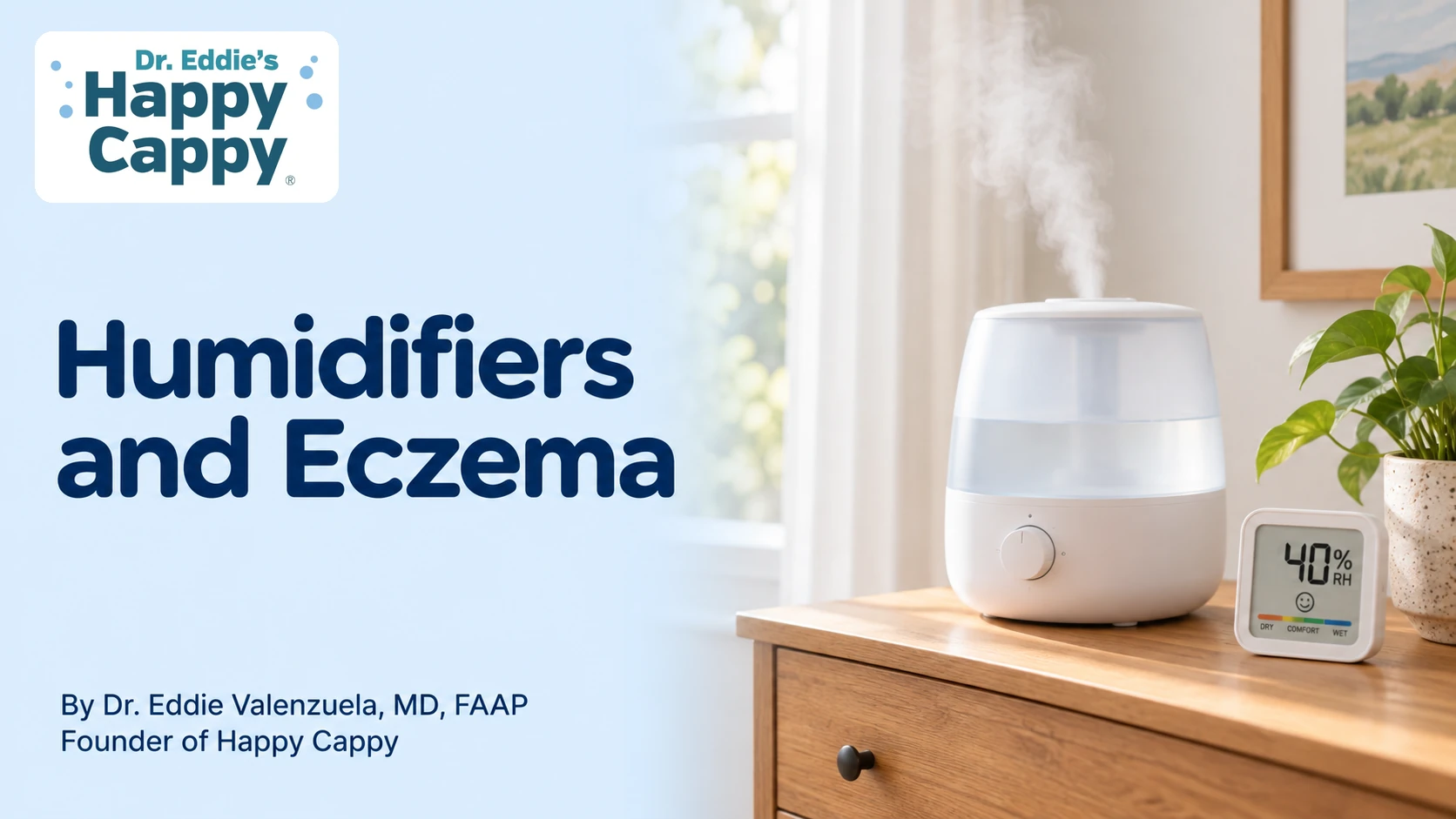
Cover: AI-generated illustration with the original Happy Cappy logo. Clinical photographs below, when shown, are separately credited.
Quick answer: A humidifier may help comfort when indoor air is very dry, but it does not treat eczema by itself. Measure humidity, generally aim for 30–50%, avoid dampness and keep the unit clean. Cool mist avoids the burn hazards of steam around children.
A humidifier is an optional comfort measure
A room humidifier adds water to the air. It may make a very dry bedroom more comfortable for someone with eczema, and pediatric guidance includes a cool-mist humidifier as one possible aid for dry skin or nighttime comfort.1 It is not a proven stand-alone eczema treatment or a necessary purchase for every family.
Measure the room first. Heating or air conditioning can change indoor conditions, and the outdoor weather does not tell you the humidity beside the bed. A small hygrometer measures relative humidity, usually displayed as “RH.” For broader seasonal care, see eczema in winter.
Use a hygrometer and avoid excess moisture
A general indoor target is about 30–50% relative humidity. This is an indoor-air guideline, not an eczema cure threshold. EPA guidance says not to humidify above 50%; condensation on windows or damp nearby surfaces is a reason to reduce output or stop, even if a distant meter reads lower.23
The room is consistently dry
If readings are below roughly 30% and dryness is uncomfortable, a carefully monitored humidifier trial may be reasonable.
The room is already 30–50% RH
Adding more moisture may provide little benefit. Look at the skin-care plan, room temperature and other sources of discomfort.
The room exceeds 50% RH
Do not add humidity. Address dampness, ventilation or leaks; a humidifier will not fix these problems.
Windows or bedding become damp
Lower the output or stop the unit. Move it away from surfaces and reassess room conditions before restarting.
Choosing a unit you can keep clean
For a child’s room, choose cool mist to avoid the hot water and steam burn hazards of a vaporizer.4 “Cool mist” describes the output: both evaporative and ultrasonic models can produce it. There is no single model proven best for eczema.
Evaporative models
A fan moves air through a wet wick or filter. Consider fan noise, access for cleaning and the cost and availability of replacement filters.
Ultrasonic models
Vibration creates a fine mist. Mineral content matters because the unit can disperse material from its water; distilled water helps reduce mineral dust.2
A wide tank opening and parts you can remove and dry are often more useful than a long list of features. A humidity control or automatic shutoff can help, but still check a separate room reading. Avoid buying a larger unit on the assumption that more mist will help more.
A practical cleaning and placement routine
Follow the manufacturer’s instructions. EPA recommends emptying, drying and refilling portable tanks daily and cleaning them every third day. Use low-mineral water, especially in ultrasonic units, and rinse cleaning residues thoroughly. Never mix cleaning chemicals.2
- Make the routine easy: keep the manual and cleaning schedule where the person refilling the unit can find them.
- Keep the tank simple: use water as directed; do not add fragrance, essential oils or cleaning products while operating it.
- Choose a safe position: place it on a stable surface with the unit and cord out of a child’s reach. Direct mist away from bedding, walls and the child’s face.
- Before storing: empty and dry the parts rather than leaving water in an unused tank. Replace filters according to the manual.
Judge the trial by comfort and room conditions
You do not need to run a humidifier around the clock. Use it only while humidity remains appropriate. Note the room reading, whether your skin feels more comfortable and whether the unit creates dampness. If there is no clear benefit, it may not be worth the cleaning burden.
Stop using it if it creates condensation, visible mold or new breathing symptoms, and seek medical advice for respiratory symptoms. Persistent itch and lost sleep need a review of the eczema plan rather than a higher humidity setting.12
Keep direct skin care at the center
A comfortable room does not replace moisture applied to the skin. Short lukewarm bathing, regular moisturizing and prescribed flare treatment remain the foundation of eczema care.5
Happy Cappy’s fragrance-free Daily Shampoo & Body Wash is a gentle rinse-off cleanser with glycerin and provitamin B5 to help soften skin. Follow with Moisturizing Cream for leave-on moisture: glycerin draws in water and petrolatum helps retain it. The cream absorbs quickly without a greasy feel.
Shop the Daily Wash + Moisturizing Cream Bundle with one 8 oz wash and your choice of a 6 oz cream tube or 12 oz pump jar. Continue prescribed treatment as directed.
A simple decision before buying
Check three things: Is the room actually dry? Can you monitor the humidity? Can you reliably empty and clean the device? If the answer to any of these is no, first address that issue. A humidifier is useful only when its benefit fits the room and the routine you can maintain.