

Part of the Eczema Resource Center.
Quick answer: Baby eczema usually reflects an interaction between inherited traits, the skin barrier, immune activity and environmental exposures. A trigger can worsen a flare without being the underlying cause. Eczema alone does not establish food allergy or justify changing a feeding plan.
Baby eczema and early onset
Baby eczema commonly refers to atopic dermatitis, a condition that causes itchy, dry and inflamed skin. It often begins in the first several months of life, but can start later. A rash present at birth or very early in life should be assessed rather than automatically labeled eczema.
For clinical photographs, skin-tone differences and common locations, see the baby eczema appearance guide.
Underlying causes of baby eczema
There is no single cause. Think of the skin barrier and immune system as partners: when the barrier loses moisture and lets irritants through, inflammation can follow, and that inflammation can weaken the barrier further. AAD: atopic dermatitis causes1.
Inherited susceptibility
A family history of eczema, asthma or allergic rhinitis raises a child’s likelihood of developing eczema. It does not make eczema inevitable, and a baby can develop it without a known family history. The inheritance is complex, so a single percentage cannot predict an individual baby’s risk.
Skin barrier changes
The outermost skin layer, the stratum corneum, helps keep moisture in and unwanted substances out. Filaggrin is one of the proteins involved in this barrier; its breakdown products contribute to the skin’s natural moisturizing factor. Some people inherit filaggrin variants that increase eczema susceptibility, but many people with eczema do not have these variants. Dryness and inflammation can also impair the barrier.4
Immune activity
Immune signaling contributes to itching and inflammation. This does not mean the baby simply has a weak immune system or is allergic to everything. Atopic dermatitis and allergic contact dermatitis are different conditions, although they can coexist.
Environmental exposures
What touches the skin and the surrounding conditions can aggravate a susceptible barrier. An irritating cleanser, repeated drooling or overheating may worsen existing eczema. Those triggers are different from the underlying reasons a baby is prone to eczema.
Individual flare triggers
Triggers vary between children. Look for a consistent pattern rather than assuming every item on this list must be removed:
- Dry skin, dry air or overheating and sweating.
- Saliva and repeated rubbing around the mouth.
- Fragranced products, irritating cleansers, detergents or fabric softeners.
- Rough clothing and scratching.
- Selected environmental allergens in a sensitized child.
Food allergy can coexist with eczema, especially when eczema is more severe, but it is not the explanation for every flare. Keep a brief record of symptoms, products and foods if you notice a repeatable connection. A pediatrician can decide whether targeted testing is useful. AAD: when a child needs allergy testing2.
Feeding and hygiene misconceptions
Diet during pregnancy and breastfeeding
Routine avoidance of foods during pregnancy or breastfeeding has not been shown to prevent eczema. A parent should not cut out dairy, eggs or other major foods simply because a baby develops a rash. A suspected food allergy deserves an individual assessment and nutritional guidance. The AAP clinical report on early feeding and allergic disease3 distinguishes prevention from treatment of an established allergy.
Breastfeeding, formula and eczema risk
Breastfeeding has many benefits, but it does not guarantee that a baby will avoid eczema. Eczema alone is not a reason to stop breastfeeding or assume that standard formula caused the rash. The AAP report found insufficient evidence that hydrolyzed formula prevents atopic disease. A clinician may recommend a special formula for a confirmed cow’s-milk protein allergy, which is a separate decision.
Timing of allergenic foods
Delaying allergenic foods is not an established way to prevent eczema. Appropriate early peanut introduction can help prevent peanut allergy, but that is not the same as treating eczema. Ask your pediatrician about age-appropriate introduction, especially if your baby has severe eczema or a known food allergy. Do not test a food at home after an immediate reaction.
Normal hygiene and microbial exposure
Research into early microbial exposures and immune development does not establish that normal hygiene causes an individual baby’s eczema. Do not deliberately expose a baby to infection, stop handwashing or leave irritated skin dirty. Gentle cleansing and avoiding irritating products can coexist.
Eczema and cradle cap have different causes
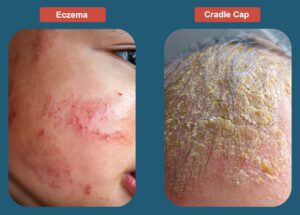
Cradle cap is infantile seborrheic dermatitis. Its often greasy or waxy scale has different causes and care needs from itchy atopic eczema. Some babies have both. A painful, very itchy, oozing or spreading rash needs assessment; the baby rash comparison explains the distinguishing patterns.
Care after the cause is assessed
Skin care supports a vulnerable barrier, while an active flare may also need prescribed treatment for inflammation. The baby eczema treatment guide owns the bathing, moisturizing, medicine and follow-up plan.
For everyday dryness, choose Daily Wash + 6 oz Cream Tube or Daily Wash + 12 oz Cream Jar. Each bundle includes one 8 oz Daily Wash for gentle, fragrance-free cleansing and one Cream to help retain moisture. See the baby eczema daily-care routine for application guidance.
New pain, pus, rapidly worsening skin or fever need prompt medical assessment. Sudden widespread painful blisters or sores need urgent care. Breathing difficulty or facial swelling after a food requires emergency care.
Evaluating possible triggers
Bring a brief record of products, exposures, feeding reactions and symptoms to the appointment. A repeatable pattern is more useful than a long list of assumed allergies.
Allergy testing should answer a specific question raised by the history and examination. Broad food panels can produce misleading positive results. A positive skin or blood test alone does not prove that a food caused eczema. An allergist may use a supervised food challenge when appropriate. Patch testing addresses suspected contact allergy.
The atopic dermatitis diagnosis guide explains the role and limits of allergy testing.