


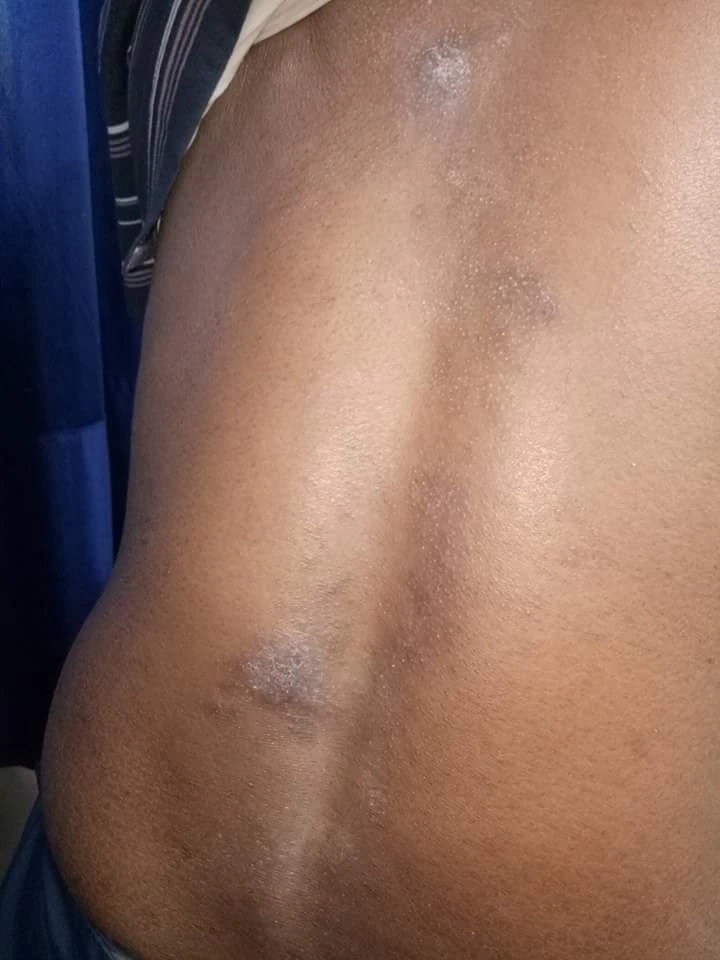
The cover photo shows follicular atopic dermatitis on the back: many small, raised bumps with scale and darker patches on brown skin. It is one pattern, not the only way eczema appears. View full photo.Photo: Kozmane and colleagues (2026), Figure 2, Cureus, CC BY 4.0. Converted to WebP; clinical appearance unaltered.
Quick answer: Eczema on Black skin may look brown, purple, gray or darker than the surrounding skin, and redness can be hard to see. Itch, roughness, swelling, scale and sleep disruption matter too. Treatment should control the active inflammation while protecting the skin barrier; dark or light marks may take longer to fade.
Eczema on Black skin
Black people have a wide range of skin tones, and there is no single “Black-skin eczema” appearance. Atopic dermatitis is a common form of eczema that causes recurring itch and inflammation. Contact dermatitis, nummular eczema and other forms can also affect Black skin.1
This guide focuses on recognizing active eczema on darker skin, interpreting changes in pigment and tracking improvement. The eczema overview explains the condition itself. A rash cannot be diagnosed from color or ethnicity alone.
Signs of an active eczema flare
An active flare changes how the skin feels as well as how it looks. Looking for several clues together helps when redness is less obvious:
- Color change: patches may look purple, gray, dark brown, reddish-brown or different from the person’s usual tone.
- Texture: roughness, fine scale, swelling or clusters of small bumps may stand out more than redness.
- Itch: scratching, rubbing, sleep loss and difficulty concentrating can signal substantial disease even when the color change looks subtle.
- Thickening: repeatedly rubbed skin can develop deeper skin lines and a leathery texture, called lichenification.
- Breaks in the skin: scratching or a strong flare may produce cracks, crust or weeping.
Compare an affected area with nearby skin and with your own baseline, rather than with a photograph of someone else. Tell the clinician what feels different as well as what looks different.1, 2
Real photographs: more than one eczema pattern
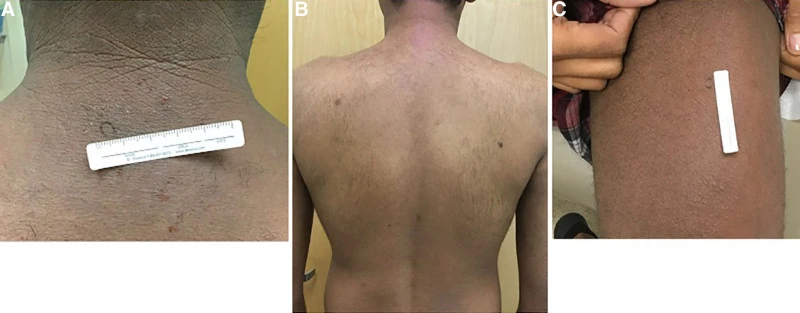
Some people develop many small bumps centered on hair follicles, as shown in the cover photograph. Others have broader patches or thickened areas. An image illustrates a pattern; itch, duration, exposures and examination help establish the cause.2, 3
For photographs and advice organized by location, visit neck eczema, back eczema, hand eczema and leg eczema.
Active eczema and leftover pigment changes
Inflammation can leave a patch darker or lighter than the surrounding skin. These changes are called post-inflammatory hyperpigmentation and hypopigmentation. They can be especially noticeable on darker skin and may last after itch and roughness improve.4, 5
Possible ongoing inflammation
Continuing itch, roughness, scale, swelling, new bumps or recurrent cracking. The treatment plan may need review.
Possible leftover pigment change
A flatter, smoother mark with much less itch after the flare has settled. Color may recover gradually over months, sometimes longer.
Both can be present together, so lingering color alone does not mean treatment has failed. A dark mark is not automatically a scar, and a pale patch is not automatically steroid damage. New, sharply white, spreading or unexplained light areas should be examined because several conditions can cause them.5
Start by controlling the inflammation. Scrubs, lemon juice, bleach and aggressive fading products can irritate eczema-prone skin. Protect exposed areas from sun; a tolerated broad-spectrum SPF 30 or higher sunscreen can help prevent dark marks from becoming more noticeable. A dermatologist can advise on persistent discoloration once the rash is controlled.4
Eczema burden and recognition in Black people
Some US studies have reported a greater burden of atopic dermatitis among Black children, including more persistent or poorly controlled disease. That does not predict any individual’s severity. Differences in access to care and recognition of inflammation can affect the experience of eczema, alongside biological and environmental factors.2
Skin color should not be used as a shortcut for judging severity or deciding that a person’s symptoms are minor. A useful assessment includes itch, sleep, pain, affected area and day-to-day function.
Triggers and everyday exposures
Atopic dermatitis involves the skin barrier and immune system. Irritants, friction, heat, sweating and other individual triggers can contribute to a flare. Black skin does not require a completely separate explanation for eczema, and race alone cannot identify a person’s trigger.6
Review products that actually touch the affected area: fragranced cleansers, hair products that run onto the neck or back, jewelry, gloves and workplace exposures. Keep track of timing and distribution. Recurrent contact-pattern rashes may need patch testing rather than repeatedly switching products at random.
Other conditions that resemble eczema
Not every dark, light or scaly patch is eczema. Fungal infections, psoriasis, contact reactions and other conditions can overlap in appearance. A clinician may examine other body areas, review products or take a skin scraping when appropriate.6
Our eczema lookalikes guide compares these possibilities in more detail. If small bumps, round plaques or an unusual distribution are the main feature, describe that pattern. Do not assume a rash is mild because it is not bright red, or keep treating an enlarging unexplained patch without reassessment.
Treatment and daily skin care
The treatment goals are shared across skin tones: calm active inflammation and support the skin barrier. The plan should also account for how the rash appears, pigment concerns, the affected body area and your response to earlier treatment.
A daily routine for the skin barrier
- Cleanse gently. Use lukewarm water and a mild fragrance-free cleanser where needed. Avoid scrubbing inflamed or pigmented patches.
- Moisturize after washing. Apply a fragrance-free cream or ointment while the skin is still slightly damp, and reapply when dry. Choose a texture you can use consistently.
- Reduce your repeated triggers. Make changes that fit the affected site, such as rinsing hair-product residue off the neck or protecting hands during wet work.
- Track how the skin feels. Record itch, sleep disruption, pain and changes in texture. Photographs in similar lighting can help show your own trend.
You do not need a moisturizer marketed specifically for Black skin. The useful questions are whether it suits your degree of dryness, avoids known triggers and feels comfortable enough to use regularly.6
Treatment for active inflammation
A clinician may prescribe a topical corticosteroid or a nonsteroid topical medicine. The choice depends on age, body site, severity and prior response. Thin skin, such as the eyelids or neck, needs a different approach from thick hand or foot skin. More extensive or persistent atopic dermatitis may need phototherapy or a systemic medicine, including a biologic or other targeted treatment.7
Ask where to apply each medicine, how much to use and when to stop or reduce it. Correctly used prescribed steroids can control inflammation; stronger treatment used too long or on the wrong area can cause side effects. If wet wraps are recommended, get specific instructions about the product, body area and duration rather than covering a steroid overnight on your own.6, 7
Support everyday skin care
Happy Cappy Moisturizing Cream is a fragrance-free, fast-absorbing, non-greasy option for dry, sensitive, eczema-prone skin. Use it for regular moisture alongside a treatment plan for active eczema. It is not a pigment-lightening treatment.
Happy Cappy Daily Shampoo & Body Wash offers gentle, fragrance-free cleansing. Use it where cleansing is needed, rinse well, and moisturize afterward.
Signs that need more help
Ask for a treatment review when itch disrupts sleep, the rash limits daily activities, flares keep returning or pigment changes are distressing. Bring photos of your usual skin and a list of products and medicines. Describe the effect on your life, even if the rash looks subtle in the exam room.
Get prompt care for increasing pain, warmth, swelling, pus, fever or rapidly developing painful blisters or open sores. Infection may not look bright red on darker skin.8
Focus on comfort, texture and control
A good result includes less itch, better sleep, smoother skin and fewer flares. Color changes can take longer to settle. Treating active eczema consistently and avoiding repeated irritation supports that recovery.
Explore the Eczema Resource Center, types of eczema guide, and eczema symptoms and pictures guide.